




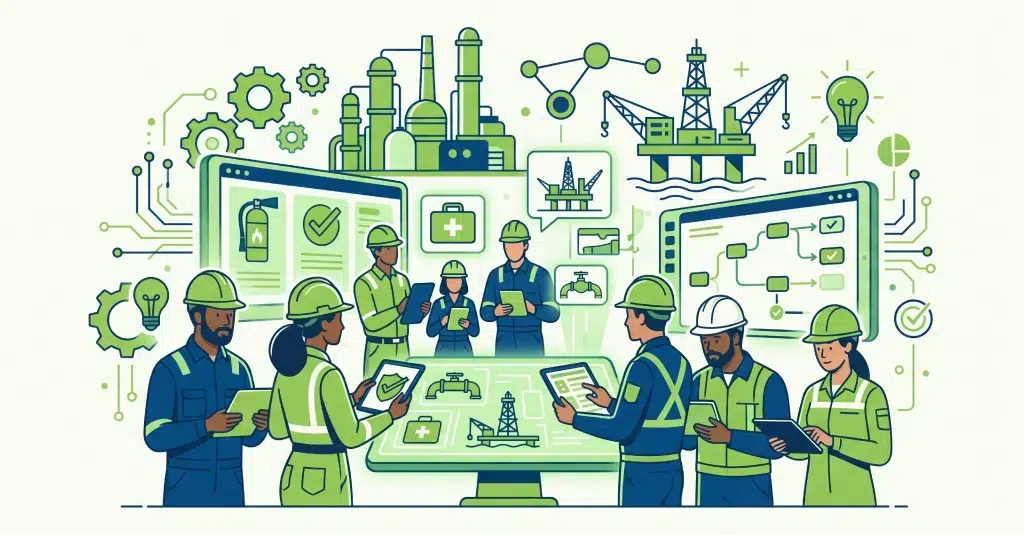
When a well-controlled incident happens, investigations rarely show a lack of training certificates. In most cases, workers completed the required safety training and passed assessments, but still made the wrong decision under pressure. This gap between training completion and real-world performance is where many oil and gas incidents occur.
This blog explores why generic safety training often fails in oil and gas operations. It looks at the impact on frontline decision-making and workforce safety. The blog also explains how custom eLearning and scenario-based training can make learning more practical for workers. It also covers offline access, multilingual training needs, and OPITO/IADC compliance requirements across oil and gas environments.

Safety Training vs Safety Culture: Does Your eLearning Actually Reduce Incidents?
Safety training and safety culture are not the same thing, and conflating the two is one of the most expensive mistakes an organization can make.
Training can tell workers what they are supposed to do. But safety culture affects what they actually do during real situations. This matters even more when teams are under pressure or working in difficult conditions. Most off-the-shelf eLearning programs are mainly created to complete mandatory training. They explain the process, tick the compliance requirement, and end there.
Why Generic eLearning Fails in High-Risk Oil & Gas Environments
Custom eLearning for oil and gas can do both, but only when designed with that intent from the start. It should include real consequence scenarios and insights from actual incident data.
The training should reflect the real situations workers face on site. It should not rely only on hypothetical scenarios that rarely happen in actual operations.

Why Generic Safety Courses Fail in Oil and Gas: The Asset-Specific Risk Problem
Generic Safety Training Lacks Operational Context
A generic H2S awareness module may teach evacuation protocols and safety limits. But it does not prepare workers for the actual conditions on your site. It will not explain your platform alarms, muster station locations, or communication systems.
Context is critical in oil and gas safety training because workers must apply knowledge quickly during real incidents. Generic courses are made for many industries. So, they often do not match the real conditions at specific sites or operations.
Why Site-Specific Risk Matters in Oil and Gas Operations
In oil and gas operations, every site has different risks, equipment, and emergency procedures. Generic training often misses these operational differences. As a result, workers may complete training successfully but still respond incorrectly during real incidents.
How Custom eLearning Closes the Safety Gap
Custom eLearning development starts with understanding the site, operational risks, and workforce requirements. This is one reason why bespoke eLearning development works better in high-risk training environments.
Designing Custom eLearning Solutions for Frontline Oil and Gas Workers
Most eLearning is designed for someone at a desk with a reliable screen and uninterrupted time. Frontline oil and gas workers are not that person.
They access corporate training for employees on tablets in direct sunlight, wearing gloves, between tasks or during shift handovers. Some have limited formal literacy. Many are working in their second or third language. Effective custom eLearning for these workers is designed around those realities.
What Good Frontline eLearning Design Looks Like
- Minimal text with voice-led learning for faster understanding
- Large, glove-friendly navigation designed for field conditions
- Short modules focused on one topic at a time
- Real site visuals instead of generic stock images
- Simple assessments that measure competency without relying heavily on reading skills

Scenario-Based Safety Training: How Custom eLearning Simulates High-Stakes Decisions
The most effective safety training puts workers inside a decision before it becomes real. Not a multiple-choice question after a video. A branching scenario where choices carry visible consequences and wrong turns require the learner to understand what went wrong and why.
Most major incidents are not caused by a lack of rules or training. They usually happen when people make quick decisions under pressure. Sometimes workers misread the situation or skip a step. Scenario-based learning helps workers prepare for these situations before they happen on site.
For better results, the scenarios should come from real incident history and near-miss cases. Generic hazard examples are often less effective. Training feels more practical when workers can relate it to situations they have actually faced.

OPITO and IADC Compliance: Building Custom Corporate Compliance eLearning That Satisfies Audits
Custom eLearning does not trade compliance for engagement. Done correctly, it delivers both.
Regulators under frameworks like OPITO and IADC assess competency, not just completion. They want evidence that workers can demonstrate specific skills in their actual roles. A generic module completion certificate gives you a timestamp.
A well-designed custom corporate compliance eLearning program gives you competency evidence, structured assessment data, and a learning record tied to specific job functions and risk categories. That is exactly what auditors need to see.
Learning objectives should align directly with regulatory competency requirements. This makes audit documentation easier while ensuring the training remains practical and relevant for real job roles.

Multilingual Safety Training Across Global Operations Where Translation Alone Creates Risk
Many companies translate safety training into different languages. But workers may still struggle to understand the training in real situations. In oil and gas operations, this can increase safety risks.
Some safety terms can lose their meaning when translated into another language. Different teams may also communicate and report issues in different ways.
Multilingual custom eLearning works better when it is adapted for different workforce groups. This includes localizing scenarios, visuals, and communication styles, not just translating the content.

Offline-First eLearning for Rigs and Remote Sites: Custom eLearning Content Development for Zero Connectivity
Most offshore platforms and many remote onshore sites have unreliable or zero connectivity. Designing eLearning for remote environments requires more than a basic download feature. Offline-first learning should work properly even with unstable internet access.
Offline-first means the learning works completely without connectivity from the moment it is downloaded. This helps frontline workers continue critical safety and compliance training in remote environments. Learning remains accessible even with unstable or zero internet access. Progress, assessments, and completions are stored locally. The data syncs automatically with the LMS when connectivity is restored. xAPI handles this more reliably than legacy SCORM implementations.
For HSE and L&D leaders managing compliance records across distributed operations, the real question is not just “can workers access it?” It is “can we trust the data?”

Measuring Corporate Compliance Training Effectiveness: Beyond Certification and Completion Rates
Completion rates and test scores only show that workers finished the training. They do not show whether the training improved real-world safety behavior. Effective corporate compliance training should also measure behavioral change and real-world safety performance.
The real sign of training effectiveness is safer behavior at work. Companies can monitor this by comparing LMS data with incident and near-miss reports over time.
Other useful indicators include repeat test failures, time taken for new workers to reach competency, and performance during post-training safety observations. These insights help HSE managers identify whether training is effective or whether modules need improvement before safety gaps lead to real incidents.

Key Takeaways
- Generic eLearning supports compliance but rarely changes safety behavior
- Custom training must reflect site-specific risks, roles, and equipment
- Frontline-friendly UX improves accessibility and retention
- Scenario-based learning drives stronger real-world decision-making
- OPITO and IADC alignment strengthens compliance outcomes
- Localization matters more than direct translation in safety training
- Offline-first xAPI design is critical for remote operations
- Incident reduction matters more than completion rates
- Blended learning outperforms standalone training methods
Reliable offline learning is not just a technical feature. It plays a critical role in maintaining continuous safety training across remote operations. Looking to build offline-first safety training for your workforce?
Schedule a conversation with our team to explore custom eLearning solutions for remote and high-risk environments.

Frequently Asked Questions
Custom eLearning for oil and gas improves safety outcomes because it is designed around site-specific risks, workforce roles, equipment, and emergency procedures. Unlike generic safety training, custom programs reflect real operating conditions, helping workers make better decisions in high-risk environments. This leads to stronger compliance, improved knowledge retention, and measurable incident reduction.
No. Custom eLearning works best when combined with practical safety drills. Scenario-based eLearning prepares workers for emergencies through digital simulations, while hands-on drills reinforce physical response procedures. A blended learning approach improves decision-making, emergency preparedness, and long-term retention more effectively than either method alone.
Offline-first eLearning allows workers to complete training without internet connectivity. Course progress, assessments, and completion records are stored locally on the device and automatically synced with the LMS once connectivity is restored. Many oil and gas companies use xAPI-based eLearning because it provides more reliable offline tracking than traditional SCORM systems.
The most effective oil and gas safety eLearning modules are typically between 8 and 15 minutes long for frontline workers. Shorter microlearning modules of 3 to 7 minutes work well for refresher training, toolbox talks, and procedural updates. Keeping modules concise improves completion rates, engagement, and knowledge retention in shift-based work environments.
An oil and gas LMS should support offline learning, xAPI tracking, multilingual content delivery, mobile accessibility, competency mapping, certification tracking, and audit-ready reporting. These features help organizations manage compliance and workforce training across remote operations.
Yes. Mobile-friendly eLearning allows offshore and field workers to access safety training on tablets and handheld devices in remote environments. Responsive design, offline access, and glove-friendly navigation improve usability and training completion rates.