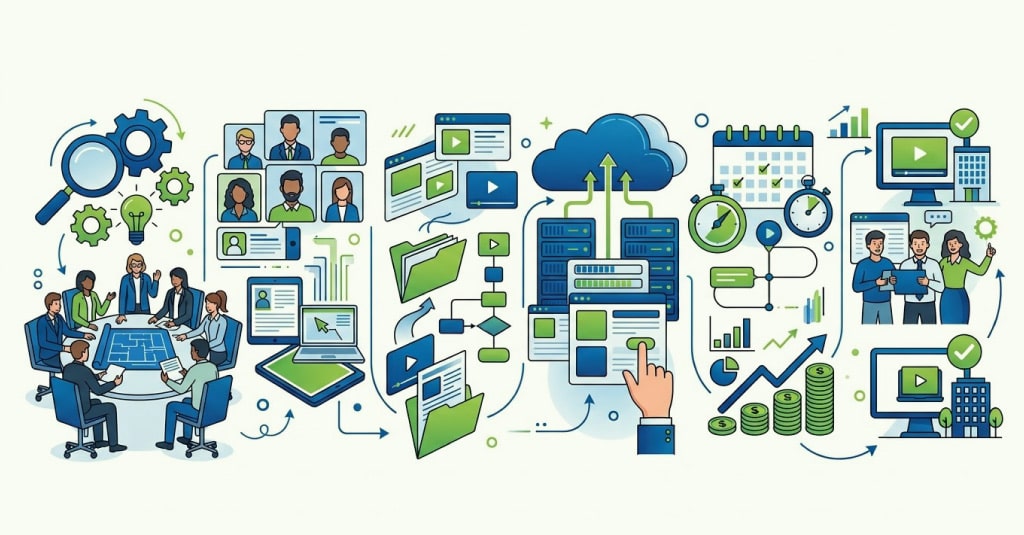





Custom eLearning helps organizations build role-specific learning journeys that take employees from onboarding to expert performance while improving capability, compliance, and business outcomes.
Most organizations already have extensive course libraries, knowledge resources, and compliance programs. The challenge is not a lack of learning content. The challenge is relevance. Generic learning rarely reflects the realities of a specific role, process, customer interaction, or operating environment.
Employees often complete training long before they are ready to perform independently. They finish onboarding programs, compliance courses, and learning modules, yet many return to work without changing how they perform.
This is where custom eLearning creates value. Unlike off-the-shelf content, it aligns learning with real workplace situations, role-specific requirements, and business outcomes.
This article explores how custom eLearning for business supports employees from onboarding to expertise, what makes learning journeys more effective than standalone courses, and how organizations can measure whether learning is creating meaningful performance improvement.

Why Content Libraries Don’t Always Create Real Learning Growth
Most organizations have experimented with content libraries. They are quick to deploy, cost-effective, and useful for providing broad access to learning resources.
The limitations become visible when learning needs become role-specific.
A customer service representative handling escalation, a pharmaceutical sales professional navigating regulatory requirements, and a manufacturing operator working in a controlled environment all require different knowledge, decisions, and behaviors. Generic content may introduce concepts, but it rarely prepares employees for the realities of their work.
This is where custom eLearning solutions create value. They focus on real workplace situations and performance outcomes.
A content library provides access to learning. A learning journey develops capability. The difference matters because completion does not automatically translate into performance improvement.
Organizations comparing custom eLearning vs off-the-shelf training often discover that access to content and workforce capability are two very different outcomes.
Organizations typically invest in custom eLearning for business when they need to:
- Reduce onboarding time
- Improve compliance outcomes
- Increase productivity
- Improve customer experience
- Accelerate role readiness
- Build workforce capability
Industries such as banking, healthcare, manufacturing, and retail often use customized eLearning because requirements vary significantly by role.
The challenge is helping employees apply knowledge in real situations.

What Makes a Custom eLearning Journey More Effective
A learning journey is more than a collection of courses. It is a structured progression designed to move employees from one stage of capability to the next.
That distinction matters.
Many organizations focus on what employees should know. Effective customized eLearning focuses on what employees should be able to do.
What Makes Custom eLearning Different?
Customized eLearning is designed around performance requirements rather than topic coverage. Every learning experience supports a specific behavior, decision, or skill that employees must demonstrate on the job.
Four elements make a custom learning journey more effective.
1. Relevance
Learning reflects actual job responsibilities, customer interactions, systems, tools, and compliance requirements. Employees spend less time translating generic examples into their own context.
2. Progression
Each learning experience builds on previous knowledge and prepares learners for the next stage of development. The journey creates continuity rather than isolated learning events.
Timing
Learning is delivered when employees are most likely to need and apply it. This increases retention and improves transfer into workplace performance.
4. Performance Alignment
Custom eLearning for business begins with a performance outcome. The question is not, “What content do we have?” The question is, “What should employees be able to do differently after learning?”
| Content Library | Custom Learning Journey |
|---|---|
| Standalone modules | Connected progression |
| Generic examples | Role-specific scenarios |
| Knowledge focused | Performance focused |
| Self-directed navigation | Guided development |
| Completion metrics | Capability outcomes |
Research consistently shows that relevance, practice, feedback, and reinforcement improve retention and transfer. Effective custom e learning services incorporate these principles from the beginning.
How to Design Custom Learning from Onboarding to Role Mastery
Mastery
Employees do not become experts through a single training intervention. Expertise develops through a sequence of learning experiences that build capability over time.
A practical custom eLearning framework typically progresses through four stages.
Stage 1: Orientation
Employees learn about the organization, role expectations, systems, and tools.
Learning at this stage often includes:
- Interactive onboarding modules
- Process walkthroughs
- Short explainer videos
- Job aids
The goal is simple. Reduce time-to-productivity without overwhelming new hires.
Stage 2: Foundation Building
Employees build role-specific knowledge and skills.
This is where custom eLearning development services often deliver the greatest value through:
- Scenario-based learning
- Product training
- Compliance learning
- Guided practice
- Structured assessments
The objective is to build capability and confidence.
Stage 3: Applied Competence
Employees begin working independently and applying judgment in real situations.
Learning experiences may include:
- Branching scenarios
- Simulations
- Peer learning activities
- Performance challenges
Employees are learning how to make better decisions.
Stage 4: Expert Performance
Learning focuses on mastery, leadership readiness, and handling complex situations. At this stage, bespoke eLearning becomes less about knowledge transfer and more about developing expertise.
Learning experiences may include:
- Advanced simulations
- Strategic decision-making exercises
- Leadership development pathways
- Mentoring and coaching programs
- Cross-functional projects
The objective is to strengthen judgment, expand business impact, and prepare employees for increasingly complex responsibilities.
Many organizations invest heavily in the first two stages and stop there. That is often where performance opportunities are lost.

Why Large Organizations Need Role-Based eLearning Solutions
Large organizations face a challenge that smaller organizations often do not: scale combined with workforce diversity.
Different roles require different capabilities. Different business units operate in different contexts. Different regions face different regulatory environments. A single learning journey cannot effectively support all of them.
Role-based custom eLearning solutions address this challenge by aligning learning experiences with the specific performance requirements of each job family.
Consider compliance learning. A relationship manager and a risk analyst may both need regulatory training. However, the situations they face, the decisions they make, and the risks they manage are fundamentally different. Effective customized eLearning solutions reflect those differences.
Role-based learning journeys help organizations:
- Improve relevance
- Increase engagement
- Reduce performance risk
- Support consistent standards
This is where custom eLearning programs create measurable value. They allow organizations to maintain enterprise-wide consistency while delivering role-specific learning experiences.
Organizations that invest in role-based learning architecture create stronger capability development pathways and more meaningful learning outcomes.
What L&D Leaders Should Expect Beyond Content Delivery
Every learning journey has a break point.
It is the moment when formal training ends and employees are expected to continue developing through experience alone. For most organizations, this happens after foundational training is complete but before employees have reached genuine expertise.
The assumption is that experience will naturally close the gap.
It often doesn’t.
What typically happens is one of three things:
- Employees continue improving and develop expertise over time
- Employees plateau and perform adequately without progressing further
- Employees develop ineffective habits that become difficult to correct later
The second outcome is the most common. The third is often the most expensive.
This is why effective custom eLearning services extend beyond content delivery.
One of the most valuable elements in a learning journey is what we often call the bridge layer, a set of learning interventions that connect formal training with workplace performance.
A bridge layer may include:
- Scenario-based reinforcement activities
- Spaced microlearning interventions
- Reflection exercises
- Manager-supported practice
- Performance support resources
These are not full courses. They are targeted performance nudges that help employees apply learning in real situations. Organizations investing in custom eLearning solutions should plan for this layer from the start. Despite its relatively small footprint, it often delivers a disproportionate impact on performance.
Effective custom eLearning services should also include performance measurement, stakeholder involvement, and ongoing updates as business needs evolve.

How to Measure the Real Impact of eLearning Journeys
Completion rates indicate participation. They do not indicate performance improvement.
Knowing that employees completed training tells you very little about whether they can perform differently afterward.
Organizations investing in bespoke eLearning for business should define success measures before development begins.
When success measures are defined upfront, learning journeys can be designed around the outcomes that matter most. Instead of measuring activity alone, organizations can track whether employees are becoming productive faster, applying skills more consistently, improving quality, or reducing performance risks over time.
The strongest programs connect learning activity directly to workforce performance and business outcomes.
Useful measures vary across the journey.
Scroll right to read more.
| Journey Stage | What to Measure |
|---|---|
| Orientation | Time-to-productivity, onboarding readiness |
| Foundation Building | Assessment improvement, knowledge retention |
| Applied Competence | Performance observations, quality metrics |
| Expert Performance | Productivity, complex task performance, business outcomes |
Compliance learning illustrates this clearly. The goal is not completion but behavior change. More meaningful indicators include reduced compliance incidents, improved audit outcomes, stronger decision-making, and increased process adherence.
The strongest tailored programs define success measures before development begins, creating a clearer connection between learning investment and business value.

Key Takeaways and Conclusion
- Custom/Bespoke eLearning for business aligns learning experiences with real job performance requirements.
- Learning journeys are more effective than standalone courses because they create progression and continuity.
- Role-based learning improves relevance, engagement, and capability development.
- The bridge layer helps employees move from competence to expertise.
- Compliance learning should focus on behavior change rather than completion metrics.
- Performance outcomes provide a more meaningful measure of success than participation data alone.
Learning journeys are most effective when they reflect how capability develops in the real world. Organizations that connect onboarding, skill development, practice, reinforcement, and performance measurement create stronger pathways to expertise and better business outcomes.
For organizations exploring custom eLearning solutions, the challenge is not simply creating content. It is designing learning experiences that support performance at every stage of the employee journey. Upside Learning, a division of Mitr Learning & Media, helps organizations build custom learning journeys aligned to workforce capability and business goals. Start a conversation about your learning journey strategy.

Frequently Asked Questions
Custom eLearning is training designed specifically for an organization’s workforce, business goals, processes, and performance requirements. Unlike off-the-shelf content, it uses role-specific scenarios, business context, and performance outcomes to create learning experiences that are directly relevant to employees and their work.
Customized eLearning is designed for a specific organization and workforce, while off-the-shelf eLearning is created for a broad audience.
Custom e learning services involve designing learning experiences tailored to an organization’s roles, processes, goals, and performance requirements.
Bespoke eLearning refers to learning content and experiences created specifically for one organization rather than adapted from generic training materials.
Custom eLearning helps make compliance learning more relevant by using role-specific scenarios, realistic decision-making situations, and workplace context that encourage behavior change rather than simple course completion.
Organizations typically measure custom eLearning through performance indicators such as productivity, time-to-competency, quality outcomes, audit results, compliance metrics, and business impact rather than completion rates alone.