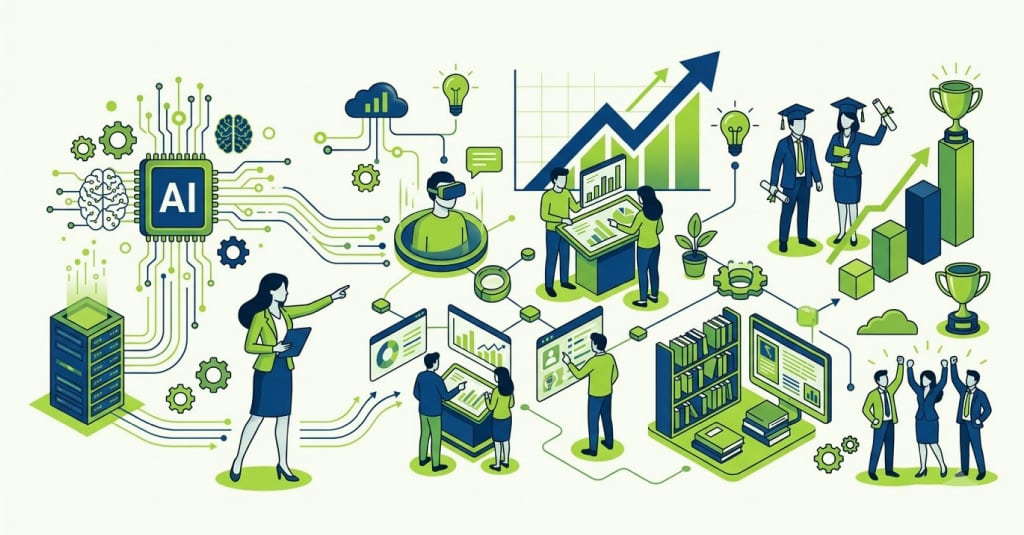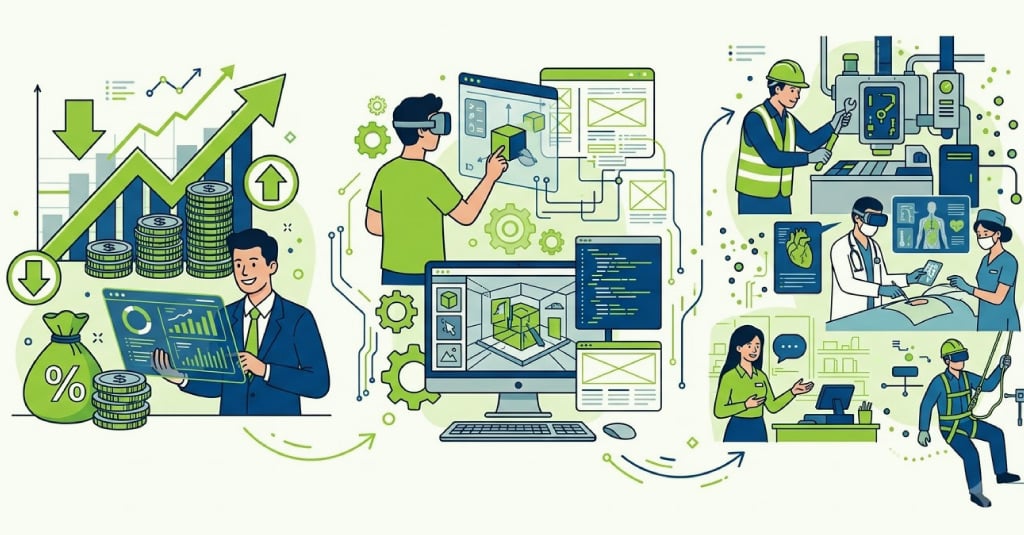





Talk to any L&D leader for ten minutes, and video comes up. Not as a buzzword, but as a real complaint: employees do not want another PDF; they want to watch someone show them what to do.
What’s new is that producing video used to cost so much time and money that most teams gave up on it as a default format. A script, a shoot, an edit, then a reshoot when the process changed six weeks later: that cycle kept video as a special project rather than a standard tool.
AI has changed the math. A subject matter expert’s screen recording or an existing SOP can now become a finished training video in a couple of days, sometimes less. No studio. No reshoot request three weeks later.
This blog looks at where AI video training actually earns its place in an enterprise learning strategy, where text and slides still do the job better, and how to build a case for it that survives contact with a finance director.

What Is AI Video Training?
AI video training uses tools like synthetic avatars, generated voiceovers, and automated editing to produce instructional videos without cameras or studios. It turns existing content, documents, decks, and recorded calls into finished training videos much faster and at a lower cost than traditional production.

Why Is AI Video Training Transforming Enterprise Learning?
Content that once sat in a production queue for weeks can now go from draft script to finished video in days.
Lower development costs and easier content updates.
Reshoots used to mean rebooking a studio and an actor. Now, a content owner can edit the script and regenerate the clip.
Higher learner engagement and knowledge retention.
People don’t retain information better simply because it’s delivered through video. The format needs to match the task. Short, focused videos also fit more easily into the limited time employees have between meetings.
Personalized and multilingual learning at scale.
AI translation and voice cloning make it possible to create multiple language versions. This eliminates the need to hire separate voice actors or rebuild the entire production.
Greater consistency across the global workforce.
Every regional office receives the same core training. This keeps the message consistent across locations.

When Does Video-Based Learning Work Better Than Text and Slides?
- Software demonstrations and product training benefit because watching something happen on screen is often easier than reading instructions about it.
- Onboarding and process training work well because new hires can see a sequence unfold instead of trying to memorize a list of steps.
- Safety and compliance are slightly different. Video can carry tone and urgency that text can't. Showing the consequence of skipping a critical step often lands differently than a paragraph explaining the same risk.
- Sales and customer-facing training benefit too, mostly because it's easier to model a conversation than describe one.
That said, text, slides, and job aids still have their place. They work better for reference material, detailed policies, or anything people need to quickly search and scan. If someone just needs to find one number, they shouldn’t have to sit through a four-minute video to get it.

AI Video Training vs Traditional Video Production: Which Approach Delivers Better Results?
Scroll right to read more.
| Factor | AI Video Training | Traditional Video Production |
|---|---|---|
| Development time | Days | Weeks to months |
| Production cost | Low to moderate | High (crew, studio, talent) |
| Content updates | Fast, script-based edits | Requires reshoot or rebuild |
| Localization | Near-instant via AI translation | Slow, costly per language |
| Engagement for process learning | Strong | Strong, but slower to refresh |
| Best for | Fast-changing, high-volume content | Flagship or brand-critical content |
For most day-to-day training needs, especially anything that will need updating within a year, AI video wins on speed and cost without meaningfully sacrificing quality. For a handful of flagship pieces where production value carries brand weight, traditional video production still has a role.

Creating Custom eLearning Content Development with AI-Powered Video
Most enterprise teams already have the raw material they need. This could include SOPs, old slide decks, or recorded Zoom walkthroughs. AI can turn these into narrated training videos without starting from scratch.
AI avatars, voiceovers, and automation remove much of the production work that used to eat the calendar.
None of this replaces instructional design. Skipping storyboarding because “AI will handle it” is where quality breaks down. Good AI video training still needs a clear learning objective and a logical sequence. It also needs a script written for how people actually learn, not just what needs to be said.
A few practices can improve the quality of AI training videos. Keep each segment short and focused on one task. Write scripts the way you would explain something out loud. Add checkpoints instead of long passive stretches. And always review the final output for accuracy before publishing.

How Can L&D Leaders Build a Business Case for AI Video Training?
Budget conversations go better when they are framed around a business problem instead of a tool.
- Reducing production costs is the easiest number to show, since AI video can lower per-video costs by removing many crew, studio, and reshoot expenses.
- Time to competency may matter even more. If new hires reach full productivity two weeks earlier, that's a number finance can actually work with.
- Measuring learning ROI means looking beyond completion rates and tracking outcomes such as error reduction, ramp time, support ticket volume, or sales readiness.
Start with the current cost of training this topic today, compare it to the cost of producing it as AI video, and add in what’s saved on future updates. Then tie all of that to a performance metric, such as ramp time, error rate, or sales readiness, that leadership already cares about.
When presenting the case internally, start with the specific problem. Establish the current cost and time baselines. Show the expected impact with real numbers. Then propose a small pilot before committing to a full rollout.

What Should You Look for in an Enterprise AI Video Training Solution?
Platforms vary more than the marketing pages suggest. Look for real customization on avatars and voice, not a handful of stock templates that every competitor is also using. Editing controls should be usable by someone without a video production background — if your L&D team needs a specialist to make basic edits, that defeats half the point.
Integration matters more than most teams expect going in. Confirm the platform actually works with your LMS, LXP, SCORM, and xAPI setup, and don’t take a vendor’s word for it. Ask for a working example.
Security and governance deserve real scrutiny too. Data handling policies, content approval workflows, and access controls should all be clear before anyone signs anything.
Before choosing a vendor, ask how your data is used. Check how version control and approvals work. Make sure the platform supports your brand requirements. Also, find out what support looks like at scale.

When Is Interactive Video Learning Worth the Additional Investment?
Interactive video adds decision points and branching inside the video itself, rather than just playing from start to finish. It earns the extra build time when the learning objective involves judgment, such as de-escalation training or a complex sales conversation where the “right” answer depends on what the other person says.
For straightforward procedural content, standard video usually gets you to the same outcome for a fraction of the development effort. The real question isn’t which format is better in the abstract. It’s whether the objective is a decision or a demonstration.

How Can Enterprises Maintain Quality and Governance in AI Video Training?
Speed only matters if accuracy holds up. Subject matter experts should review every AI-generated video before it goes live.
AI-generated videos still need to meet accessibility, brand, and compliance standards. That includes getting the captions, alt text, branding, and required disclosures right, just as you would with any other learning content in your LMS.
Version control becomes even more important with AI video. AI makes it easy to create and publish content quickly. Without a clear review cycle, outdated videos can easily pile up. But speed doesn’t replace human review. Someone still needs to watch the video before it goes live.
Scaling e Learning Video Production for Workforce Development Programs
Once the production pipeline is working, scale becomes much easier. Global onboarding can use one core video localized across languages, while product launches can reach reps in every market without waiting for separate regional training cycles.
Continuous learning also becomes easier to sustain. Refreshing a video no longer means restarting production. This makes it easier to keep training content current.

Common Mistakes Organizations Should Avoid When Implementing AI Video Training
The most common mistake is trying to turn everything into video, including content that would work better as a one-page reference. Close behind is letting the technology lead instead of instructional design. A polished avatar doesn’t fix an unclear learning objective.
Governance and accessibility are often overlooked because teams assume AI-generated content needs less scrutiny. In reality, faster production makes proper oversight even more important.
And watch out for measuring the wrong thing. Production speed isn’t the goal. Learning outcomes are. AI also makes updates cheap enough that there’s little excuse for ignoring learner feedback when something isn’t working.

Key Takeaways & Conclusion
AI video training delivers the most value for process, product, and procedural content that needs frequent updates. Text and slides work better for reference material and detailed policies. ROI should focus on performance outcomes, not completion rates. A good enterprise platform also needs strong integration, security, and governance.
AI video training isn’t a replacement for good instructional design. It’s a faster, more affordable way to produce, personalize, and scale the video content enterprise learning already needed. The organizations getting real value from it are the ones who still start with the learning objective and let AI handle the production grind, not the other way around.
If you’re exploring where AI video training fits into your learning strategy, Upside Learning can help you combine the speed of AI-powered production with the instructional design needed to make the content actually work.

FAQs
Compare current development time and cost per module against video production costs, then tie the difference to a metric leadership tracks, like ramp time or error rate. Pilot one program first. A small, measurable result outperforms a large budget request with no baseline.
Faster time to competency, lower error rates, reduced support tickets, and shorter onboarding cycles justify the spend. Completion rates don’t. The strongest cases connect video training directly to a performance metric the business already reports on, not to how many employees watched the content.
Track performance changes before and after rollout across regions, including ramp time, error reduction, and task accuracy, not completion percentages. Compare results by location to spot gaps in localization or delivery. Consistent gains across regions signal the training is working, not just reaching people.
Require clear data handling policies, defined content approval workflows, and version control for published videos. Ask how subject matter expert review fits into the vendor’s process. Confirm accessibility standards, including captions and alt text, are built in by default, not offered as an add-on.
They reserve interactive video for training where judgment matters, like negotiation or de-escalation scenarios, and use standard video for straightforward demonstrations. The deciding factor is whether the learner needs to make a decision within the content or simply watch and absorb a process.