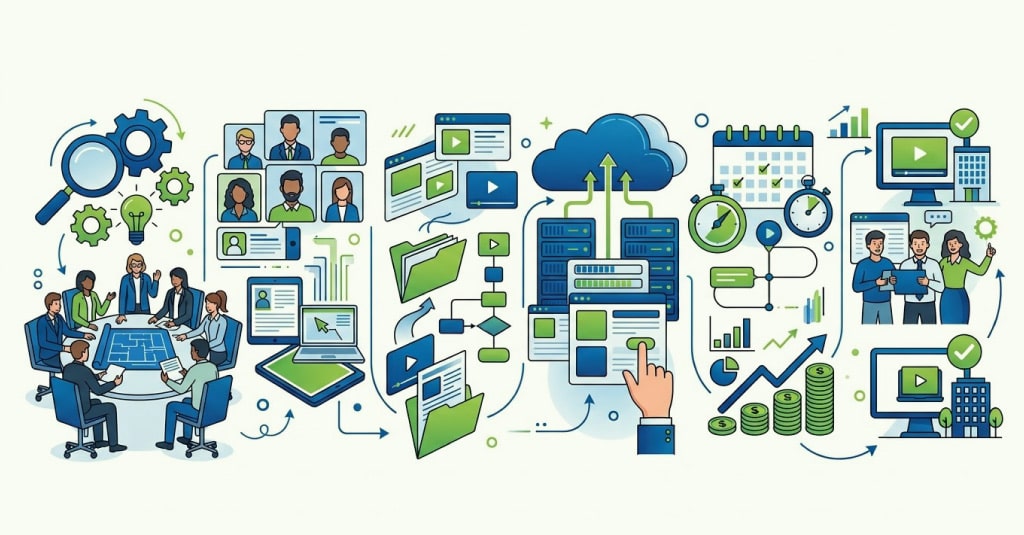





Learning in the flow of work delivers learning and performance support directly within an employee’s workflow, at the moment it is needed. It helps employees solve problems, make decisions, and apply knowledge without stepping away from their work.
For organizations investing in custom eLearning design, this approach helps close the gap between training completion and real workplace application through job aids, performance support, and other targeted learning interventions embedded in the flow of work.

Why Your Training Gets Completed but Never Gets Used
Most enterprise learning programs are designed around a simple assumption: if employees complete the training, they’ll apply what they learned. It’s a reasonable assumption. It’s also wrong most of the time.
Completion rates climb. Dashboards look healthy. Then a manager watches a rep freeze in a customer call, or a new hire makes the same process error three weeks into the job, and the question resurfaces: why isn’t the training sticking?
The answer isn’t content quality. It’s timing and context. Learning that happens away from the work – in a separate platform, at a scheduled time, disconnected from the actual moment of need – asks employees to bridge a gap between knowledge and application entirely on their own. Most don’t. Not because they’re disengaged, but because real work doesn’t pause to let them retrieve what they learned in a module two weeks ago.
Learning in the flow of work changes that equation. Instead of pulling employees out of their workflow to train them, it embeds the right support at the exact moment they need it. This post covers what that actually looks like in practice, how to design for it, and what it means for enterprise learning strategy.
Why Completion Rates Don't Reflect Real Custom eLearning Design Adoption
Completion rates are the most reported metric in enterprise L&D. They’re also the least useful indicator of whether learning is working.
A completed module tells you an employee clicked through the content. It tells you nothing about whether they retained it, applied it, or changed how they perform on the job. That’s not a small gap. It’s the entire point of training.
The problem runs deeper than measurement. When completion becomes the goal, design follows. Modules get built to be finished, not to be used. Content gets front-loaded because that’s where attention is highest. Assessment happens at the end because that’s where it’s easiest to place. And the entire experience is engineered around the LMS, not around the job.
Here’s what that produces:
- High completion, low transfer - Employees finish the course and return to old habits because nothing in the design reinforced the new behavior at the moment it mattered.
- Invisible adoption gaps - Without performance data tied to the training, L&D has no visibility into which behaviors actually changed and which didn't.
- Learning treated as an event - One completion, one checkbox. No reinforcement, no follow-up, no connection to real work moments.
- Disengagement over time - When employees repeatedly complete training that doesn't help them do their job better, they stop taking it seriously. Completion becomes a compliance ritual, not a learning experience.
The fix isn’t better content. It’s a different design logic – one built around adoption, not completion.
How Custom eLearning Design Differs from Formal Training for Flow of Work Learning
The phrase “learning in the flow of work” was coined by Josh Bersin in 2018 – and it’s become one of the most referenced concepts in enterprise L&D precisely because it names a problem most practitioners already recognized but hadn’t articulated.
The distinction matters because it changes everything about how you design, deploy, and measure learning. Formal training and flow-of-work learning aren’t competing approaches. They serve different moments and different needs.
Here’s how they differ in practice:
- Timing - Formal training happens at a scheduled time, often before or after the work. Flow-of-work learning happens at the moment of need - when an employee is about to do something, is doing it, or has just done it and needs to course-correct.
- Format - Formal training is typically structured, sequential, and comprehensive. Flow-of-work support is short, specific, and immediately applicable. A two-minute job aid beats a 45-minute module when someone needs to remember a process step mid-task.
- Location - Formal training lives in an LMS. Flow-of-work learning lives where the work happens - inside the tools, platforms, and systems employees use every day.
- Purpose - Formal training builds foundational knowledge. Flow-of-work learning reinforces, supports, and extends that knowledge into actual performance.
- Measurement - Formal training is measured by completion and assessment scores. Flow-of-work learning is measured by whether the behavior changed and whether performance improved.
The strongest enterprise learning strategies use both – formal training to build the foundation, flow-of-work support to close the gap between knowledge and performance.

How Custom eLearning Design Addresses Real Job Moments
Designing for the flow of work starts with a different question. Not “what does this person need to know?” but “what does this person need to do, and when do they need to do it?”
That shift sounds simple. It requires a fundamentally different design process – one that starts in the workflow, not in the content library.
Here’s what that looks like in practice:
- Map the job, not the subject - Before building anything, map the actual tasks, decisions, and moments of uncertainty in the target role. Where do people get stuck? Where do mistakes happen? Where is confidence lowest? Those are your design targets.
- Design for the moment of need - Conrad Gottfredson and Bob Mosher identified five moments of need that flow-of-work learning should address: learning something new, learning more, applying knowledge, solving a problem, and handling something that's changed. Each moment requires a different type of support.
- Keep it contextual - Flow-of-work support that's generic doesn't get used. Custom eLearning design that reflects the actual language, tools, systems, and scenarios of the target role gets used because it feels relevant, not like training.
- Embed it where the work happens - A job aid that lives in the LMS won't be used mid-task. The same resource embedded in the CRM, the intranet, or the workflow tool the employee already has open will be. Placement is a design decision.
- Design for retrieval, not recall - The goal isn't for employees to memorize everything. It's for them to know where to find the right support exactly when they need it. Design the access path, not just the content.

What Role Do Job Aids and Microlearning Play in Custom eLearning Design?
Job aids and microlearning are the primary delivery formats for flow-of-work learning – but they’re not interchangeable, and they’re not just short versions of longer courses.
Each serves a specific function in the performance support ecosystem. Understanding that distinction is what separates custom eLearning services that actually change behavior from those that just produce shorter content.
Job aids
Checklists, quick reference guides, decision trees, process maps. Designed to be used during the task, not before it. The best job aids don’t teach – they prompt the right action at the right moment. A compliance checklist used in a live customer interaction is more valuable than a compliance module completed three months earlier.
Microlearning for reinforcement
Short, focused learning moments delivered after formal training to reinforce specific concepts at spaced intervals. Not a summary of the full course – a targeted reinforcement of the one behavior most likely to be forgotten or misapplied.
Scenario-based microlearning
Short decision scenarios that put employees in realistic situations and ask them to apply knowledge, not recall it. These work because they simulate the moment of performance, not just the moment of learning.
Performance support tools embedded in workflow
Contextual help, in-app guidance, embedded resources that surface at the right step in a digital process. This is where custom eLearning design and UX design converge – the learning is invisible because it’s part of the work.
This is also where PersonaTrain.ai changes what’s possible for flow-of-work learning. Instead of a static scenario or a pre-recorded simulation, PersonaTrain creates adaptive AI role-play conversations – built from your actual SOPs, policies, and product knowledge – that employees can practice on demand, inside Microsoft Teams or their existing LMS. A sales rep can run a discovery call practice before a real meeting. A customer service agent can rehearse a difficult escalation before their shift. The practice happens in the flow of the workday, not in a separate training session, and every session delivers real-time feedback on what to do differently next time.

Why Managers Are Key to Custom eLearning Design Adoption
Here’s something most L&D strategies underinvest in: the manager is the most powerful performance support tool in any organization. And most learning programs design around them entirely.
Research consistently shows that manager reinforcement is one of the strongest predictors of whether training transfers to the job. Not the quality of the content. Not the platform. The manager. What they notice, what they ask about, what they recognize – that’s what signals to employees whether the learning matters.
Here’s what designing for manager involvement actually looks like:
- Brief managers before the learning launches - Not a summary email. A short, specific briefing on what employees are learning, what behavior change to look for, and what conversations to have during the 30 days after training.
- Give managers performance support too - Observation checklists, coaching conversation guides, specific questions to ask during one-on-ones. Managers can't reinforce learning they don't understand or don't have tools to support.
- Make the learning visible in team conversations - When managers reference the training in team meetings, connect it to real work situations, and recognize employees who apply new skills, adoption accelerates. When they don't, the learning disappears.
- Use manager feedback as a measurement input - Manager observations at 30, 60, and 90 days are the most reliable indicator of whether learning transferred to behavior. Build that into the program design, not as an afterthought.

How to Measure Whether Custom eLearning Design Is Getting Used on the Job
Measuring flow-of-work learning requires moving away from platform metrics entirely. The question isn’t how many people accessed the resource. It’s whether performance changed.
That requires connecting learning data to operational data – and that’s where most L&D functions hit a wall. But it’s not as complicated as it sounds when you start with the right framework.
Here’s a practical approach:
- Define the behavior before you build - Before designing any flow-of-work resource, specify the exact behavior it's meant to support. What will an employee do differently after using this resource? That behavior becomes your measurement target.
- Track usage in context - Flow-of-work resources embedded in workflow tools give you contextual usage data. When was it accessed? At what point in the process? How often? That data tells you whether the support is being used at the right moment.
- Connect to operational metrics - Error rates, process adherence, call quality scores, time-to-completion, customer satisfaction. These are the metrics that reflect whether the performance support is working. Match them to the behaviors you targeted.
- Use manager observations as qualitative data - Structured observation at 30 and 60 days gives you behavioral evidence that platform data can't provide. Build it into the program as a standard step, not an optional add-on.
- Measure resource effectiveness, not just access - A resource accessed frequently but followed by repeated errors isn't working. A resource accessed rarely but correlated with strong performance improvement is. Frequency isn't the metric - impact is.
Upside Learning has designed and delivered custom eLearning solutions for enterprise workforces across the USA, Europe, APAC, and the Middle East – building performance support ecosystems for organizations in banking, pharma, retail, and telecom where learning adoption, not just completion, is the measure of success. If your current learning programs are producing strong completion numbers but not showing up in field performance, that’s the exact problem we work on. Talk to our team.

Key Takeaways and Conclusion
Completion is easy to produce. Adoption is harder. And adoption is the only thing that produces performance change.The strongest organizations treat safety as an ongoing skilling program, where capability is continuously reinforced through practice, coaching, and operational feedback rather than annual certification alone.
Here’s what to take away:
- Completion rates measure whether training happened. They don't measure whether anything changed.
- Flow-of-work learning works because it meets employees at the moment of need, not at a scheduled training time.
- The strongest enterprise learning strategies combine formal training for foundation-building with embedded performance support for day-to-day application.
- Job aids, microlearning, scenario-based practice, and adaptive AI role-play are the delivery formats that close the gap between knowledge and performance.
- Manager involvement isn't optional. It's the most underinvested driver of learning adoption in most organizations.
- Measurement has to connect learning to operational outcomes - not just platform activity.
The goal isn’t a workforce that has completed the training. It’s a workforce that uses what they learned.

FAQs
The term was coined by Josh Bersin in 2018 to describe learning embedded directly into the work environment at the moment of need. Rather than pulling employees out of their workflow for scheduled training, flow-of-work learning delivers the right support – job aids, microlearning, performance prompts – exactly when and where employees need it.
Just-in-time training delivers content close to when it’s needed, typically before a task. Flow-of-work learning goes further – embedding support inside the tools and systems employees already use, so the learning is part of the work itself rather than preparation for it.
Performance support platforms, in-app guidance tools, LMS integrations with workflow software, and AI role-play platforms like PersonaTrain.ai – which deploys adaptive practice scenarios directly inside Microsoft Teams, LMS environments, and web apps. The principle is the same across all of them: learning surfaces where the work happens, not in a separate system.
Yes, particularly for reinforcement and application. Formal compliance training still has a role in building foundational knowledge and meeting regulatory requirements. Flow-of-work support – decision aids, scenario-based practice, contextual reminders – is what ensures that knowledge gets applied correctly in real situations, not just recalled on an assessment.