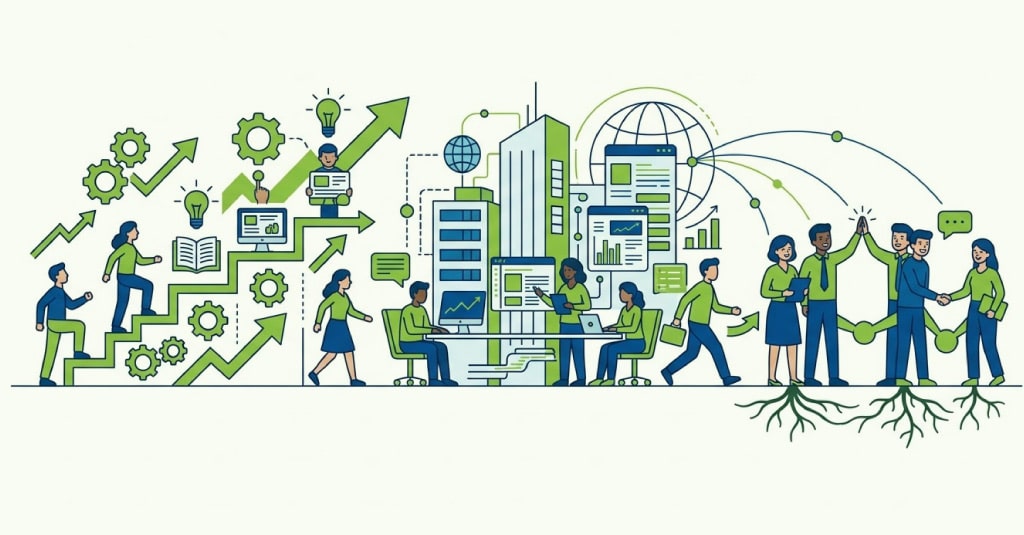


Workforce upskilling at scale means delivering consistent, role-specific training to thousands of employees at once without losing quality or multiplying cost. It depends on modular content, shared governance standards, a platform built for volume, and measurement tied to job performance. Enterprises with 2,000+ employees often add managed learning services to keep production steady.

Introduction
Most enterprise upskilling programs do not fail in design. They fail in month four, when the third business unit asks for its own version, the localization queue backs up, and your L&D team spends more time managing requests than improving learning.
That pattern is predictable, and it gets expensive. The World Economic Forum’s Future of Jobs Report 2025 estimates that 39% of a typical worker’s existing skills will change or become outdated between 2025 and 2030. It also found that 63% of employers name skills gaps as the biggest barrier to business transformation. For a company with 5,000 employees across several regions, that is not a course catalog problem. It is a production, governance, and measurement problem.
This article covers where traditional training models break, what that costs, and how we structure scalable upskilling programs at Upside Learning. You will also see what the infrastructure behind them looks like, how to measure whether performance changes, and when managed learning services beat building in-house.

Why Traditional Models Break Down When You Try to Scale Workforce Upskilling
Traditional models break at scale because they rely on custom builds and individual people to hold quality together. Each new audience adds a course variant, a facilitator, and a review cycle, so effort grows as fast as headcount.
Four failure points show up repeatedly above 2,000 employees:
- One-off builds. A business unit wants its own examples, and one core course becomes 12 versions. Nobody can update all 12 when a policy changes.
- Review bottlenecks. Subject matter experts and legal teams, not designers, set the pace.
- Facilitator dependence. Instructor-led delivery varies by trainer and region, so you cannot compare results.
- Platform-first thinking. Teams upgrade the LMS and expect throughput to follow. A platform delivers content. It does not produce, govern, or standardize it.
Budget rarely appears on this list. The constraint is throughput and governance. We see CLOs win funding for ambitious programs, then watch delivery stall because the production model cannot handle the volume.
Also Read: Skills Gap Analysis: A Strategic Upskilling Framework for CLOs

The Business Cost of Unscalable Workforce Upskilling
Unscalable training costs money in places the L&D budget does not show: rework, uneven performance, and decisions made on unreliable data.
Take an illustrative case. A 6,000-person sales organization launches a product. Four regions build their own training under deadline pressure, and two skip scenario practice. Within a month, field managers hear different pitches in the market. The team spends the next quarter retraining the weaker regions. The company paid for the program twice and still lost selling time.
Track these cost lines before you commit to a delivery model:
- Rework: content rebuilt after errors, policy changes, or inconsistent regional versions.
- SME time: expert hours spent reviewing near-identical content.
- Delayed readiness: the gap between a business need and a trained workforce.
- Compliance exposure: outdated versions still live in the system.
- Learner trust: employees who sit through one weak course often disengage from the next. This cost is the hardest to measure, and it compounds.
Upside Learning’s Framework for Scalable Upskilling Programs
We built our approach on one idea: scale comes from the operating model, not from working faster. Our managed learning services rest on four pillars, and each one removes a specific bottleneck.
Scroll right to read more.
| Pillar | What we do | Bottleneck it removes |
|---|---|---|
| Strategy and consulting | Needs analysis tied to business goals, capability frameworks by role, learning architecture, measurement design | Unclear priorities, one-off builds |
| Staff augmentation | Add L&D professionals who work in your tools and processes | Capacity gaps |
| Production studios | Instructional design, development, and video running in parallel, with AI-assisted authoring | Build and review queues |
| Operations and analytics | LMS administration, reporting, quarterly business reviews | Inconsistency, unreliable data |
The pillars work together or alone. Many clients start with production studios or staff augmentation and add strategy and operations as the engagement matures.
We work inside your authoring tools, brand standards, and review workflows, so your team keeps control while we carry execution. This approach draws on 20+ years and 500+ client engagements in enterprise L&D. For programs built around role-based capability gaps, our skilling practice applies the same model.
In practice: standardizing safety training across five sites
A multinational automotive OEM asked us to standardize safety training across five North American sites with different equipment and languages. We built multilingual, mobile-ready microlearning tied to equipment, with QR-based refreshers at shop floor stations.
Scroll right to read more.
| 27% | 40% |
|---|---|
| drop in incidents, year over year | reduction in training time |
The test for any provider, including us: can they show how quality stays constant as volume rises, and will they work inside your systems?
Also Read: Workforce Upskilling Strategy: Build the Skills Business Needs Now

What a Scalable eLearning Infrastructure Looks Like for Workforce Upskilling
A scalable infrastructure separates what changes from what stays fixed, so one update reaches every audience. Five layers do that work.
Scroll right to read more.
| Layer | What it does | What breaks without it |
|---|---|---|
| Modular content architecture | Reusable components and a single source for core content | Dozens of versions to update by hand |
| Production pipeline | Parallel design, development, and review with set turnaround times | SME and review bottlenecks |
| Localization workflow | Content structured for translation, shared glossaries, translation memory | Translation costs that rise with every course |
| Platform integration | LMS or LXP connected to HR and skills data, SCORM or xAPI tracking | Learning data that cannot link to roles |
| Governance | Version control, ownership, review deadlines, retirement rules | Outdated content live in the system |
Two trade-offs deserve attention. Modular design costs more upfront, and it pays off once you serve more than a handful of audiences. AI-assisted authoring, including our authoring platform BrinX, speeds first drafts, but it raises the volume of content that needs review. Governance matters more, not less. If your content pipeline is the constraint, our custom eLearning development teams build to this architecture.

How to Measure Whether Workforce Upskilling Is Changing Performance
Completion rates show who clicked through. They do not show whether performance changed. Measure against a business metric you set before launch.
- Pick one performance metric per program. Error rate, time to productivity, ticket volume, or sales cycle length. Agree on it with the business owner, not only L&D.
- Capture a baseline. Without pre-launch data, you cannot attribute change to training.
- Stage the rollout. Release to cohorts in sequence so early groups act as comparison for later ones. It is not a perfect experiment, but it beats guessing.
- Test application, not recall. Combine scenario-based assessments, manager observation, and xAPI data to see whether people apply skills on the job.
- Review quarterly. Feed results back into content priorities, and retire modules that do not move the metric.
This follows the logic of the Kirkpatrick model, which separates reaction, learning, behavior, and results. Most programs stop at the first two. Pushing to behavior and results builds executive confidence in L&D.

How US Enterprises Scale Workforce Upskilling with Managed Learning Services
Managed learning services let enterprises add production capacity and operating discipline without rebuilding the L&D function. Large US organizations typically choose one of three routes, based on where the bottleneck sits:
- Capacity gap, strong process: add augmented staff who work inside your systems.
- Content volume gap: use production studios. Our typical engagements deliver 30 to 100+ eLearning courses per quarter, depending on complexity, media, and review cycles.
- Process and measurement gap: add strategy and operations so one team owns governance and reporting.
Managed and team-based engagements typically onboard within 1 to 2 weeks of contract signing. Keep what defines your culture and strategy in-house, such as leadership programs and sensitive content. Outsource repeatable volume. A good provider extends your team and never replaces it, so ask any vendor how your people keep ownership of strategy and review.

Key Takeaways & Conclusion
- Scaling fails because of the production model, not the budget.
- Rework, inconsistency, and lost trust cost more than the course build itself.
- Modular content, parallel production, and governance keep quality steady as volume grows.
- Measure one business metric per program, with a baseline.
- Outsource repeatable volume. Keep strategy and ownership in-house.
The central insight is simple: you cannot scale upskilling by scaling effort. You scale it by changing how content gets produced, governed, and measured. For a CLO, that means auditing where your bottleneck sits before you buy another platform or approve another headcount request.
If you want a second opinion on that audit, download our enterprise upskilling guide or talk with our team about managed learning services.

FAQs
Standardize the build, not the audience. Use modular content with a single source, shared design standards, fixed review turnaround times, and version control. Then stage the rollout by cohort and compare results against a baseline metric.
Pair modular content architecture with parallel production studios and AI-assisted authoring. Reuse components across courses, set review deadlines, and outsource repeatable volume. This removes the single-team bottleneck without adding permanent headcount for every new program.
Structure content for translation from the start. Keep text separate from media, build shared glossaries, and reuse translation memory. Adapt only the examples that need cultural change, so cost does not rise with each new language.
An LMS hosts and tracks content. Scalable upskilling also covers how you produce, govern, localize, and measure that content across roles. A platform without a production model delivers volume, but not consistency or performance results.
Outsource when content demand outpaces your team’s capacity, when you need to start within weeks, or when quality varies across units. Keep strategy, sensitive programs, and stakeholder relationships in-house. Many enterprises start with one service and expand.