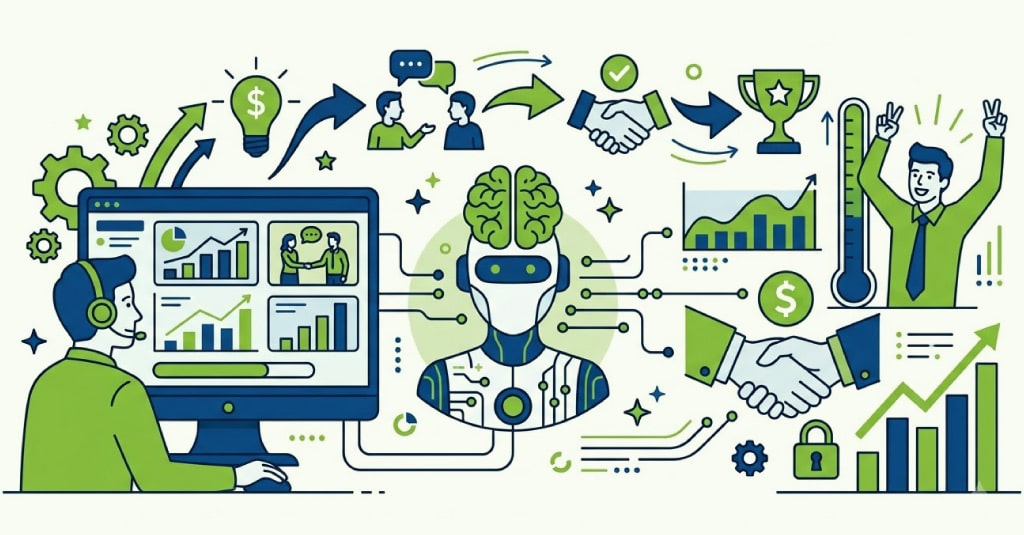





AI literacy training teaches employees how to use AI tools safely, judge AI output critically, and apply AI within their actual job function. For US enterprises, effective AI training for employees typically means role-specific modules on prompting, data privacy, output verification, and appropriate use cases, delivered through eLearning, workshops, or blended coaching rather than a single generic course.
Most enterprises didn’t plan their AI rollout. It happened anyway.
Someone in marketing started using a chatbot to draft copy. A sales rep began summarizing calls with an AI notetaker. Finance quietly built a spreadsheet macro that calls an AI model. None of this went through procurement, and none of it came with training.
Now you have thousands of employees using AI tools with almost no shared understanding of what these tools do well, where they fail, and what they should never be trusted with. But this isn’t simply a training gap. It’s a capability gap. AI literacy needs to move beyond a course employees complete and become an enterprise capability that evolves with the tools, roles, and risks surrounding AI.
Also Read: Workforce Upskilling Strategy: Build the Skills Business Needs Now
Why Is AI Literacy Now a Workforce Priority?
AI literacy stopped being a nice-to-have the moment AI stopped being optional. But enterprises should be careful about defining the problem too narrowly. The goal isn’t to make every employee an AI expert. It’s to make employees capable of using AI appropriately within the context of their role.
Employees are already using these tools, whether or not HR sanctioned it. The question isn’t whether your workforce touches AI. It’s whether they understand what they’re touching.
The World Economic Forum’s 2025 Future of Jobs Report found that employers expect 39% of workers’ core skills to change by 2030. That number includes AI fluency as a baseline expectation, not a specialist skill reserved for technical teams. A finance manager who can’t judge whether an AI-generated forecast makes sense is now at a real disadvantage, and so is the company relying on her judgment.
For L&D leaders, the implication is bigger than adding an AI course to the learning catalog.
If the skills employees need are changing, the way organizations identify, build, and maintain those skills has to change too. AI literacy is therefore less like a one-time training intervention and more like an ongoing workforce capability.
The risk side is just as real.
- Employees paste confidential data into public AI tools.
- They accept AI output without checking it.
- They use AI for decisions it was never designed to support, like performance reviews or hiring recommendations.

Building Practical AI Skills Training Through AI Upskilling
Good AI upskilling starts with a hard question: which employees need what level of AI skill, and why?
Not everyone needs the same training. A call center agent using AI for ticket summaries needs different skills than a product manager using AI for competitive research. Treating AI skills training as one course for the whole company usually produces shallow training that nobody applies. The problem isn’t that enterprises need more AI training. It’s that they need more relevant AI training.
AI Upskilling: A Three-Tier Framework for AI Skills Training
A more workable approach breaks upskilling into three tiers:
Scroll right to read more.
| Tier | Who it’s for | Focus |
|---|---|---|
| Foundational | All employees | Safe use, data privacy, AI limitations |
| Functional | Role-based groups | AI tools specific to their workflow |
| Advanced | Power users, AI champions | Advanced prompting, tool evaluation, coaching peers |
The foundational tier is non-negotiable. Everyone touching AI tools should understand basic data handling rules, know how to spot a confident-sounding but wrong answer, and know when to escalate a decision to a human instead of trusting the model. This creates a baseline of AI literacy for employees across the organization.
The objective at this stage isn’t technical expertise. It’s judgment. Employees should be able to recognize what AI can help with, what information should never be shared, and when an AI-generated answer requires human verification.
The functional tier is where most of the business value shows up. This is where you train a recruiter on using AI for resume screening within legal boundaries, or train a customer service team on when an AI-drafted response needs a human check before it goes out. This type of role-based AI training connects employee AI skills directly to day-to-day workflows.
The advanced tier is small by design. These are the people other employees go to with questions, and they’re worth investing in properly because they multiply your training effort across the organization.
What AI Literacy Training for Employees Should Cover
AI training for employees fails most often because it stays too abstract. “AI is transforming the workplace” doesn’t help anyone do their job better tomorrow. Specific, applied content does.
Components of AI literacy Training
At minimum, effective workplace AI training should include:
- How the tools actually work, in plain terms. Not the math, but the practical behavior: AI predicts likely responses, it doesn't verify facts, and it can sound certain while being wrong.
- Data and privacy boundaries. What can and can't go into a prompt, especially customer data, financial figures, and anything under a confidentiality agreement.
- Verification habits. How to check AI output before using it, especially for anything customer-facing or decision-relevant.
- Bias awareness. Understanding that AI models reflect patterns in their training data, which means their output can carry the same blind spots.
- Appropriate use cases by role. What AI is good for in this specific job, and where it should stay out of the process entirely.
- Escalation paths. Who to ask when an employee isn't sure whether a use case is appropriate.
The real test of AI literacy isn’t whether an employee can explain what generative AI is. It’s whether they can recognize when to use it, when to verify it, and when not to use it at all.
Skip the temptation to make this a one-time course. AI tools change fast enough that a course built in January can feel dated by summer. Treat AI training for employees as a maintained program, not a launch event.
Using AI Literacy in Learning and Development to Personalize Training
There’s a useful irony here. The same technology causing the skills gap can also help close it.
Using AI in learning and development shouldn’t mean simply using AI to personalize course recommendations. The bigger opportunity is to personalize the capability journey itself.
An employee who already demonstrates strong AI judgment shouldn’t spend hours repeating basic definitions. Someone who struggles to identify unreliable output needs more practice with verification and decision-making. The training should respond to the capability gap, not simply the employee’s job title.
AI personalized learning works by tracking what an employee already knows, where they struggle, and how they prefer to learn, then adjusting the path accordingly. In practice, that might mean:
- Skipping ahead for employees who pass an initial skills check
- Recommending a short refresher when someone struggles with a specific concept
- Adjusting content format based on engagement patterns, more scenario-based practice for some learners, more direct instruction for others
This isn’t just a convenience feature. Personalization is what makes large-scale enterprise AI training feel relevant instead of generic, which is usually the difference between a program employees actually complete and one they click through to check a box
Also Read: Workforce Upskilling & Reskilling: The Enterprise Roadmap
Scaling AI Learning with Adaptive Learning Technology and eLearning Content Development
Personalizing training for a few hundred employees is manageable by hand. Personalizing it for tens of thousands isn’t, which is where adaptive learning technology earns its place.
Adaptive learning technology uses learner data (quiz results, time spent, completion patterns) to adjust the difficulty and sequence of content in real time. Combined with a solid content foundation, it lets one training program serve a beginner and an advanced user without building two separate courses.
AI literacy programs need to behave more like living systems than finished courses.
The content, scenarios, assessments, and learning paths should be capable of changing as AI tools and workplace use cases change.
That foundation matters more than the technology itself. Adaptive systems personalize the path, but they still need well-built content to draw from.
This is where eLearning content development becomes the real bottleneck for most enterprises. It changes the content challenge for L&D.
The question is no longer simply how to build an AI course. It is how to build an AI learning content pipeline that can keep pace with a technology that changes faster than traditional course-development cycles.
Producing role-specific, regularly updated AI training content at scale takes real instructional design capacity, and most internal L&D teams are already stretched thin.
The enterprises that scale AI workforce training well usually do one of two things:
- They build dedicated internal capacity for ongoing content development.
- They work with a partner who can produce and refresh that content without slowing everything else down.
Either way, the content pipeline needs to keep pace with how fast the tools themselves are changing.

Three Shifts L&D Leaders Need to Make in AI Literacy
1. From Course Completion to Capability
AI literacy shouldn’t be measured primarily by whether employees completed training. The stronger question is whether they can use AI appropriately in real work.
2. From Generic Training to Role-Based Capability
Employees don’t need identical AI skills. They need the AI capabilities that match their workflows, decisions, and risk exposure.
3. From One-Time Training to Continuous Enablement
AI tools and workplace use cases change too quickly for static courses to remain effective indefinitely. AI literacy needs an ongoing model for content, practice, reinforcement, and measurement.

Key Takeaways & Conclusion
AI literacy shouldn’t be treated as another course added to the corporate learning catalog. It should be treated as an enterprise capability that needs to evolve alongside the technology.
For L&D leaders, that means moving beyond generic AI awareness toward role-specific skills, realistic practice, continuous reinforcement, and measurement tied to workplace behavior. The organizations that get this right won’t simply have employees who know how to use AI. They’ll have a workforce that knows when, where, and how to use it responsibly.
If you’re weighing whether to build this internally or bring in support, it helps to look at how Upside Learning approaches AI-native learning design, particularly around content that scales without losing the instructional quality your employees actually need.

FAQs
It depends on volume and update frequency. If you need constant content refreshes across many roles, an authoring tool pays off faster. If updates are occasional, a development partner usually costs less than building internal authoring capacity.
Pilot it on one low-risk course first. Compare production time, cost, and reviewer feedback against your current process. A small, measured proof point resolves quality concerns faster than a policy debate.
Look for SCORM 1.2 or 2004 support, WCAG 2.1 AA accessibility, and confirmed compatibility with your specific LMS. Ask vendors for a working export test in your environment before signing, not just a compliance checklist.
Require a locked style guide, template controls, and a human review step before publishing. Governance should cover tone, terminology, and visual brand rules, with clear approval ownership so AI-generated content doesn’t drift from company standards.
Track hours per course and cost per course before and after adoption, over at least three to five projects. One-off comparisons are misleading. Look for a consistent trend, not a single fast result.