



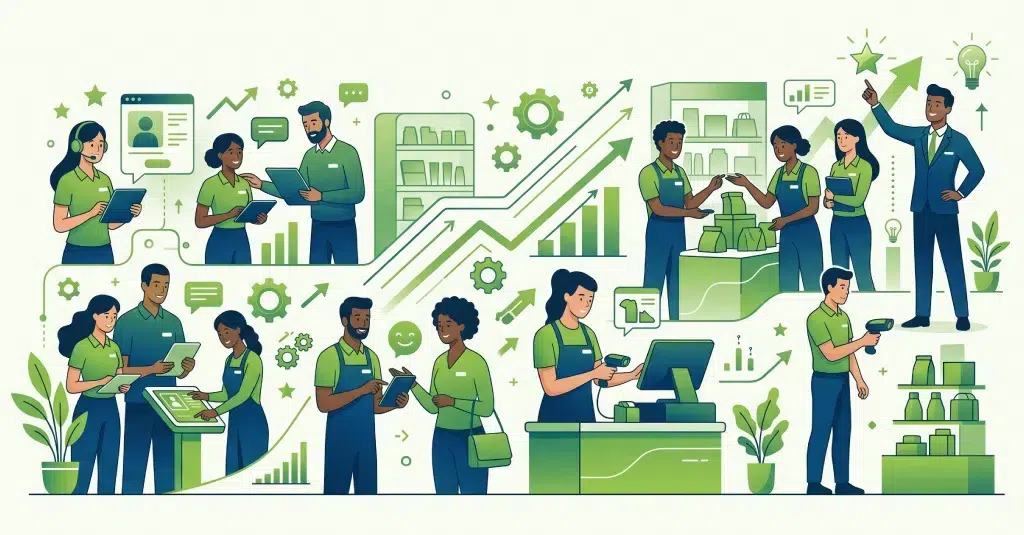
Retail staff training helps frontline employees build the product knowledge, customer service, compliance, and operational skills needed to improve store performance. Modern retail skilling programs combine employee upskilling, microlearning for employees, blended learning, and custom elearning solutions to support deskless teams across stores, geographies, and role levels. Unlike traditional corporate training programs, effective eLearning corporate training in retail focuses on measurable outcomes like customer satisfaction, conversion rates, retention, and reduced shrinkage.

Why Retail Staff Training Has Become a Business-Critical Priority
Retail staff training has changed dramatically over the last few years. What once looked like a simple onboarding checklist now sits at the center of customer experience, employee retention, store profitability, and brand consistency.
Walk into any busy retail store on a Saturday afternoon, and you’ll see the challenge instantly. One associate handles a frustrated return; another explains a product’s feature, and someone else manages inventory alerts while helping customers on the floor. Retail work has become more complex, more digital, and honestly, more emotionally demanding than many corporate leaders realize.
Yet a surprising number of retail organizations still rely on outdated corporate training programs built around static modules and one-time onboarding sessions. Employees complete courses, managers tick boxes, and three weeks later the same operational issues return. Sound familiar? It happens because training alone rarely changes behavior.
Retail excellence comes from sustained skilling.
The most successful retailers today are investing in employee upskilling through custom elearning solutions, blended learning, and mobile-first learning ecosystems designed specifically for deskless employees. They understand that retail learning must happen in moments, not just classrooms. It must support performance while work is happening, not weeks afterward.
And perhaps most importantly, modern retail skilling programs connect learning directly to measurable store outcomes like conversion rates, customer satisfaction, compliance, and shrinkage reduction.

Retail Staff Training vs. Skilling: What Actually Changes Customer Outcomes
There’s a subtle but important difference between training and skilling.
Retail training often focuses on information transfer:
- Learn the POS system
- Complete compliance modules
- Memorize promotions
- Follow store procedures
Retail skilling focuses on capability building:
- Handle difficult customer conversations confidently
- Cross-sell naturally
- Solve operational problems quickly
- Adapt to changing store demands
One helps employee’s complete tasks. The other helps them perform under pressure.
That’s why effective eLearning corporate training in retail now prioritizes applied learning over passive consumption.
High-performing retailers increasingly use:
- Scenario-based learning
- Practice simulations
- Microlearning for employees
- Manager coaching loops
- Real-time reinforcement
This approach aligns closely with experiential learning principles where employees build capability through doing, reflection, and repetition instead of simply consuming information.
The difference shows up directly on the sales floor. Customers don’t remember whether an associate completed compliance modules. They remember whether the interaction felt helpful, confident, and human.

The High-Turnover Problem: Designing Skilling Programs That Deliver Value Before the 90-Day Mark
Retail turnover changes everything about learning strategy.
Many retailers lose frontline employees within the first three months. That reality forces L&D teams to rethink how quickly learning can create operational value.
Traditional onboarding models simply move too slowly.
Long induction sessions packed with policy slides often overwhelm employees before they’ve even learned where extra inventory is stored. Cognitive overload becomes a real problem, especially for younger associates balancing multiple systems, customer expectations, and operational procedures simultaneously.
The strongest retail staff training programs focus aggressively on the first 30–90 days.
Successful programs typically:
- Prioritize role-critical skills first
- Deliver short learning bursts
- Use mobile reinforcement
- Build confidence through guided practice
- Include immediate manager feedback
One apparel retailer reduced early turnover significantly after replacing lengthy onboarding modules with daily five-minute mobile learning nudges combined with peer shadowing. Associates felt productive faster. Managers spent less time correcting repeated mistakes. Customers noticed the difference, too.
Sometimes the simplest change creates the biggest shift.

Frontline Variability: Retail Staff Training Across Store Formats, Geographies, and Role Levels
Retail learning becomes complicated because no two stores operate exactly alike.
Flagship urban stores face different customer expectations than suburban outlets. Luxury retail environments demand different conversational skills than grocery or electronics formats. Add regional language differences, seasonal staffing variations, and multiple role levels, and suddenly standardized training begins to break down.
This is where custom eLearning solutions become essential.
Strong retail skilling programs create:
- Core learning standards across the organization
- Flexible localization options
- Role-based learning pathways
- Store-specific reinforcement activities
Blended learning works especially well here because it combines centralized consistency with local adaptability.
For example:
- Digital modules establish baseline product knowledge
- In-store coaching reinforces behavioral expectations
- Peer learning supports practical problem-solving
- Mobile reinforcement sustains retention over time
The key is flexibility without fragmentation.
Employees should feel that learning reflects their actual work environment instead of some imaginary “perfect store” that exists only in PowerPoint slides.

Product Knowledge, Soft Skills, and Compliance - Why Bundling All Three into One Program Dilutes All Three
Retail organizations often try to simplify learning delivery by combining everything into one giant onboarding curriculum.
Unfortunately, that approach usually weakens all three areas.
Product knowledge requires memorization, application, and customer translation.
Soft skills require practice, feedback, and emotional intelligence.
Compliance training requires accuracy, repetition, and risk awareness.
These are fundamentally different learning objectives.
A store associate learning return policies does not need the same instructional approach used for customer empathy conversations or premium product recommendations.
That’s why modern corporate training for employees increasingly separates:
- Product capability pathways
- Behavioral skill development
- Compliance reinforcement systems
Gamification in training also works particularly well for product knowledge reinforcement. Retail teams often respond strongly to:
- Leaderboards
- Scenario challenges
- Product quizzes
- Team competitions
- Achievement badges
Used correctly, gamification creates repetition without making learning feel repetitive.
Of course, there’s a fine line. Nobody wants training that feels like a mobile game from 2014 with exploding confetti after every answer. Retail employees spot forced engagement tactics immediately.
Good gamification supports motivation. Bad gamification becomes background noise.

Mobile-First Retail Staff Training: Reaching Deskless Associates Where They Work
Most retail employees don’t have desks. Many don’t even have uninterrupted time.
That changes everything about learning delivery.
Retail associates learn:
- Between customer interactions
- During shift transitions
- On personal devices
- In short operational windows
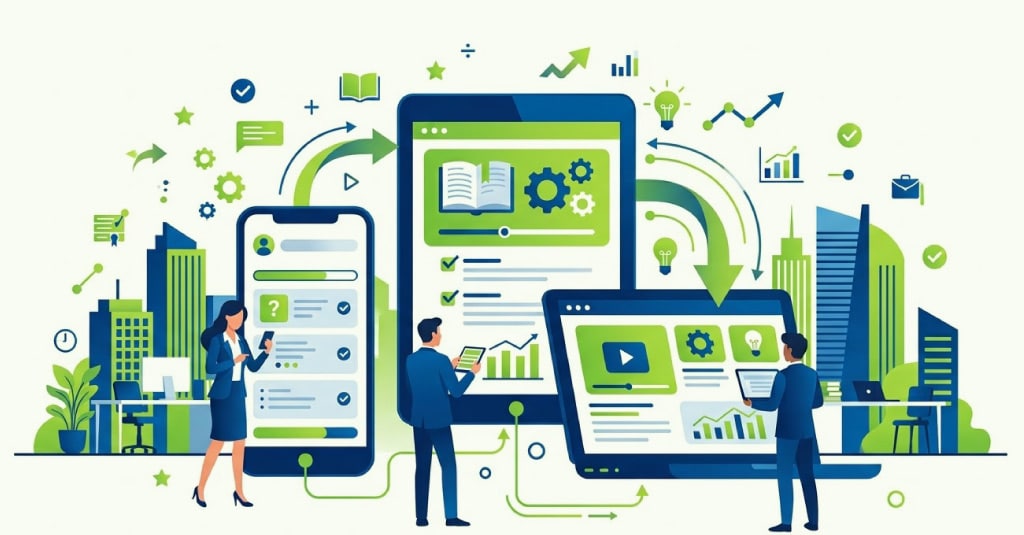
Mobile-first learning is no longer optional for retail workforce development. It’s foundational.
Effective mobile retail learning usually includes:
- Short videos
- Interactive scenarios
- Quick refreshers
- Searchable knowledge support
- Peer tips
- Push-based reinforcement
Microlearning for employees becomes especially valuable because it reduces cognitive friction. Associates can consume learning quickly without disrupting operational flow.
One electronics retailer saw stronger product recommendation consistency after shifting from monthly LMS modules to daily two-minute mobile refreshers tied directly to current promotions. Employees retained more because learning matched the rhythm of their workday.
That’s the real secret most retail L&D teams eventually discover: learning succeeds when it fits naturally into operational reality.

Seasonal Retail Staff Training: Rapid Onboarding Without Sacrificing Quality
Holiday hiring creates enormous pressure for retail organizations.
Stores need employees to be productive almost immediately. Yet rushing onboarding often increases operational errors, inconsistent customer experiences, and compliance risk.
The answer isn’t simply “faster training.” It’s smarter sequencing.
Strong seasonal onboarding programs:
- Prioritize high-frequency customer interactions first
- Delay nonessential information
- Use guided practice heavily
- Provide manager checklists
- Reinforce learning daily during early shifts
This mirrors principles from the ADDIE and SAM instructional design models where iterative learning and practical application improve speed-to-competence without overwhelming learners.
And honestly, retail associates appreciate practical clarity.
Nobody remembers slide 47 of a policy deck during Black Friday rush hour. They remember quick decision guides, coaching support, and confidence-building practice.

Connecting Retail Staff Training Investment to Store KPIs: Conversion, NPS, and Shrinkage
Retail learning programs often struggle for executive attention because they’re measured using learning metrics instead of business metrics.
Completion rates rarely impress operations leaders.
Store performance does.
The most effective retail learning teams connect skilling investments directly to:
- Conversion rates
- Average transaction value
- Customer satisfaction scores
- Net Promoter Score (NPS)
- Shrinkage reduction
- Time-to-productivity
- Employee retention
This changes the conversation completely.
Instead of asking:
“Did employees finish training?”
Leaders begin asking:
“Did customer interactions improve?”
“Did sales performance increase?”
“Did operational mistakes decline?”
That’s a much more strategic discussion.
Retail organizations increasingly partner with learning and development consulting specialists to build analytics models connecting learning behavior to operational performance. When done correctly, L&D stops being viewed as a support function and starts operating as a business performance driver.

Key Takeaways & Conclusion
Retail workforce excellence doesn’t come from isolated training events. It comes from consistent capability building tied directly to operational performance.
The best retail staff training programs recognize several realities:
- Frontline work is fast-moving and unpredictable
- Employees learn best through application and reinforcement
- Mobile-first learning fits the realities of deskless work
- Product knowledge, compliance, and behavioral skills require different learning strategies
- Employee upskilling must connect directly to customer and business outcomes
Modern retailers are moving beyond traditional corporate training programs toward blended learning ecosystems that combine flexibility, personalization, coaching, and measurable business alignment.
And perhaps that’s the biggest shift of all.
Retail learning is no longer just about helping employees “complete training.” It’s about helping them succeed in moments that directly shape customer loyalty, revenue, and brand trust.
The retailers that understand this early are building stronger teams, better customer experiences, and more resilient businesses along the way. Want to build retail learning programs that drive real business outcomes? Talk to our learning experts.

Frequently Asked Questions
Retail environments are fast-paced, high-turnover, and operationally unpredictable. Employees often work across varied schedules, store formats, and customer expectations, making consistent learning delivery difficult.
Mobile-first learning, microlearning for employees, blended learning, scenario-based practice, and manager-led coaching tend to work best because they fit naturally into retail workflows.
Focus on role-critical tasks first, use short learning modules, provide structured coaching support, and reinforce learning daily during the first few weeks of employment.
Yes. Strong employee upskilling programs improve confidence, role clarity, engagement, and career growth opportunities, all of which contribute to stronger retention outcomes.