



Learning and development consulting helps organizations solve business performance problems by identifying root causes before recommending training. Unlike traditional corporate training programs that focus only on content delivery, performance consulting evaluates skills, workflows, leadership, motivation, and operational barriers to design effective corporate training solutions. Modern performance consulting combines instructional design, custom learning solutions, employee upskilling, and blended learning strategies to improve measurable business outcomes.

Why Performance Consulting Changes How Organizations Solve Business Problems
A few years ago, I sat in a meeting with a frustrated operations leader who slammed a notebook shut and said, “We’ve already done the training twice. Why are people still making the same mistakes?”
Honestly, the room went quiet.
Not because anyone had a magical answer. Mostly because everyone secretly knew the truth. The problem probably wasn’t training in the first place.
That moment sticks with me because it perfectly captures what’s happening in many organizations today. Teams invest heavily in corporate training programs, launch polished modules, track completion rates, and still struggle to improve performance where it matters. Productivity stalls. Customer complaints continue. Managers get frustrated. Employees feel overwhelmed. L&D teams wonder why nobody values their work.
And somewhere along the way, “build another course” becomes the default response to almost every business problem.
That’s exactly where learning and development consulting enters the picture.
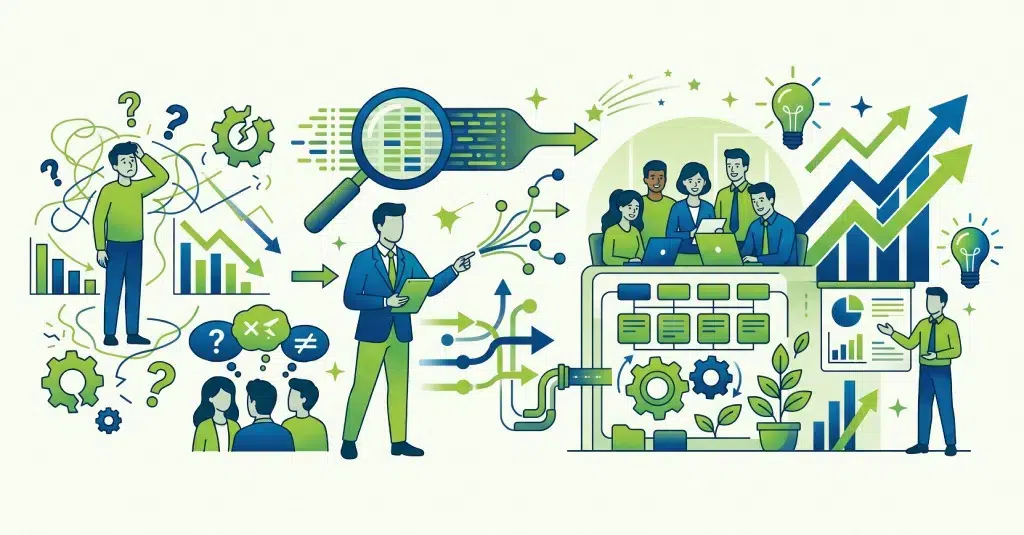
Performance consulting shifts the conversation from “What training should we create?” to “What’s really preventing people from succeeding?”
Sometimes employees genuinely need employee upskilling. Sometimes systems are clunky. Sometimes managers unintentionally reinforce bad habits. Sometimes processes are so confusing that even top performers struggle to navigate them. I’ve seen all of it. Once, an organization spent months designing customer service training only to discover the real issue was an outdated approval process slowing response times by three days. The poor training team never stood a chance.
That’s why modern performance consulting matters so much. It helps organizations diagnose the actual problem before prescribing learning as the cure.
And honestly, that one shift changes everything.
Training Order-Taking vs. Performance Consulting: The Shift Most L&D Functions Haven't Made
A lot of internal L&D teams still operate like restaurant servers taking orders.
“Can we get a compliance course?”
“We need leadership training.”
“Please build a workshop for communication skills.”
Order received. Development begins. Deadline set. Everyone moves on.
The problem? Nobody stops asking whether the requested training will solve anything.
Performance consulting works differently.
Instead of rushing toward content creation, consultants slow things down and investigate the bigger picture first. It sounds simple, but it takes discipline because organizations often want fast answers. Stakeholders usually expect learning teams to jump straight into production mode.
I’ve watched talented instructional design teams spend months building beautifully designed programs for issues rooted entirely in broken workflows or inconsistent management practices. It’s a bit like giving someone vitamins when what they actually need is sleep and fewer meetings. Helpful maybe, but not exactly solving the real problem.
Strong learning and development consulting changes the role of L&D from content producer to strategic business partner.
That means asking uncomfortable but necessary questions:
- What business outcome is suffering?
- What behavior needs to change?
- What’s preventing employees from succeeding today?
- Is training even the right intervention?
Sometimes it is.
Sometimes it absolutely isn’t.
And knowing the difference is where real performance consulting begins.

What Performance Consulting Actually Involves: Diagnosing Root Causes Before Prescribing Solutions
If you ask most people what learning consultants do, they’ll usually say something like, “They help build training.”
That’s only a small part of it.
Good performance consultants spend more time diagnosing than designing.
They observe workflows. Interview employees. Analyze operational data. Talk to managers. Review systems. Listen carefully to frustrations people usually don’t say out loud in executive meetings.
And honestly, those conversations can get pretty revealing.
I once spoke with frontline employees at a company struggling with compliance errors. Leadership believed workers needed refresher training immediately. Employees, meanwhile, quietly admitted they skipped certain procedures because the software timed out every few minutes and slowed production targets. Suddenly the issue looked very different.
That’s why performance consulting focuses heavily on root-cause analysis.
A consultant might uncover:
- Skill gaps
- Process friction
- Leadership inconsistencies
- Motivation issues
- Technology barriers
- Environmental distractions
- Misaligned incentives
This broader view matters because workplace performance rarely breaks for just one reason.
Modern corporate learning strategies increasingly recognize that employee behavior is shaped by systems, culture, tools, leadership, and environment, not simply knowledge transfer.
And honestly, employees know when organizations skip this step. Nothing frustrates people faster than mandatory training that completely ignores the obvious operational chaos they deal with every day.

Performance Gap Analysis: How Performance Consulting Separates Training Problems from Process and Motivation Issues
One of the smartest things performance consultants do is separate symptoms from causes.
That sounds obvious. It’s surprisingly hard to practice.
Here’s a simple example.
Imagine customer satisfaction scores suddenly drop.
The immediate reaction might be:
“Employees need customer service training.”
Maybe.
But maybe:
- Staffing levels are too low
- Systems crash constantly
- Policies frustrate customers
- Managers coach inconsistently
- Employees are burned out
- Incentives prioritize speed over quality
See the difference?
Performance gap analysis helps organizations figure out what’s actually happening beneath the surface.
Generally, performance issues fall into four buckets:
Skill and Knowledge Gaps
Employees don’t know how to perform the task effectively.
This is where employee upskilling, blended learning, and custom learning solutions genuinely help.
Process Problems
Employees know what to do but face operational barriers.
Honestly, this one shows up everywhere. Confusing approvals, outdated systems, duplicated tasks… you name it.
Motivation Issues
Sometimes employees understand expectations perfectly but lack engagement because recognition, incentives, or leadership support are weak.
Environmental Constraints
Noise. Interruptions. Understaffing. Unrealistic workloads. Poor tools.
No amount of eLearning fixes a broken work environment.
That’s why effective corporate training solutions must align with operational realities instead of pretending those realities don’t exist.

Why Skipping Performance Consulting Produces High Course Volume and Low Business Impact
Here’s a slightly uncomfortable truth.
A lot of organizations are producing more learning content than employees could realistically consume in three lifetimes.
New modules appear weekly. Libraries grow endlessly. LMS dashboards look impressive. Yet business leaders still question learning ROI.
Why?
Because activity isn’t the same as impact.
I once heard an L&D director joke, “We’re basically Netflix with mandatory compliance deadlines.” Funny. Also painfully accurate.
When learning teams skip consulting and analysis, they often create:
- Too many courses
- Redundant training
- Generic learning paths
- Content disconnected from real workflows
Employees quickly learn to “complete training” instead of actually learning from it.
Performance consulting shifts the focus toward business outcomes:
- Faster onboarding
- Better customer experience
- Higher productivity
- Reduced operational errors
- Stronger leadership capability
- Improved retention
That’s a completely different conversation.
And honestly, it’s the conversation executives care about most.

Needs, Task, and Audience Analysis: Three Performance Consulting Layers Most L&D Briefs Collapse Into One
One of the biggest mistakes organizations make is treating all analysis as one generic discovery conversation.
In reality, strong learning and development consulting separates three very different layers.
Needs Analysis
This looks at the business problem itself.
What is happening?
Why does it matter?
What risk exists if nothing changes?
Task Analysis: Where Performance Consulting Surfaces Hidden Workflow and Behaviour Gaps
This focuses on the actual work employees perform.
What decisions do they make?
Where do mistakes happen?
Which behaviors separate high performers from average performers?
Sometimes task analysis reveals tiny workflow frustrations, causing massive downstream problems. Those insights rarely show up in executive presentations.

Audience Analysis: Why Performance Consulting Examines Who Is Learning, Not Just What They Need
This examines the people themselves:
- Experience levels
- Technology comfort
- Work environment
- Motivation
- Language needs
- Daily pressures
A regional manager, sales associate, and technical specialist all experience learning differently. Yet many corporate training programs still treat employees as one giant audience blob. That almost never works well.
Strong instructional design depends on understanding these layers separately.
Otherwise, learning solutions become broad, generic, and forgettable.

External Performance Consulting vs. Internal L&D Capability: How to Decide What You Need
Some organizations build strong internal consulting capability over time. Others rely on external expertise. Most end up using a mix of both.
External consultants can be especially useful during:
- Large transformations
- Digital adoption initiatives
- Leadership restructuring
- Enterprise-wide employee upskilling
- High-stakes compliance shifts
Why?
Because outside consultants bring objectivity.
Internal teams sometimes become so familiar with organizational habits that certain problems start feeling “normal.” External partners spot friction faster because they aren’t emotionally attached to existing systems.
That said, internal teams offer something consultants can’t easily replicate: context.
They understand politics, history, personalities, and cultural dynamics that shape performance every day.
The strongest organizations combine both perspectives strategically.
And honestly, the best consulting relationships don’t create dependency. They help internal teams become stronger over time.

Translating Consulting Outputs into a Learning Architecture: From Diagnosis to Design Brief
Once diagnosis is complete, the real work begins.
Consulting insights must eventually translate into action.
This is where strong instructional design becomes incredibly important. Insights alone don’t improve performance unless organizations turn them into practical interventions employees can actually use.
An effective learning architecture might include:
- Digital learning
- Coaching
- Simulations
- Performance support tools
- Peer learning
- Manager reinforcement
- Practice environments
Blended learning works especially well because workplace performance usually improves through repeated application, not one-time information delivery
I’ve seen organizations completely transform onboarding simply by adding structured manager coaching alongside digital modules. Tiny change. Massive impact.
And honestly, that’s one of the biggest lessons performance consulting teaches over time:
People rarely improve because they consumed information once.
They improve because learning becomes part of how work happens every day.
Measuring Performance Consulting Impact Beyond the Training Plan
One of the funniest things about corporate learning is how often success gets measured by course completion.
Imagine hiring a fitness coach and celebrating because you downloaded the workout app without ever exercising. Same energy.
Performance consulting measures something much more meaningful:
Did performance actually improve?
That means looking at:
- Productivity
- Customer satisfaction
- Operational accuracy
- Employee confidence
- Retention
- Time-to-performance
- Leadership effectiveness
- Adoption behavior
Kirkpatrick’s evaluation framework becomes especially useful here because it pushes organizations beyond participation metrics toward behavioral and business outcomes.
And honestly, this is where credibility gets earned.
Business leaders don’t care how beautiful the learning platform looks if operational problems remain exactly the same afterward.
The organizations seeing the strongest results today treat corporate learning as part of business strategy, not simply employee education.
That’s a huge mindset shift.

Key Takeaways & Conclusion
Learning performance consulting helps organizations stop reacting to symptoms and start solving actual business problems.
Instead of immediately building training every time performance dips, performance consultants investigate what’s truly happening beneath the surface. Sometimes employees need knowledge. Sometimes they need clearer processes, stronger leadership, better tools, or simply fewer operational obstacles getting in the way.
That distinction matters more than most companies realize.
The strongest learning organizations today:
- Diagnose before designing
- Align learning with business goals
- Focus on measurable outcomes
- Use blended learning strategically
- Build employee upskilling around real operational needs
- Treat L&D as a business performance function, not just a content team
And honestly, this shift feels refreshing once organizations experience it.
Because employees stop feeling buried under endless corporate training programs that don’t help them succeed. Managers stop viewing learning as a checkbox exercise. Leaders begin seeing measurable performance improvement instead of just participation reports.
That’s when learning finally starts earning real credibility inside the business.
And funny enough, it usually starts with someone asking a very simple question:
“Are we solving the right problem in the first place?”

FAQs
A training vendor usually develops requested learning content, while a learning consultant investigates the underlying business problem first to determine whether training is actually the right solution.
No. Many performance gaps stem from process issues, leadership challenges, motivation problems, unclear expectations, or environmental barriers rather than skill deficiencies.
Costs vary depending on project scope, workforce size, consulting duration, and analysis depth. Some organizations engage consultants for short assessments, while others build long-term strategic partnerships.
Organizations typically measure operational and behavioral outcomes such as productivity improvement, customer satisfaction, reduced errors, employee capability growth, leadership effectiveness, and business performance changes.