




Multilingual eLearning helps organizations deliver consistent training across multiple languages. It also adapts learning for local cultures, regulations, and learner needs. Success depends on localization-ready design, strong governance, version control, and quality assurance, not translation alone.
Creating one eLearning course is a content project. Creating that course in 15 languages is an operating model.
That’s the distinction I encourage global L&D teams to make early.
The first multilingual rollout often looks manageable. Build the English course, translate it, run quality checks, and publish each language version. Then the source course changes. A regulation is updated in Germany. A product term changes globally. A local SME asks for a different scenario. Suddenly, the team isn’t managing one course anymore. It’s managing a network of related versions.
And that’s where multilingual eLearning gets difficult.
The real challenge isn’t simply translating training. It’s maintaining quality, consistency, compliance, and control while learning changes across countries.

What Is Multilingual eLearning and Why Is It Hard to Scale?
Multilingual eLearning is digital learning designed and delivered in multiple languages. It accounts for the linguistic, cultural, regulatory, and technical needs of different learner groups. Translation is part of that process, but it isn’t the whole process.
Translation vs Localization vs Multilingual eLearning Design: Key Differences
Scroll right to read more.
| Approach | What changes |
|---|---|
| Translation | Words are converted from one language to another |
| Localization | Language, examples, visuals, formats, terminology, and cultural context are adapted |
| Multilingual learning design | The original learning experience is designed from the start to work across languages and regionss |
A US-based organization may need the same compliance program in Brazil, Germany, Japan, India, and the Middle East. But local requirements can vary. Regulations, reporting processes, terminology, examples, and interface needs may differ from one region to another.
The technical issues also grow. German text may require more screen space than English. Arabic requires right-to-left support. Voice-over creates another set of assets to maintain. Images, currencies, dates, measurements, accessibility requirements, and subtitles may all need attention.
There’s also evidence that this effort matters. ATD’s 2024 localization research found that more than 80% of talent development professionals said employees were more satisfied with localized training. More than 80% also believed localization improved information retention.
Also Read: eLearning Localization: Train Global Workforces Without Losing Impact
How to Design Multilingual eLearning That Works Across Regions
One of the most expensive multilingual eLearning mistakes happens before anyone starts translating.
The source course wasn’t designed for localization.
If global rollout is likely, custom eLearning content development should account for it from the beginning. Retrofitting a highly localized English course later usually creates unnecessary cost and rework.
Design Multilingual eLearning for Localization from the Start
I would make a few decisions early:
- Write clear source copy and avoid unnecessary idioms, jokes, and wordplay.
- Keep text editable rather than embedding it inside graphics.
- Allow layouts to accommodate text expansion.
- Avoid interactions that depend heavily on sentence length or fixed positioning.
- Keep source files, scripts, media, and design assets organized.
- Decide early whether audio, video, subtitles, or on-screen text will require localization.
This doesn’t mean making the source course culturally bland. It means avoiding design decisions that create problems in every subsequent language.
Decide What Stays Global and What Becomes Local in Multilingual eLearning
This is where multilingual programs often need stronger governance.
Not everything should be localized. And not everything should be standardized globally.
For a compliance course, for example, the enterprise might establish a global core covering company policy, expected behaviors, brand language, and assessment standards.
Regional teams could then own a local layer covering legislation, reporting channels, terminology, examples, and locally relevant scenarios.
This gives local teams enough flexibility to make learning accurate without allowing 20 countries to create 20 different interpretations of the same corporate requirement.
The same principle works for product, onboarding, safety, and process training.
The useful question is: What must remain consistent across the business, and what must change for the learner?
That decision should happen during eLearning content development, not during final translation review.
Also Read: How to Buy eLearning Content Development Without Getting It Wrong
How to Maintain Quality, Compliance, and Version Control in Multilingual eLearning
For small multilingual projects, translation quality gets most of the attention.
For enterprise programs, I’d worry just as much about control over time.
Why Multilingual eLearning Translation Quality Needs More Than One Reviewer
A native-speaking translator can make sure the language sounds right. But technical accuracy is a different matter. They may not know if a medical term, safety instruction, or manufacturing process has been translated correctly.
For high-risk learning, think about quality in layers:
Translation → linguistic review → local SME review → functional QA → final approval
The level of review should match the risk.
A low-risk internal product update may work well with AI-assisted translation followed by human review. A safety or regulatory course needs much tighter controls and subject-matter validation.
Translation memories and approved glossaries can help keep terminology consistent. RWS also recommends using terminology databases. These tools help teams use the same terms across courses and languages.
AI can make the workflow faster in 2026. It doesn’t remove accountability for the final content.
Treat the Source Course as the Single Source of Truth in Multilingual eLearning
Now consider what happens six months after launch.
A global compliance course exists in 14 languages. Three paragraphs in the English version change.
Which translated courses need updating? Who triggers the work? Which local SMEs need to review it? Has the previous LMS package been replaced? Can you prove which version employees completed?
This is why version control becomes a governance issue, not an administrative detail.
A practical workflow looks something like:
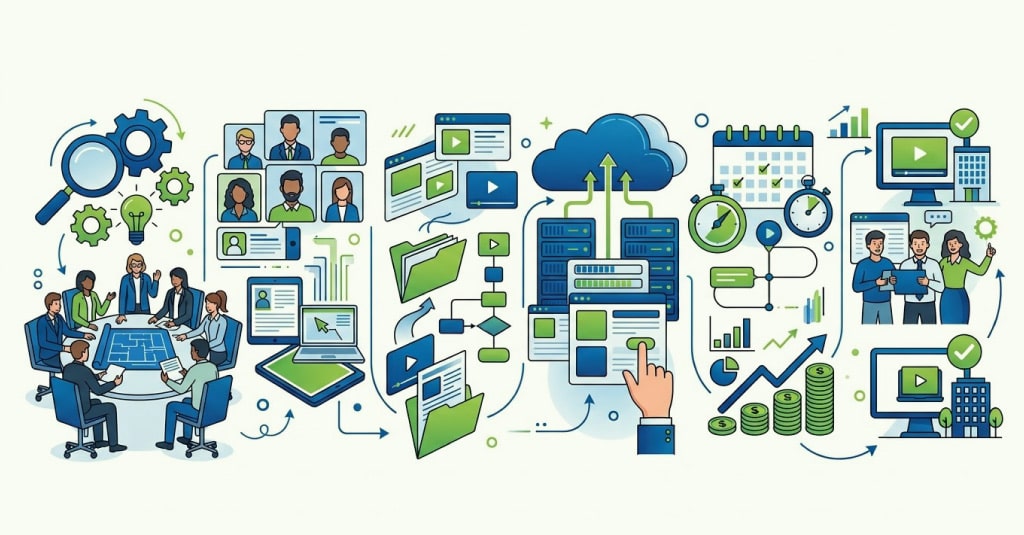
Master version → change identified → affected content flagged → localization → local review → QA → approval → LMS update → previous version archived
Modern localization workflows can detect changes and send only updated content for translation rather than reprocessing an entire course. RWS, for example, describes this delta-based approach as a way to reduce retranslation, cost, and turnaround time.
The technology helps. Clear ownership matters just as much.
Someone still needs responsibility for the master version, language status, local approvals, release dates, and audit trail.
What Does Multilingual eLearning Development Actually Cost?
There isn’t a useful universal answer such as “multilingual eLearning adds 30% to development cost.”
The cost depends on what you’re localizing and how often it changes.
Main Cost Drivers in Multilingual eLearning
The main cost drivers include:
- number and type of languages
- course length and word count
- localization complexity
- audio and voice-over requirements
- video and subtitle adaptation
- graphics and screenshots
- technical or regulatory SME review
- QA requirements
- authoring tools and file structure
- frequency of future updates
The Four Parts of Multilingual eLearning Cost
I find it more useful to think about cost in four parts:
Base course development + localization + QA and multimedia adaptation + ongoing maintenance
That fourth cost is easy to underestimate.
A course translated into 12 languages doesn’t create a one-time translation expense. It creates 12 versions that may need to stay aligned with the source course for several years.
Good localization-ready design can reduce that lifecycle cost. So can translation memory, modular content, reusable assets, and clear change-control processes.
The cheapest translation workflow on version one isn’t necessarily the lowest-cost model over the life of the program.
What Are the Business Risks of Getting Multilingual eLearning Wrong?
Poor localization can affect learner engagement. But for enterprises, the risks go much further.
Compliance risk: Employees may misunderstand policies, reporting obligations, or required procedures.
Safety risk: An unclear translation in operational or safety training can change how someone performs a task.
Performance risk: Different regions may interpret the same process differently, creating inconsistent execution.
Audit risk: Weak version control can make it difficult to establish which content employees actually completed.
Brand risk: Poor terminology, inappropriate imagery, or culturally awkward scenarios can undermine trust in the training and the organization behind it.
Cost risk: An error discovered after deployment may need to be corrected, reviewed, rebuilt, and republished across every affected language.
This is why I wouldn’t apply the same localization workflow to every course.
A leadership program, product introduction, code-of-conduct module, and safety certification don’t carry the same business risk. Their review models shouldn’t be identical either.
When Should You Outsource Multilingual eLearning Development?
There’s no reason to outsource multilingual eLearning simply because more than one language is involved.
An internal team may be perfectly capable of handling a few languages, especially when local SMEs are available and update volumes are low. The decision changes as complexity increases.
Multilingual eLearning: In-House vs eLearning Outsourcing Decision Guide
Scroll right to read more.
| Keep more work in-house when… | Consider eLearning outsourcing when… |
|---|---|
| Language volumes are limited | Many languages launch together |
| Internal language expertise exists | Specialist linguists are required |
| Updates are infrequent | Content changes frequently |
| SMEs have review capacity | Internal reviewers are overloaded |
| Multimedia needs are simple | Voice-over and video need localization |
| The library is manageable | Multilingual assets are difficult to track |
Outsourcing eLearning can also make sense when launch timelines require parallel production that the internal team can’t support.
But vendor capacity isn’t the only thing I’d assess.
Ask how the partner handles terminology, technical review, translation memory, source files, version control, QA, data security, local SMEs, and future updates.
For a global enterprise, you’re not only selecting someone to translate version one. You’re choosing part of the process that may maintain the content for years.
How Managed Learning Services Help Scale Multilingual eLearning Operations
Eventually, some organizations reach a point where the problem isn’t multilingual course development at all. It’s multilingual learning operations.
Imagine hundreds of courses, multiple business units, 15 languages, several learning platforms, frequent updates, different vendors, and regional approval requirements.
The workload now includes localization coordination, content updates, LMS administration, reporting, vendor management, version tracking, learner support, and asset management.
That’s where managed learning services can make sense.
Rather than adding permanent internal capacity for every operational activity, an enterprise can move selected repeatable processes to a managed model while keeping strategy, governance, and key capability decisions internally.
The boundary matters.
A managed service shouldn’t decide what employees need to learn or which business capability matters most. Those decisions belong with the organization.
It can make sure approved learning reaches the right people in the right language and version. This also reduces the time internal L&D teams spend managing files and vendors.

Key Takeaways & Conclusion
The difficult part of multilingual eLearning isn’t getting an English course translated into ten languages. It’s keeping those ten versions accurate, relevant, compliant, and current as the business changes.
That requires more than good translation. It requires localization-ready design, clear global and local ownership, risk-based quality controls, version management, and a realistic view of lifecycle cost.
For a small library, those processes may remain internal.
At enterprise scale, the challenge gets bigger. L&D teams need the right people, technology, language expertise, and processes to manage multilingual learning over time.
If that operating load is becoming difficult to manage, Upside Learning can support multilingual custom eLearning development, localization, and the learning operations around it. The useful starting point is to assess where complexity is actually coming from before deciding what should stay internal and what should move to a partner.

Frequently Asked Questions
Multinationals often keep the core training the same across regions. This includes company policies, learning goals, brand standards, and assessments. Local teams can then adapt legal requirements, terminology, examples, and reporting processes. Clear approval rules help keep these changes under control.
The additional cost depends on the number of languages and the complexity of the content. Multimedia and the level of review also affect the cost. Translation is only one expense. Voice-over, cultural adaptation, technical review, QA, and ongoing updates add to the overall cost.
The main risks are regulatory non-compliance, safety incidents, inconsistent employee performance, audit problems, and costly rework. The risk is especially high when employees rely on translated training to follow regulated, technical, or safety-critical procedures across different countries.
Enterprises typically maintain one controlled master course and link every localized version to it. When the master changes, affected translations are identified, reviewed, approved, and republished. Previous versions are archived, creating an audit trail showing which content was active in each region.
Translation quality requires both language and subject-matter review. A qualified translator handles linguistic accuracy, while local or technical SMEs verify terminology, procedures, and regulatory requirements. Functional QA then checks the completed course before release. Higher-risk content requires stricter human validation.