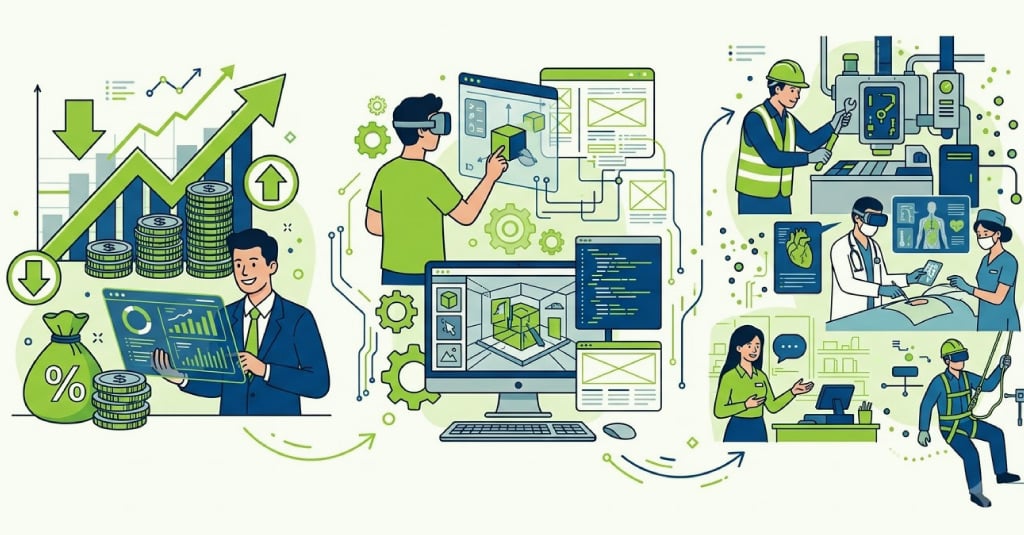





Frontline worker training helps deskless workforce learn through mobile, offline, and task-based experiences instead of traditional LMS courses. This approach is equally valuable for retail employee training, manufacturing, logistics, and field services, where building workforce skills requires learning that fits naturally into the flow of work.
Eight in ten workers globally never sit at a desk. They drive trucks, stock shelves, run machines, treat patients, and serve customers face-to-face. Yet walk into most enterprise L&D functions, and you’ll find course catalogs, LMS dashboards, and content strategies built almost entirely for the other two in ten. Helping these employees build workforce skills requires learning that is continuous, accessible, and embedded into the flow of work, not limited to occasional compliance training or annual learning events.

Why Most Enterprise Learning Fails Frontline Worker Training Needs
L&D systems were designed by and for people who looked like the people building them: knowledge workers with laptops, inboxes, and quiet stretches of time to complete a course. The assumptions got baked into everything.
The LMS-Centric Trap in Frontline Worker Training
- Stable login credentials
- Reliable Wi-Fi
- Forty-five uninterrupted minutes
- A manager who reminds you by email
None of that describes a warehouse picker, a retail associate, or a field technician. Their day is shift-based, noisy, physically demanding, and shared across multiple people using the same device. When L&D hands them a course built for a desk, the course doesn’t fail because the content is wrong. It fails because the delivery model was never designed for their reality.
This is the LMS-centric trap: organizations keep buying better course players while the actual constraint, access to learning at the point of work, goes unaddressed.

What Frontline Workers Actually Need from Their Training Programs
Frontline workers don’t need more content. They need the right answer, fast, in a format they can use with their hands already busy or their shift already started. This is where microlearning proves especially effective. Short, focused learning experiences help frontline employees solve immediate problems without disrupting productivity.
Performance Support Over Generic Modules in Frontline Worker Training
That means task-specific guidance supported by performance support tools rather than generic learning modules. A two-minute walkthrough for resetting a machine beats a forty-minute course on equipment fundamentals, because the worker doesn’t need theory; they need to complete the task in front of them right now. Combined with microlearning, these short interventions improve knowledge retention and make learning easier to apply on the job.
Peer-Validated Knowledge:
It means peer-validated knowledge matters as much as official content. The most trusted source on a shop floor is often the senior associate who’s solved this exact problem before, not a course built by someone who’s never worked the line. In some environments, gamification in corporate training can also reinforce safe behaviours and encourage participation, especially when combined with short learning activities and real-world performance goals.
Literacy-Aware Design:
And it means language and literacy-aware design isn’t a nice-to-have. Frontline workforces are often the most linguistically diverse part of an organization. Training that assumes fluent, fast reading excludes the people who need it most.
Speed of Access: The Real Design Goal in Frontline Worker Training
A worker who has to search through a course library to find the one answer they need will give up and ask a colleague instead, and that colleague’s answer might be outdated or wrong. The design goal isn’t a richer course. It’s a faster, more reliable path to the right answer.

Why Safety and Compliance Training Is the Highest-Stakes Frontline Worker Training
Higher Stakes:
Safety and compliance training carries a different weight on the frontline because the cost of failure is physical, not reputational. A missed e-learning module for a desk worker is a process gap. A missed safety protocol for a forklift operator is an injury.
The Completion Trap:
A worker can finish a compliance module, pass the quiz, and still not know how to respond when the actual hazard shows up, because passing a quiz and demonstrating competence under pressure are not the same skill.
What Effective Frontline Safety Training Actually Requires:
- Scenario-based practice, not information transfer
- Spaced reinforcement that survives past the day of training, because hazards don't announce themselves on a schedule that matches your course calendar
- A direct line between the training record and actual behavior on the floor, because regulators and insurers care about outcomes, not attendance logs

What Makes Frontline Worker Training Work Across Mobile and Offline Environments
Frontline Environment Constraints:
- Connectivity is inconsistent in warehouses, retail backrooms, and remote field sites
- Devices are often shared, not personally owned, which complicates login and progress tracking
- Shifts are short, and learning has to fit inside the cracks of a packed day
Designing Frontline Worker Training for Mobile, Offline, and Shift-Based Reality:
- Content has to work offline-first, syncing progress when connectivity returns rather than requiring it throughout
- Formats stay short enough to consume in the gap between tasks, not during a dedicated training block that doesn't exist
- Access has to be frictionless: no personal email required, no twelve-step login process standing between a worker and the answer they need
This is a delivery problem before it’s a content problem. Organizations that solve the access layer first see far better outcomes than those that keep refining course content while ignoring how it actually reaches the worker.
Many organizations address these challenges with custom eLearning solutions built specifically for mobile, offline, and multilingual frontline environments instead of relying on standard desktop-first learning experiences.
Why Managers Are the Real Reinforcement Layer in Frontline Worker Training
Frontline supervisors are the real reinforcement layer for learning, whether or not L&D designs for that role deliberately. A worker forgets most of what a course taught within days. What sticks is what their supervisor reinforces, corrects, or models on the job.
Manager Enablement:
Frontline learning strategy has to include manager enablement as a core component, not an afterthought. Supervisors need the tools and time to coach in the moment:
- A quick way to confirm someone followed the right procedure
- A simple way to identify gaps through ongoing skills gap analysis before they become incidents.
Most L&D functions invest heavily in content and barely at all in equipping the people who actually shape day-to-day behavior. That imbalance is worth correcting before adding another course to the catalog.Frontline learning strategy has to include manager enablement as a core component, not an afterthought. Supervisors need the tools and time to coach in the moment:

How to Measure the Real Business Impact of Frontline Worker Training
Completion rates tell you nothing about whether frontline training worked. They tell you someone clicked through a module. The metrics that matter sit closer to the business:
Outcome Metrics That Prove Frontline Worker Training ROI:
- Incident rates
- Quality defects
- Time-to-competence for new hires
- Customer satisfaction scores
- Turnover in the first ninety days
Connecting Frontline Worker Training Data to Operational Business Data:
This requires L&D to connect training data to operational data, something most teams aren’t yet set up to do. It’s also where a skills-intelligence approach earns its value: tracking what a worker can actually do, not what they’ve sat through, and tying that capability data to the outcomes the business already measures. Measuring workforce skills instead of course completions provides a much clearer picture of operational readiness and capability growth.
Building Shorter Feedback Loops in Frontline Worker Training:
Frontline worker training generates data daily: defect rates, near-misses, output per shift. That cadence lets L&D test whether a training intervention actually moved a number within weeks, not at the end of an annual review cycle. Few L&D functions are built to operate at that speed yet, but frontline operations are exactly where that muscle should be built first.
The frontline is where this connection is easiest to prove and hardest to ignore. A safety incident or a quality defect is a visible, costing event. That makes frontline training one of the clearest places to demonstrate that learning drives business outcomes, not just activity.

Key Takeaways and Conclusion
The deskless majority has been treated as an afterthought for too long, not because anyone decided to exclude them, but because the entire L&D infrastructure grew up around the minority who had a desk. Fixing that means rethinking the model from the ground up. Rather than treating training as isolated events, organizations should build an ongoing skilling program that continuously develops frontline capabilities and adapts to changing operational requirements.
- Task-specific over generic
- Peer-validated over purely official
- Scenario-based over information transfer
- Offline-capable over connectivity-dependent
- Manager-enabled over course-dependent
- Outcome-measured over completion-tracked
Organizations that get this right won’t just train their frontline better. They’ll build a scalable skilling program that continuously develops workforce capability while improving business performance.

FAQs
Frontline or deskless worker training serves the roughly 80% of the workforce that never sits at a desk: warehouse staff, technicians, retail associates, drivers, care workers. It’s different because the constraints are physical and situational, not informational, so desk-built courses simply don’t reach these workers
Short, task-specific performance support tools delivered on mobile, in the flow of work, beat long courses every time. Think two-minute walkthroughs and job aids over modules that assume forty-five quiet minutes at a desk.
Replace information transfer with scenario-based practice and spaced reinforcement, since passing a quiz and performing under pressure are different skills. Tie training records to actual on-the-job behavior, not just attendance, since that’s what regulators and insurers care about.
Use mobile-first tools that work offline and sync progress when connectivity returns, then report through dashboards tied to operational systems already in use, like shift logs or quality data. Track task performance and incident rates alongside completion, since completion alone proves nothing.
Manufacturing, healthcare, retail employee training, logistics, and field services present some of the most complex frontline learning challenges because they combine high safety requirements, shift-based work, and frequent onboarding.