




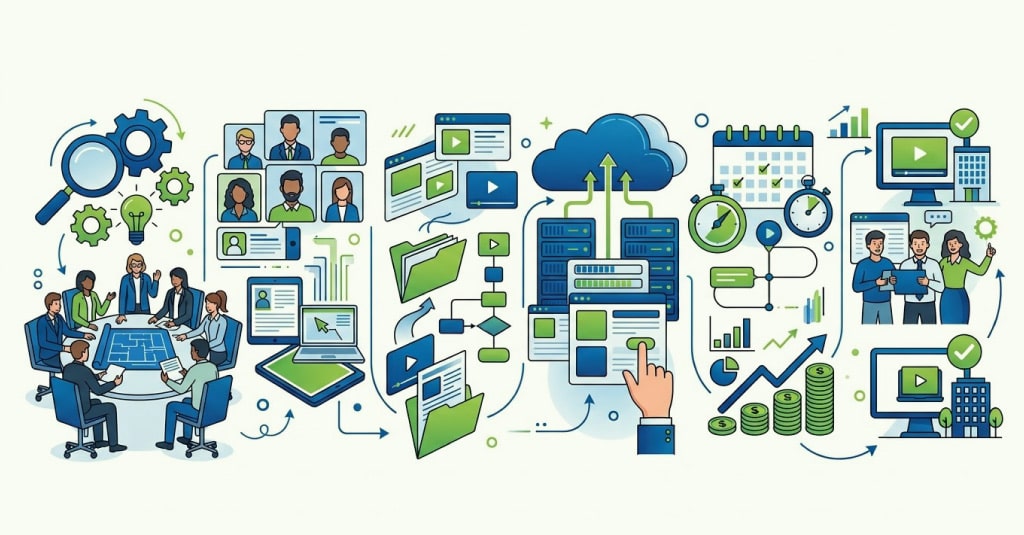
Quick answer: eLearning production is the sequence of work that turns a training need into a finished course. It runs through instructional design, content development, media build, and quality assurance, usually in overlapping cycles rather than a straight line. For a US enterprise, a single hour of finished eLearning can take 30 to 100+ hours to build, depending on interactivity, media complexity, and the amount of customization involved. Knowing this before you brief a vendor is what separates a smooth project from a missed deadline.
If you’ve commissioned custom eLearning before and the result showed up late, watered down, or nothing like the proposal, you’re not alone. Most of that friction doesn’t come from a bad vendor. It comes from a gap in expectations that nobody named out loud before the contract got signed.
You knew what you wanted the course to do. The vendor knew what their production process could deliver in the time and budget given. Those two things were never lined up.
This piece is about closing that gap. Not a vendor pitch, and not a production manual either. Just a clear look at how eLearning production actually works, so your next brief holds up and your next vendor conversation starts from the same page.

What Good eLearning Production Starts With
Before any storyboard or slide gets built, good eLearning production starts with a decision most teams skip: what is this course supposed to change?
Not “what should learners know.” What should they do differently on the job once they’ve finished it. That distinction shapes everything downstream. A course meant to build judgment (say, handling a difficult customer conversation) needs branching scenarios and practice. A course meant to convey a policy change needs neither. Building the wrong one costs the same money and delivers none of the outcome.
The teams that get strong results treat this as a business conversation, not a training request. They involve the manager who owns the performance gap, not just the L&D lead who owns the course.
Factors to Consider Before Signing for eLearning Production
A few things worth locking down before a vendor writes a single word of script:
- The specific behavior or decision the course needs to change
- Who the learner is and what they already know
- Where and how they'll take the course (desktop, mobile, on the floor, between calls)
- What "done" looks like, measured in something other than completion rate
Skip this step and you’ll spend the review cycles arguing about tone and visuals when the real problem is that nobody agreed on the goal.

eLearning Development Services vs. In-House Production
Most enterprises don’t build every course from scratch internally, and most don’t outsource everything either. The real question is where the line sits, and that depends on three things: how often you need new content, how specialized the subject matter is, and how fast you need to move.
Scroll right to read more.
| Factor | In-house makes sense when | eLearning development services make sense when |
|---|---|---|
| Volume | You produce a steady, predictable stream of similar courses | Demand spikes, or projects are one-off and specialized |
| Speed | You have bandwidth to absorb a slower ramp-up | You need parallel production across multiple courses at once |
| Subject depth | Your team already has the SME access and domain fluency | The content requires simulation, video, or compliance expertise you don’t have on staff |
| Cost structure | You want a fixed internal cost, regardless of output | You’d rather pay for capacity only when you need it |
That split shows up in the data too. The 2025 Training Industry Report found that US organizations now outsource more instruction and facilitation than they handle in-house, 62 percent versus 38 percent, even as the average outsourcing budget dipped slightly to $217,178. Outsourcing isn’t a fallback anymore. It’s a deliberate choice for the work that benefits most from outside expertise.
A pattern we see often: enterprises keep core compliance and onboarding content in-house because it changes rarely and the org already understands the audience well. They bring in custom eLearning development services for anything that needs deeper instructional design, media production, or a fast turnaround across several courses at once.
Neither model is inherently better. The mistake is picking one and applying it to every project regardless of fit.
Also Read: Best eLearning Development Services in the USA: 2026 Enterprise Guide

What to Expect From an eLearning Production Vendor
A capable eLearning vendor should be able to answer some direct questions before you sign anything. If they can’t, that’s information too.
What's your actual development ratio?
Ask how many hours they estimate per finished hour of content, and ask them to break it down by content type. A vendor who gives you one flat number for everything from a simple module to a branching simulation hasn’t scoped your project carefully.
How many review cycles are built into the timeline?
Two is common. If a vendor promises one round of feedback and no more, you’re likely to end up rushing the parts that matter most.
Who’s actually doing the instructional design?
Some vendors staff a senior instructional designer through the whole project. Others hand off after the storyboard to a production team that’s never spoken to your SME. Ask directly.
What happens when the SME goes quiet?
Subject matter experts get pulled into other priorities constantly. A vendor with a real process has a plan for this. One without will just let the timeline slip and blame the client.
Can they show you a course that failed, and why?
This tells you more than any polished case study. A vendor who can explain a miss and what changed afterward has actually shipped enough work to learn something.
None of this is about catching a vendor out. It’s about finding one whose process matches how your organization actually operates.

How Instructional Design Services Shape the Final Course
Instructional design is the part of production that’s easiest to underweight in a brief and hardest to fix after the fact. By the time media production starts, the instructional design has already decided whether the course will actually change behavior or just deliver information nobody retains.
3 Things Instructional Design Services Cover
Good instructional design services do three things that aren’t obvious from the outside:
- First, they translate a subject matter expert’s knowledge into something a learner without that expertise can actually use. SMEs know too much and explain it in the order they learned it, which is rarely the order a learner needs. A skilled instructional designer restructures that content into a learning experience.
- Second, they decide where practice belongs, not just where content belongs. A course that explains a process and then tests recall of that explanation teaches nothing. A course that has the learner apply the process to a realistic scenario, with consequences for getting it wrong, actually builds capability.
- Third, they set the pace of the course against how the audience will actually consume it. A course built for 45 minutes of focused desktop time behaves completely differently when it’s taken in four-minute bursts between calls on a mobile device. Good design accounts for that from the outline stage, not as a retrofit.
If your vendor’s instructional designer is only involved in the kickoff call and disappears until final review, you’re not getting instructional design services. You’re getting a script writer.

Evaluating eLearning Content Development Services and Corporate Training Vendors
Enterprises comparing corporate training vendors tend to focus on the portfolio and the price. Both matter, but neither predicts whether the engagement will go smoothly. What predicts that is process maturity, and process maturity shows up in specific, checkable places.
Evaluation Framework of eLearning Content Development:
- Discovery depth: Do they interview the manager who owns the performance gap, or just the L&D contact who submitted the request?
- Estimation transparency: Will they show you their hours-per-content-type math, or just quote a flat project fee with no breakdown?
- QA structure: Is quality assurance a separate step with its own checklist, or is it folded into “final review” with no defined criteria?
- Change management: How do they handle scope changes mid-project? Vendors without a clear change process either eat the cost silently (and cut corners elsewhere) or fight you on every adjustment.
- Post-launch support: Do they offer a defined window for fixes after go-live, or does the relationship end at delivery?
None of this replaces trusting your gut about the people you’ll actually work with. But a vendor who can walk through each of these points specifically, rather than in generalities, has almost certainly run this kind of project enough times to do it well.
Also Read: eLearning Training ROI: How to Prove What Actually Changed

Key Takeaways & Conclusion
eLearning production isn’t a single vendor deliverable. It’s a chain of decisions, discovery, instructional design, development, and quality assurance, and a weak link anywhere in that chain shows up in the finished course. The enterprises that get consistently good results aren’t the ones with the biggest budgets. They’re the ones who understand the process well enough to brief it clearly and manage it honestly.
If your last few projects came in late or fell short, it’s worth asking whether the brief gave the vendor enough to work with, or whether the vendor’s process had gaps you couldn’t see until it was too late.
If you’re weighing whether to build a project team internally, bring in a vendor for a single course, or hand off an ongoing production load entirely, it might help to look at how a Upside Learning’s eLearning services actually works before you decide. It’s a useful comparison point even if you end up going another route.

FAQs
Discovery and instructional design usually take one to two weeks per hour of content. Development and media production take the bulk of the time, often 30 to 100+ hours per finished hour, depending on interactivity, media complexity, and the amount of customization involved. More complex interactive, simulation-based, or media-heavy courses can require substantially more time. QA and revisions typically add another one to two weeks.
Name the specific behavior change the course needs to drive, describe the audience’s real context (device, time available, prior knowledge), and set measurable success criteria upfront. Vague briefs produce vague first drafts, which is where most wasted revision cycles come from.
QA should check instructional accuracy, technical functionality across devices, accessibility compliance, and alignment with the original learning objective as separate, documented checks. Folding all of this into one general “review” step is where errors slip through.
They stagger kickoff dates so instructional design and SME interviews don’t compete for the same people at once, and they assign a single point of accountability per project rather than splitting attention across a shared team.
Look at SME availability first, since that’s usually the real bottleneck, not production capacity. If the same SMEs are needed across projects, sequencing protects quality. If SME pools don’t overlap, running projects in parallel is usually safe.