




Organizations are entering a moment where traditional training models are struggling to keep pace with change. AI is reshaping how work gets done; roles are evolving rapidly, and expectations around performance are higher than ever.
For many organizations, the problem is no longer access to learning. Courses are abundant. Knowledge is everywhere.
The real question leaders must now ask is:
Rather than focusing only on training programs, the eBook explains how organizations can connect courses, skills, and capabilities into a system that supports consistent execution in complex environments.

Why This eBook Matters Right Now
Organizations continue to invest heavily in learning initiatives. Employees complete courses, earn certifications, and acquire new skills.
Yet when real challenges arise such as adopting AI technologies, navigating market disruption, or making high-stakes decisions, performance gaps often remain.
The reason is simple.
Capabilities emerge when skills combine with real context, experience, tools, and decision-making ability.
This is where many learning strategies fall short.

From Courses to Capabilities
- Courses introduce knowledge.
- Skills build proficiency.
- Capabilities enable performance.
Organizations that succeed in the coming years will be those that intentionally connect these layers.
The Capability Transformation explains how learning systems can be redesigned so that courses lead to skills, and skills evolve into capabilities that drive measurable outcomes.

The Atoms to Molecules Model
One of the key concepts explored in the eBook is the Atoms to Molecules model.
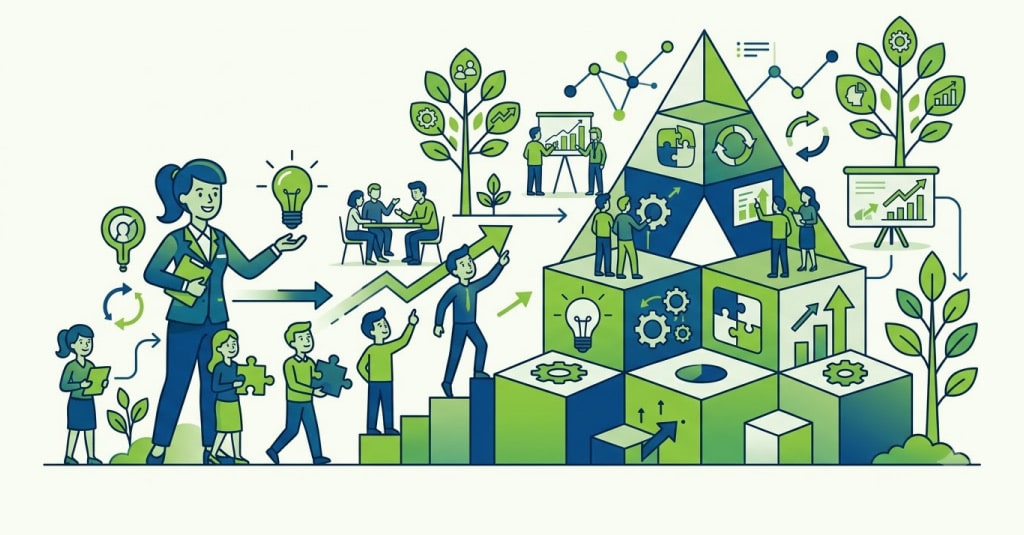
Think of individual skills as atoms. On their own, they represent useful knowledge or abilities, but they rarely produce meaningful performance.
Real impact happens when these atoms combine.
When skills are applied together in the right context and supported by tools, experience, and judgment, they form capability molecules that allow individuals and teams to perform effectively in real-world situations.
For example, selling a complex product rarely depends on a single skill. It requires product knowledge, negotiation ability, industry insight, communication skills, and the judgment to apply them at the right moment.
The eBook explores how organizations can design learning systems that allow these capability molecules to form, turning learning investments into measurable performance.


Inside the eBook: What You’ll Explore
Executive Summary
An overview of why organizations must rethink how learning contributes to real performance.
Chapter 1
Why skills-focused learning models plateau and why capability-driven approaches outperform them.
Chapter 2
Assessing Current State
How to identify the gap between knowledge and execution and evaluate the maturity of your learning ecosystem.
Chapter 3
Defining Enterprise Capabilities
How organizations can build capability frameworks using the atoms-to-molecules model.
Chapter 4
Mapping Gaps to Performance
How proficiency heatmaps and AI-driven insights reveal capability gaps.
Chapter 5
Designing for Performance
How simulations and capability academies convert skills into execution.
Chapter 6
The AI-Powered L&D Tech Stack
How organizations can evolve from LMS libraries to AI-enabled learning ecosystems.
Chapter 7
Sustaining the Shift
Why capabilities decay and how culture, leadership, and incentives sustain them.
Chapter 8
Measuring the Transformation
How to move beyond vanity metrics and track real performance outcomes.
Chapter 9
The AI-Augmented L&D Leader
How the role of L&D leaders is evolving from course creators to capability architects.
Chapter 10
The Action Plan Blueprint
A practical roadmap to launch capability pilots and demonstrate measurable results.

Who This eBook Is For
This guide is designed for leaders who want learning initiatives to drive real business outcomes.
- Business leaders focused on workforce performance and execution
- L&D professionals seeking to move beyond course creation
- Transformation leaders responsible for building capabilities at scale
If the goal is to build a workforce ready to navigate complexity and rapid change, this eBook provides a clear starting point.

Your Next Step
Course libraries alone will not define the future of learning.
Organizations that succeed will be those that turn courses into skills and skills into capabilities.

Download The Capability Transformation
Access the full eBook here

Frequently Asked Questions about Pharma Workforce Training
Pharma workforce skill readiness refers to employees’ ability to apply technical knowledge and regulatory procedures during real operational work. It focuses on execution capability rather than training completion, ensuring employees perform consistently in manufacturing, quality, and compliance environments.
Traditional training focuses on knowledge delivery and course completion. Employees learn procedures but rarely practice applying them in operational contexts. Without contextual training or performance feedback, organizations struggle to convert a learning strategy into reliable execution.
Skills represent individual knowledge units such as understanding GMP training principles. Capabilities combine multiple skills and apply them within operational workflows. Pharmaceutical environments require capabilities because employees must interpret procedures and act correctly during real manufacturing and quality scenarios.
Companies can build capability through contextual learning and scenario-based simulations. Expert-led training and capability mapping also help. Integrating learning with quality data reveals workforce skill gaps.
Capability-based metrics measure operational performance rather than training activity. Indicators such as time-to-proficiency, deviation reduction, and inspection readiness show training impact. They confirm whether employees apply procedures correctly in regulated operations.
Pharmaceutical workforce training programs stand at a turning point. Traditional knowledge-based training remains necessary for compliance documentation. However, knowledge delivery alone cannot ensure operational readiness.