




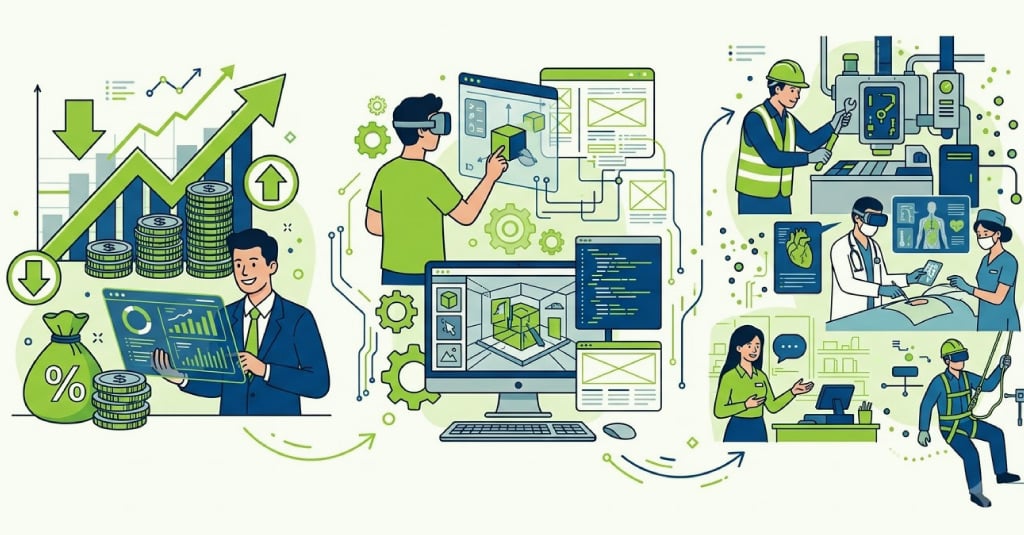
Virtual reality training works best for high-stakes, hands-on, or emotionally charged scenarios where practice in the real world is expensive, risky, or rare. Enterprise programs that pair VR with clear behavioral objectives can support practical skill development and decision-making in situations that are difficult to recreate through classroom or traditional eLearning. It is not a replacement for most compliance or knowledge-based training.
Every few years, a new technology shows up in the L&D conference circuit promising to fix training the way nothing else could. VR has been through that cycle more than once, and it has come out the other side with a clearer use case: not every learning problem needs immersion, but some benefit significantly from it.
That leads to a more useful question for L&D leaders. Instead of asking, “Does VR training work?” ask, “Does my use case match what VR is actually good at?”
This blog walks through where VR training earns its place, what the research tells us, the design choices that separate a memorable demo from a program that changes behavior on the job, and how to build a business case that survives a CFO’s second read.

Where Virtual Reality Training Works and Where It Doesn't
Here’s the mistake we see most often. A learning team gets budget approval for VR, then goes looking for a use case to justify the spend. That’s backward, and it’s one reason pilots can struggle to move beyond an initial cohort.
3 Conditions for Virtual Reality Training
VR earns its cost when three conditions line up:
- The skill involves a physical or interpersonal action, not just information recall.
- Practicing the real version is expensive, dangerous, or logistically hard to arrange.
- Repetition matters, and the learner needs to fail safely before they perform.
Compliance refreshers, policy updates, product knowledge, and most onboarding content fail this test. Reading a policy doesn’t get better in a headset. You’re paying for immersion the content doesn’t need.
Equipment training, emergency response, difficult conversations, and customer-facing scenarios pass the test more easily. These are the cases where a manager may need to practice de-escalating an angry customer repeatedly before the real version happens once, or where getting a procedure wrong in a simulation carries no real-world consequence.
The filter is simple: If the learning objective is “know this,” don’t automatically build VR. If the objective is “do this, under pressure, correctly,” VR starts to make sense.
Also Read: VR Safety Training in the USA: Enterprise Buyer’s Guide 2026

VR Training Use Cases That Have Earned Their Place in Enterprise L&D
A handful of categories are particularly well suited to immersive learning because they involve physical practice, realistic decision-making, or situations that are difficult to reproduce safely.
Equipment and procedural training.
Manufacturing, aviation, energy, and healthcare can use VR to train on machinery and procedures that are too costly or too dangerous to practice repeatedly on the actual equipment. A trainee can repeat a startup sequence in a simulated environment without risking equipment damage or injury.
Leadership and management training.
VR leadership training can put new managers through scenarios such as performance conversations, difficult employee discussions, and conflict mediation, with a virtual counterpart that responds to the learner’s choices. The value comes from giving managers a safe environment to practice conversations that can be difficult to recreate consistently in the workplace.
Customer-facing soft skills.
Sales negotiation, service recovery, and de-escalation training benefit from repetition under realistic pressure. Field reps can rehearse a difficult client conversation before they encounter a similar situation with a real customer.
Safety and emergency response.
Fire evacuation, hazardous material handling, and other high-risk scenarios are natural fits because organizations cannot always run realistic live drills frequently enough to build confidence and competence.
Interpersonal and communication skills.
VR can create immersive scenarios that allow learners to practice responding to challenging situations and then reflect on their decisions. The effectiveness depends heavily on scenario design, facilitation, and the connection between practice and workplace behavior.
Outside these use cases, high-quality simulation-based eLearning may be a more practical option when the learning objective does not require immersive or physical practice.

What the Research on VR Soft Skills Training Actually Proved
The research on VR for soft-skills training is becoming more focused. A 2025 literature review of 33 papers on VR-based soft-skills training examined the types of skills targeted, the VR technologies used, training approaches, and methods for evaluating effectiveness. The review shows that VR is being actively explored as a tool for developing soft skills while also highlighting gaps in how these interventions are designed and evaluated.
Recent research also provides evidence on social-skills development. A 2025 systematic review of VR interventions for social skills examined 31 studies and found potential benefits across the research reviewed, while also identifying limitations in the existing evidence and the need for stronger research.
A separate 2025 empirical study on social-skill acquisition in immersive VR used a preregistered, multi-wave intervention and found positive long-term effects on task-related self-efficacy and anxiety. The effects were similar to those produced by chat-based training, although the VR intervention was more time-efficient.
What this means for enterprise L&D is more specific than simply saying that VR improves soft skills. The recent evidence suggests that VR can create a useful environment for practicing social and behavioral skills, particularly when learners need to engage with realistic situations rather than simply read about them. But immersion alone is not enough. Scenario design, the behavior being practiced, feedback, and how learning is evaluated all influence the outcome.
For L&D leaders, the practical takeaway is to use VR where the learning objective requires practice, interaction, and behavioral application not simply because the technology is immersive.

Design Decisions That Determine Whether VR Training Transfers to the Job
A VR module can look impressive in a demo and still fail to change anything once people are back at their desks. The gap almost always comes down to a handful of design choices made early.
- Build for decisions, not scenery.
Learners should spend their time making choices with consequences, not walking through a beautifully rendered lobby. If a module has more environmental detail than decision points, the budget went to the wrong place.
- Match the difficulty curve to real variation.
Real customers, employees, and equipment failures don’t behave the same way twice. A module with one scripted path teaches a script, not a skill. Branching that reflects genuine variation is what makes the practice transferable.
- Keep the physical and cognitive load realistic.
If the interaction mechanics in VR are harder to learn than the skill you’re teaching, you’ve added a new obstacle instead of removing one. Controls should fade into the background quickly.
- Debrief every session. The immersive moment creates the experience, but the debrief helps learners reflect on what happened and connect the practice to their work. A manager who runs a difficult conversation in VR and then reflects on what they would change has a clearer opportunity to connect the practice to their work.
- Design for the manager, not just the learner.
VR leadership training works best when a manager’s coach or supervisor sees a summary of decisions made in the simulation, so coaching conversations afterward have something concrete to reference.
Skip any of these and you get a module people enjoy and remember fondly, without a measurable change in how they act on the job. That’s the gap between a good demo and a good training program.
Also Read: Immersive Learning: USA Enterprise Strategy Beyond the Headset

Proving VR Training ROI Without Relying on Completion Data
Completion rates tell you very little about whether VR training worked. An immersive format can be engaging, but engagement alone does not demonstrate improved performance.
Build your business case around three categories instead:
Time-to-competency.
Compare how long it takes a new hire, manager, or technician to reach a defined performance standard with VR versus your current method. The important question is not simply how quickly learners finish the module, but whether they reach the required level of performance sooner.
Behavior change on the job.
Track a specific, observable action, such as a manager actually initiating a difficult conversation instead of avoiding it, or a technician following a safety procedure correctly during an audit. This requires manager input, observation, assessment, or performance data rather than an LMS completion report.
Cost per learner at scale.
Model the full cost of the program across the expected learner population. Include development, hardware, software, or platform costs, maintenance, content updates, facilitation, and learner time. Compare that with the cost of the current training approach rather than relying on a generic industry break-even point.
If your pilot cannot produce evidence across these categories, you have limited evidence for making a broader investment decision.

Key Takeaways & Conclusion
VR training earns enterprise budget when the skill is behavioral, the stakes are high, and repetition in the real world isn’t practical. Current evidence points to particular value in procedural training, safety-related practice, behavioral skills, and situations where realistic repetition is difficult to recreate in the workplace. For knowledge-heavy or lower-risk learning objectives, simulation-based eLearning may provide a more practical alternative to VR.
Effective VR programs share three things: a use case chosen for the right reasons, design built around decisions instead of production value, and an ROI model that goes beyond completion rates.
If you’re weighing a VR pilot against a simulation-based eLearning build, it’s worth getting both costed out before committing either way. Upside Learning’s team regularly works through that comparison with L&D leaders, scoping simulation-based eLearning against immersive formats based on the actual skill gap, not the format that’s trending.

FAQs
Potential outcomes include improved practical skill development, more opportunities for realistic practice, and better evidence of performance when simulations are tied to defined competencies. The timeframe for measurable results depends on the skill, learner population, training design, and performance measures being tracked.
Model the total cost of the program against your expected learner population, not just the pilot size. Include development, hardware, software or platform costs, maintenance, content updates, facilitation, and learner time. Then pair the financial model with a specific, observable performance metric rather than completion data alone.
VR is particularly relevant for physical procedures, safety drills, and emotionally charged interpersonal scenarios where realistic repetition is costly or difficult to arrange. Simulation-based eLearning may be more appropriate for decision-heavy but non-physical content such as sales strategy, compliance judgment calls, or process training.
Hardware is only one part of the cost equation. Organizations should also consider content development, platform or licensing costs, device management, technical support, content updates, and deployment logistics.
Run one scenario against a matched control group using your current training method. Measure time-to-competency, performance against defined skill criteria, and at least one observable on-the-job behavior. Use those three numbers, not satisfaction scores, to make the scale-up decision.