




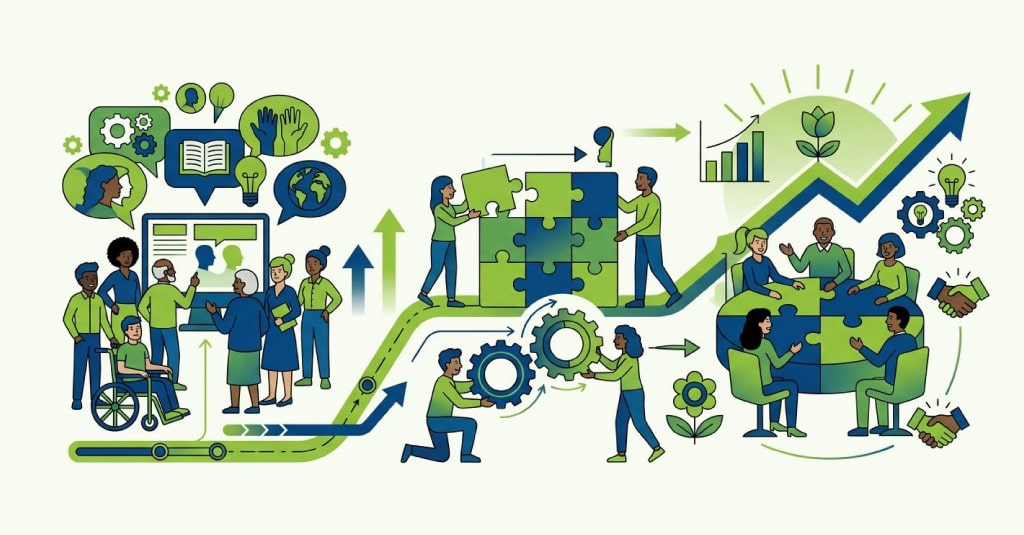
DEI training programs work when they move past one-time awareness sessions and build skills people use every day, things like running a fair meeting, giving unbiased feedback, and speaking up when something feels off. The programs that actually shift behavior combine short, scenario-based learning with manager coaching, and they get measured against inclusion outcomes, not completion rates.
Most CHROs we talk to have already run a DEI training program. Some have run three or four. And yet, according to SHRM’s 2025 State of the Workplace report, just 47% of US workers say their organisation’s inclusion and diversity efforts are effective or very effective. That’s after years of investment.
This isn’t an argument against DEI training. It’s an argument for building it differently. The rest of this piece looks at why so much training stalls at awareness, where unconscious bias training genuinely helps, and how to design and measure a program that changes what people actually do at work.

Why DEI Training Programs Don't Always Change Behavior
DEI training programs usually fail to change behavior because they’re built to deliver information, not to build a habit. A two-hour session on inclusive language is easy to schedule, easy to track, and easy to forget by Friday.
There’s also a harder problem, and it’s one CHROs don’t always see coming: mandatory training can backfire. In their well-known Harvard Business Review study, sociologists Frank Dobbin and Alexandra Kalev spent nearly three decades tracking diversity efforts at more than 800 US firms. Five years after companies made diversity training mandatory for managers, they saw no improvement in the representation of white women, Black men, and Hispanic employees in management, and the share of Black women in management actually fell by 9%, on average. Voluntary training told a different story. It led to increases of 9% to 13% in management representation for Black men, Hispanic men, and Asian-American men and women over the same five years.
The mechanism is simple once you see it. Compulsory training reads as control. People resist being controlled. Trainers routinely report that employees respond to required courses with anger, and some come away feeling more animosity toward other groups, not less.
None of this means training doesn’t work. It means the delivery model matters as much as the content, and a program built around completion rates will keep producing certificates without producing change.

Moving From Diversity Training Programs to Everyday Inclusion
The organisations getting real traction have stopped treating diversity training programs as an event and started treating inclusion as a set of daily habits.
Here’s what that looks like in practice. Instead of one annual session, inclusion shows up in the moments that already happen every week:
- How a manager runs a hiring debrief and pushes back on "culture fit" as a proxy for sameness
- How feedback gets delivered in one-on-ones, with specific, behavior-based language instead of vague impressions
- How meetings get facilitated, so the same three voices don't dominate every discussion
- How promotion decisions get documented, so criteria are visible and consistent
Workplace inclusion training built this way doesn’t compete with a manager’s calendar. It sits inside the work managers are already doing. A short module before a hiring debrief. A prompt inside the performance review tool. A five-minute scenario before a difficult conversation. Each touchpoint reinforces the last, which is exactly what a single long session can’t do.

Where Unconscious Bias Training Can Make a Difference
Unconscious bias training works when it’s specific, voluntary where possible, and tied to a real decision, not when it’s a standalone awareness session.
Generic bias training that just names biases and hopes for self-correction has a well-documented limit: people forget the concepts within weeks, and awareness alone rarely changes behavior under pressure, like during a fast hiring decision or a tense performance conversation.
What works better is pairing bias training with a structural checkpoint. Teach a hiring manager about anchoring bias right before they use a structured interview rubric. Teach a promotion committee about affinity bias right before they review a slate using standardised criteria. The training gives people the “why.” The structure gives them the “how,” and it removes the option to fall back on gut instinct once the session ends.
This is also where the voluntary-versus-mandatory finding from the Dobbin and Kalev research matters again. Where possible, frame bias training as something managers opt into as part of a broader capability track, rather than a compliance checkbox everyone is forced through on the same day.
Also Read: New Employee Training Plan: Build Productivity from Day One

Designing Effective Diversity Training Programs as DEI eLearning
Good DEI eLearning is built around scenarios employees actually face, not abstract principles they’re expected to apply on their own later.
Awareness vs Behavior-Focused Diversity and Inclusion Training
Scroll right to read more.
| Awareness-only training | Behavior-focused DEI eLearning |
|---|---|
| One long session, once a year | Short modules, spaced over time |
| Defines concepts (bias, privilege, inclusion) | Practices specific responses to real situations |
| Same content for every role | Manager and employee tracks differ |
| Success measured by completion | Success measured by applied behavior |
| Delivered once, rarely revisited | Reinforced through nudges and refreshers |
Design Principles of DEI eLearning
A few design principles consistently separate the DEI eLearning that sticks from the DEI eLearning that gets clicked through:
Build for the moment of use: A manager needs different skills than an individual contributor. Manager tracks should focus on decisions, hiring, feedback, promotion. Employee tracks should focus on everyday interactions and speaking up.
Use scenarios, not slides: Branching scenarios that let someone practice a difficult conversation, and see how different responses play out, build muscle memory in a way that reading a definition never will.
Keep it short and spaced: Ten minutes a month beats two hours once a year. Spacing gives the brain time to consolidate the skill instead of forgetting it before it’s ever used.
Getting this right at scale, across roles, regions, and languages, is usually where internal teams run out of capacity. That’s often when eLearning content development gets outsourced to a partner who can build the scenario library once and adapt it across the organisation.

Measuring Diversity Training Programs with Custom eLearning Development Services
The most useful DEI training metrics track behavior and outcomes, not attendance. Completion rates tell you who showed up. They don’t tell you whether anything changed.
Diversity and Inclusion Training ROI Measures
A more useful measurement stack looks at three layers:
- Applied skill. Are managers using structured interview rubrics consistently? Are performance reviews citing specific behaviors instead of vague traits?
- Inclusion signals. Are pulse survey scores on belonging and psychological safety moving? Are exit interviews citing inclusion as a reason for leaving less often?
- Outcome trends. Are promotion rates across groups converging? Are bias-related grievances trending down rather than simply staying unreported?
This is where custom eLearning development services earn their keep. When measurement gets designed into the program from the start, rather than bolted on afterward, you can tag each module to a specific behavior, track it against manager scorecards, and show the board something more convincing than a completion dashboard. A generic, off-the-shelf course can’t do this because it wasn’t built around your organisation’s specific roles, decisions, or data systems.

Key Takeaways & Conclusion
DEI training programs don’t fail because DEI is hard to teach. They fail because most programs are built to deliver a session, not to build a habit. The research is fairly consistent on what works better: shorter, scenario-based learning; training that people opt into where possible; bias training paired with structural checkpoints; and measurement that tracks behavior and inclusion outcomes instead of completion.
If you’re evaluating your own program right now, the honest question to ask isn’t “did people finish the course.” It’s “what decision does this training change, and how will we know.” If you’re not confident in the answer, that’s usually the starting point for a redesign, not a bigger training budget.
Upside Learning works with CHROs and L&D leaders on exactly this kind of behavior-focused DEI training design, from scenario-based eLearning to the measurement frameworks that prove it’s working. If you’re rethinking your approach, it’s worth a conversation before your next training cycle rather than after.

FAQs
Anchor training to specific decisions, like hiring, feedback, and promotions, rather than general awareness. Use short, scenario-based modules paired with structural tools like interview rubrics, and measure applied behavior and inclusion metrics rather than completion rates.
Present behavior and outcome metrics, not completion data: promotion rate convergence, retention among underrepresented groups, and reduced bias-related grievances. Cite that only 47% of US workers currently rate their organisation’s DEI efforts as effective, per SHRM’s 2025 research, framing the investment as fixing a measurable gap.
Short, spaced, scenario-based eLearning consistently outperforms one-off sessions because it lets employees practice real decisions and reinforces skills over time. AI roleplay adds value for high-stakes conversations, like giving difficult feedback, where practice before the real moment matters most.
Track three layers: applied skill (rubric use, feedback quality), inclusion signals (pulse survey scores on belonging), and outcome trends (promotion parity, grievance trends). Tie each training module to a specific metric at the design stage, not after launch.
Make participation voluntary where possible; Research published by Harvard Business Review found mandatory training can trigger backlash while voluntary training improved outcomes. Use realistic scenarios instead of lectures, and frame sessions around practical skills like giving feedback, not around correcting individual attitudes.