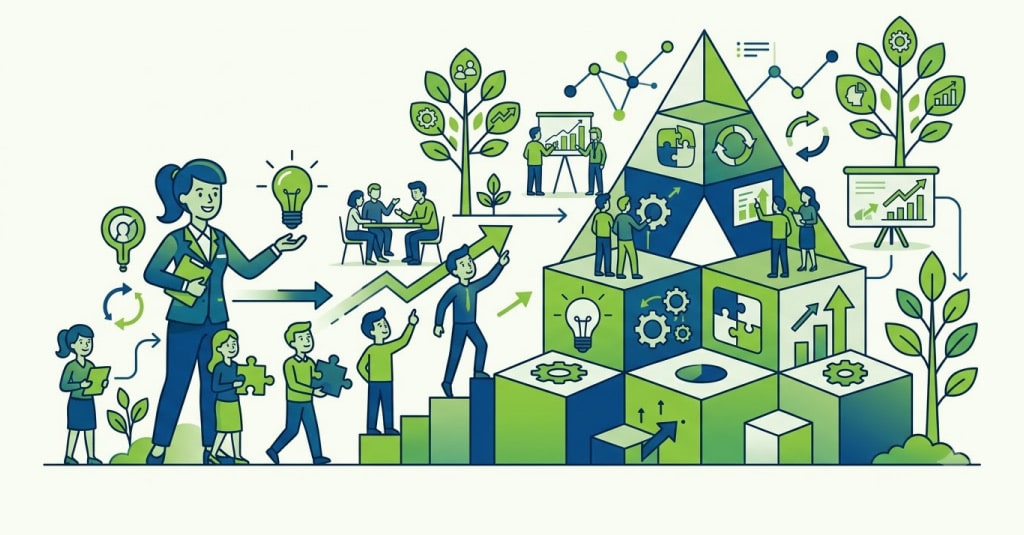




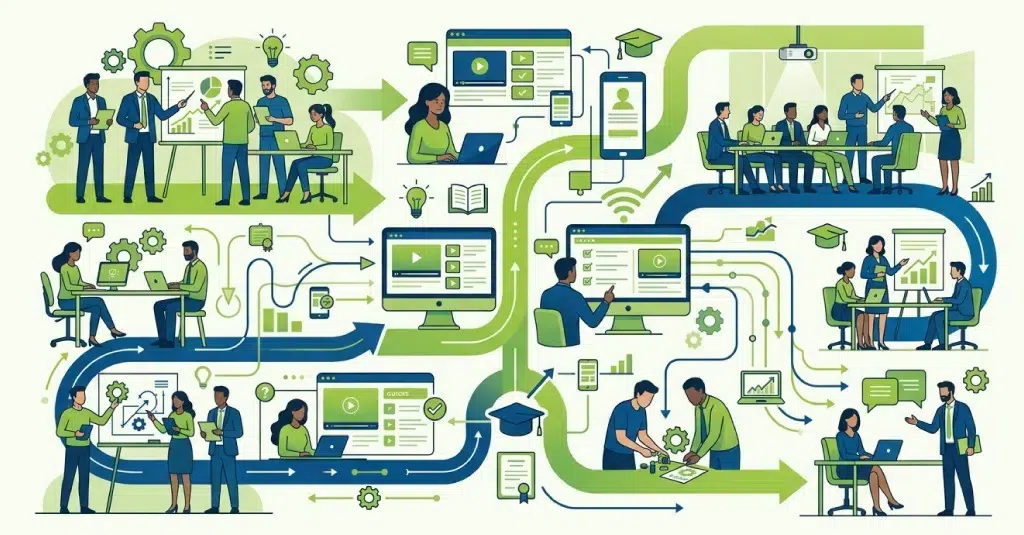
Defining blended learning in an enterprise context starts with the structured integration of learning modalities designed around specific performance outcomes. Many programs fail because they focus on combining formats such as ILT, eLearning, and webinars instead of driving behavior change. An effective strategy defines outcomes, maps the full learner journey, aligns each modality to the right moment, enables managers, and establishes measurement before content is created.

Why Most Enterprise Blended Learning Strategies Fail
Here’s what most enterprise blended learning strategies actually look like: an ILT session on Monday, an eLearning module on Wednesday, and a webinar at the end of the month. Someone calls it a blend, puts it in the LMS, and declares the program complete.
That’s not a strategy. That’s a content schedule with good intentions, and it fails to deliver the real benefits of blended training.
The organizations that struggle with blended learning aren’t failing because they lack content or tools. They’re failing because they started with modalities instead of outcomes. They asked, “What format should this be?” before asking, “What behavior needs to change?”
At an enterprise scale, the cost of that mistake compounds fast. You’re not retraining 50 people. You’re deploying learning across thousands of employees, multiple geographies, and dozens of roles, often with fragmented technology and competing stakeholder priorities. Getting the architecture wrong at the beginning means rework, wasted spend, and learning that never shows up on the job.
Blended learning at an enterprise scale requires architectural thinking, not content scheduling.

Challenges of Blended Learning Strategy at Enterprise Scale
What works for a mid-sized team rarely survives contact with enterprise complexity. A few reasons why:
Scale changes the design logic. A program that works beautifully for 50 learners starts breaking at 5,000. Facilitation bottlenecks, inconsistent delivery, and unmanageable cohort sizes all surface quickly. The design has to account for that from day one.
Geography and time zone distribution make ILT-first strategies impractical. Global workforces can’t wait for a live session that works for one region. Synchronous learning has a real place in the blend, but it can’t be the default.
Role diversity makes a single blended strategy a contradiction. A frontline operations team and a senior leadership cohort don’t share learning needs, time availability, or how they apply new skills. Treating them the same way produces mediocre outcomes for both.
Your technology stack probably doesn’t connect cleanly. LMS platforms, VILT tools, content authoring systems, and performance support applications were often purchased independently. They don’t always share data, which means your visibility into learner progress is fragmented by design.
Stakeholder fragmentation creates competing definitions of success. L&D, HR, IT, and business unit leaders often want different things from the same program. Without a shared performance framework, the blend gets designed to satisfy everyone and measures nothing clearly.

How to Design a Blended Learning Strategy for Enterprises
A well-designed enterprise blended learning strategy starts well before any content is built. Here’s the architectural approach that holds up at scale:
Step 1: Define the Performance Outcome
Before choosing a format, answer three questions: What behavior needs to change? What decision needs to be made better? What skill does it need to show up on the job? Once you have those answers, the modality follows naturally. Without them, you’re just guessing.
Step 2: Map the Learner Journey
There’s a meaningful difference between a content calendar and a blended curriculum designed as a learning journey. A journey includes what happens before formal learning begins, what structured touchpoints exist during it, and how reinforcement and application are built afterward. Most programs skip the before-and-after. That’s where the learning transfer actually happens.
Step 3: Match the Modality to the Learning Moment
Not every moment calls for the same format:
- New information and concept introduction: structured eLearning or VILT
- Practice and application: simulations, role-play, scenario-based exercises
- Reinforcement: microlearning, spaced repetition, performance support tools
- Collaboration and judgment development: live cohort sessions, peer learning
- On-the-job reference: job aids and searchable resources in the flow of work
Step 4: Design for the Manager Layer
This is where most corporate training programs quietly fail. The content is solid, the delivery is clean, and then learners go back to their teams, and nothing changes. Why? Because their managers weren’t part of the strategy. Managers who don’t reinforce new skills on the floor undo weeks of learning within days. Any blended strategy that doesn’t include a manager enablement layer is incomplete.
Step 5: Build the Measurement Architecture Before Building the Content
Define what success looks like at Week 1, Month 3, and Month 12. Identify which behaviors, decisions, or performance metrics will indicate that learning has transferred. Then design content to move those indicators. Measurement added after delivery is almost always partial and often disconnected from the outcomes the business actually cares about.

When to Use ILT vs eLearning in a Blended Learning Strategy
Instructor-led training isn’t the problem. The problem is undifferentiated ILT, applied to every learning need regardless of fit.
When ILT Earns Its Place
There are things ILT does that digital formats genuinely can’t replicate: real-time calibration of complex judgment calls, high-stakes role-play with immediate feedback, and peer dialogue that surfaces assumptions and shifts perspective. For leadership development, compliance with significant consequences, or any learning that involves nuanced human interaction, ILT is the right choice.
When ILT Should Be Replaced
It should be replaced for straightforward knowledge transfer, product update rollouts, compliance information delivery, and anything where the learning goal is awareness or recall rather than application. These are better served by structured eLearning, which learners can complete on their own time and revisit when needed.
The VILT Middle Ground
VILT sits between ILT and self-paced digital learning, and it deserves honest evaluation. When VILT is thoughtfully redesigned for the medium, with breakout sessions, collaborative activities, and shorter, more focused runtimes, it works well. When it’s just ILT delivered over Zoom with everyone’s cameras off, it doesn’t. The format change isn’t the redesign. The redesign is the redesign.

Technology Requirements for an Enterprise Blended Learning Strategy
A blended learning strategy is only as strong as the infrastructure connecting it.
Where Most Enterprise LMS Setups Fall Short
Most enterprise L&D teams are designing workarounds for LMS limitations rather than addressing them directly. Data sits in silos. Completion records don’t tell you whether learning transferred. Reporting answers questions about activity, not performance.
How xAPI Changes What’s Measurable
xAPI and learning record stores change what’s measurable. When implemented well, they allow organizations to capture learning activity across platforms and connect it to performance data in ways that traditional SCORM tracking never could. That visibility is what makes impact measurement credible rather than anecdotal.
Partnering for Infrastructure Capability
Organizations working with a learning partner like Upside Learning, which combines instructional design expertise with managed technology services, can close the gap between strategy and infrastructure without building that capability from scratch internally.

Common Blended Learning Strategy Mistakes in Enterprises
Designing for the Average Learner
At an enterprise scale, no such person exists. The blend has to accommodate real variation in role, experience level, access to technology, and available learning time. A one-size program delivers diluted results across every segment.
Treating VILT as a Direct ILT Replacement
Swapping ILT for VILT without redesigning for the medium produces poor results and erodes learner trust in digital formats. The platform changes. The experience has to change with it.
Skipping the Reinforcement Layer
Without spaced practice and application prompts, retention drops sharply. Learning evaporates within days if there’s no reinforcement built into the journey after formal delivery ends.
Retrofitting Measurement After Delivery
Building the blend first and figuring out measurement later guarantees you’ll be unable to defend the investment when leadership asks what changed. Define success before a single module is built.
Underestimating Manager Readiness
In most organizations, manager readiness is the single biggest predictor of transfer failure. If managers aren’t equipped and motivated to reinforce learning on the job, even a well-designed program will stall at the team level.
Key Takeaways
- Blended learning at enterprise scale is an architectural problem, not a scheduling one
- Start with performance outcomes, not modality choices
- Design for the full learner journey, including what happens before and after formal learning
- Build manager enablement into the strategy from the start, not as an afterthought
- Define measurement criteria before content is built, not after delivery
- VILT requires redesign for the medium, not just a platform switch from ILT
- Technology infrastructure must connect the blend, not silo it
A well-designed blended learning strategy connects learning to real business outcomes. At an enterprise scale, this requires architectural thinking, integrated technology, and a focus on measurable performance. At Upside Learning, we help organizations build learning ecosystems that deliver impact across complex workforces. Talk to our experts to design a strategy that drives real results.

Frequently Asked Questions
Blended learning meaning in an enterprise context refers to the structured combination of learning modalities such as eLearning, VILT, microlearning, and performance support. It is designed around business outcomes and scaled for large, distributed workforces. The focus is on performance impact, not format variety.
Blended learning combines multiple learning modalities over time to support a complete learning journey. Hybrid learning refers to a setup where some learners attend in person while others join remotely at the same time. The two serve different design purposes.
Blended learning effectiveness is measured through behavior and performance indicators defined before the program begins. These are tracked at intervals such as one week, three months, and twelve months after training. Completion rates measure participation, not impact.
Enterprises should replace ILT with eLearning when the goal is knowledge transfer, awareness, or recall. It works well for product updates, compliance training, and onboarding. ILT should be retained for complex skills, decision-making, and interpersonal learning scenarios.
A blended learning strategy requires an LMS for delivery and tracking, a VILT platform for live sessions, and content authoring tools. Advanced setups also use xAPI and a learning record store to unify data. Integration across systems is more important than the number of tools.