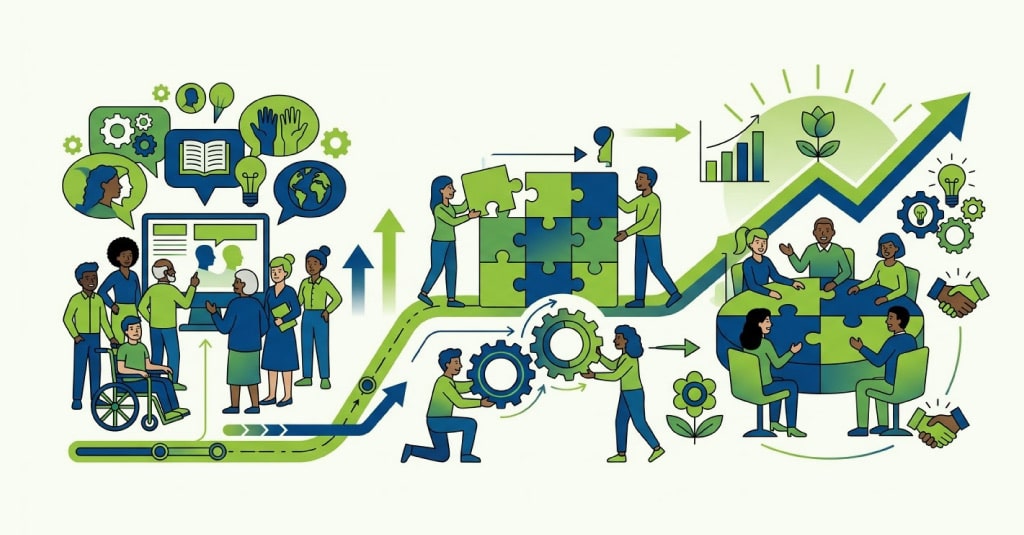


Learning agility is the ability and willingness to learn from experience and apply those lessons in unfamiliar situations. Research has linked it to leadership performance and potential, making it useful for succession planning and leadership development. However, it should complement performance history, behavioral evidence, and role-specific assessments rather than determine leadership readiness on its own.

Introduction: Why Past Performance Stops Predicting Leadership Success
A high-performing regional sales director moves into a COO role. Within a year, decisions slow and the team loses confidence. The director hasn’t stopped working hard. The new role simply demands capabilities that the previous one never tested.
This is a familiar challenge for CHROs and talent leaders. Organizations need successors who can handle changing business models, unfamiliar stakeholders, and decisions without established answers. Yet talent reviews still rely heavily on past results and competency frameworks.
These tools remain useful, but they answer different questions. Performance shows what someone has achieved. Competency assessments examine specific capabilities. Neither alone reveals how a person will respond when the job changes significantly.
Learning agility adds another dimension to leadership potential: how people learn, adapt, and change their approach when experience no longer provides a ready answer.

What Is Learning Agility and Why Does It Matter for Leadership Success?
Learning agility is the willingness and ability to learn from experience and apply those lessons in new or challenging situations. The concept is associated with the work of Michael Lombardo and Robert Eichinger and has become widely used in leadership development and talent management.
A 2019 meta-analysis of 20 field studies reported strong relationships between learning agility and leader performance (ρ = 0.74) and leadership potential (ρ = 0.75). These findings support its relevance, but they should not be interpreted as proof that learning agility alone predicts future success or outperforms every other predictor.
There is also an important qualification. Researchers have raised concerns about inconsistent definitions and the validity of different assessment tools. A 2024 review of learning agility measures identified continuing questions about how the construct is defined and measured.
For enterprise talent leaders, the practical conclusion is clear: learning agility is a useful signal, not a verdict. Its value depends on how well the assessment reflects the role, the evidence collected, and the other factors considered in the decision.

The Five Dimensions of Learning Agility for Enterprise L&D
A commonly used framework, associated with Lombardo and Eichinger’s work, describes five dimensions of learning agility. They provide a useful starting point for leadership development, although specific models and assessment tools may differ.
Scroll right to read more.
| Dimension | Observable behavior | Development opportunity |
|---|---|---|
| Mental agility | Questions assumptions and connects ideas across problems | Cross-functional problem-solving |
| People agility | Adapts to different perspectives and working styles | Cross-team assignments and coaching |
| Change agility | Experiments and responds constructively to unfamiliar situations | Pilots and stretch assignments |
| Results agility | Delivers outcomes under new or difficult conditions | Time-bound assignments with clear goals |
| Self-awareness | Seeks feedback and adjusts behavior | 360-degree feedback and structured reflection |
Don’t simply average the five dimensions into a single score. A leader who delivers results but repeatedly ignores feedback may struggle when a new role requires a different approach.
Instead, examine the profile against the demands of the target role. The question isn’t whether every leader must score highly on every dimension. It’s which capabilities the next role requires and whether the person has demonstrated them.
Also Read: Outsourcing L&D: What Managed Learning Services Really Deliver

How US Enterprises Assess Learning Agility in High-Potential Employees
A learning agility assessment is most useful when combined with evidence from real situations. No single score should determine whether an employee is ready for a senior role.
A practical assessment process uses three sources of evidence.
1. Structured assessments
Use an assessment with documented reliability and validity evidence. Understand what it measures, how its results should be interpreted, and whether the framework fits your intended decision. Don’t assume different commercial tools measure learning agility in the same way.
2. Behavioral interviews
Ask candidates about situations where they lacked a playbook.
Useful questions include:
- Tell me about a decision that didn't work. What did you change afterward?
- When has feedback challenged your view of your own performance?
- Describe a situation where you had to learn an unfamiliar function quickly.
Look beyond polished answers. Ask what the person actually did, what evidence changed their thinking, and whether the lesson influenced later behavior.
3. Observed behavior
Review performance in stretch assignments, cross-functional projects, and situations involving uncertainty. Compare manager observations with peer feedback and documented outcomes.
Calibrate findings across business units so that one manager’s definition of potential doesn’t become another manager’s definition of readiness.
This approach gives talent reviews a more complete picture of high-potential employees than self-report scores alone.

Designing Development Programs That Build Learning Agility
Learning agility develops through experience, feedback, and changes in behavior. A course can introduce a concept, but it cannot establish how a leader will respond when familiar methods stop working.
Four elements should shape an effective leadership development program.
- Unfamiliar assignments: Give leaders responsibilities that require new skills or perspectives, not simply larger versions of their current workload.
- Structured reflection: Ask participants to identify assumptions, decisions, outcomes, and lessons after important milestones.
- Coaching and feedback: Help leaders examine blind spots and test alternative approaches.
- Room to experiment: Define acceptable risks and establish support before assigning work in unfamiliar territory.
Individual Development Plan Example for Leadership
Consider a director preparing for a general manager role.
- Development goal: Improve change agility and cross-functional decision-making.
- Assignment: Lead the integration of an acquired team's reporting process.
- Support: Work with an executive coach and a sponsor from another function.
- Reflection: Review decisions and feedback at 30, 90, and 180 days.
- Evidence of progress: The director adjusts the approach based on stakeholder feedback, resolves implementation issues, and achieves agreed process outcomes.
The assignment matters because it tests the capability being developed. Reflection and feedback help the leader identify what worked, what didn’t, and what to change next time.
This is more useful than enrolling every high-potential employee in the same leadership and management training programs.

Learning Agility and Succession Planning Training: Connecting the Dots
Learning agility should be evaluated in relation to the distance between a person’s current role and the role they may inherit.
This role-novelty framework is a practical decision aid, not a validated scoring formula.
Scroll right to read more.
| Target role | Evidence to prioritize |
|---|---|
| Low novelty: promotion within the same function | Performance history, functional expertise, and readiness for broader responsibility |
| Medium novelty: new region, team, or stakeholder group | Relevant agility dimensions, adaptability, and experience working across boundaries |
| High novelty: new business, turnaround, or unfamiliar operating model | Evidence from first-time situations, learning from setbacks, and adapting decisions under uncertainty |
For example, a successful sales leader moving into a larger regional role may have relevant experience to draw on. The same person moving into operations may need to demonstrate different capabilities, such as process management, cross-functional coordination, and decisions involving unfamiliar constraints.
The assessment should reflect that difference.
Succession planning training should therefore help managers distinguish current performance, demonstrated potential, and readiness for a specific role. Once a gap is identified, the individual development plan should provide experiences that address it.
Add one question to your next talent review: What evidence shows this person can succeed when the next role demands something different?

How Upside Learning Supports High-Potential Development for US Enterprise Clients
Identifying learning agility is only part of the challenge. Organizations also need development experiences that help leaders practice unfamiliar decisions and demonstrate changes in behavior.
Upside Learning, a division of Mitr Learning & Media, supports enterprise organizations through learning design, development, and consulting.
- Learning and development consulting: Upside Learning’s consultancy services help organizations identify learning needs and establish clear objectives before designing interventions.
- Custom competency frameworks: Learning experiences can be aligned with role-specific behaviors and capability gaps, giving development programs a clearer connection to leadership requirements.
- Practice-based learning: Custom learning design and development can incorporate scenarios and simulations that let leaders work through unfamiliar decisions and receive feedback.
- Measurement and performance support: Learning analytics and follow-up assessments can help organizations examine participation, demonstrated behavior, and progress toward defined outcomes.
The aim is to connect leadership development to the demands of the role, rather than treating course completion as evidence of readiness.

Key Takeaways and Conclusion
Learning agility can strengthen leadership development and succession planning, but only when organizations use it carefully.
- Assess learning agility alongside performance and role-specific evidence.
- Examine individual dimensions rather than relying on an overall score.
- Use structured assessments, behavioral interviews, and observed behavior.
- Develop agility through unfamiliar assignments, feedback, coaching, and reflection.
- Match development opportunities to the demands of the target role.
The most useful shift is from asking whether someone has performed well to examining how they respond when the next challenge requires something different.
If you’re reviewing your succession planning criteria, start with one critical role. Identify what will make that role unfamiliar to a potential successor, then examine whether your current assessment and development process captures the capabilities needed.
Upside Learning’s learning and development consulting can help organizations connect capability gaps with practical learning interventions and measurable outcomes.

FAQs
Learning agility is the ability and willingness to learn from experience and apply those lessons in unfamiliar situations. It helps talent leaders examine how employees may respond to new responsibilities, complementing performance history and other evidence when assessing leadership potential.
Organizations can combine validated assessments, structured behavioral interviews, and observations from challenging assignments. Using multiple sources provides a fuller picture of how employees respond to feedback, learn from setbacks, and adapt their behavior when familiar approaches no longer work.
CHROs can use unfamiliar assignments, executive coaching, structured reflection, and feedback to develop learning agility. Each experience should target a specific capability gap and include observable outcomes, so leaders can demonstrate whether they have changed their approach.
Examine how employees have handled situations beyond their usual responsibilities. Evidence of learning from setbacks, adapting decisions, seeking feedback, and delivering results under unfamiliar conditions can complement current performance when evaluating readiness for a different role.
Track changes in observed behavior, feedback from managers and peers, and performance on new assignments. Reassess progress over time and examine role-specific outcomes. Changes in assessment scores alone are insufficient to establish improved leadership performance.