



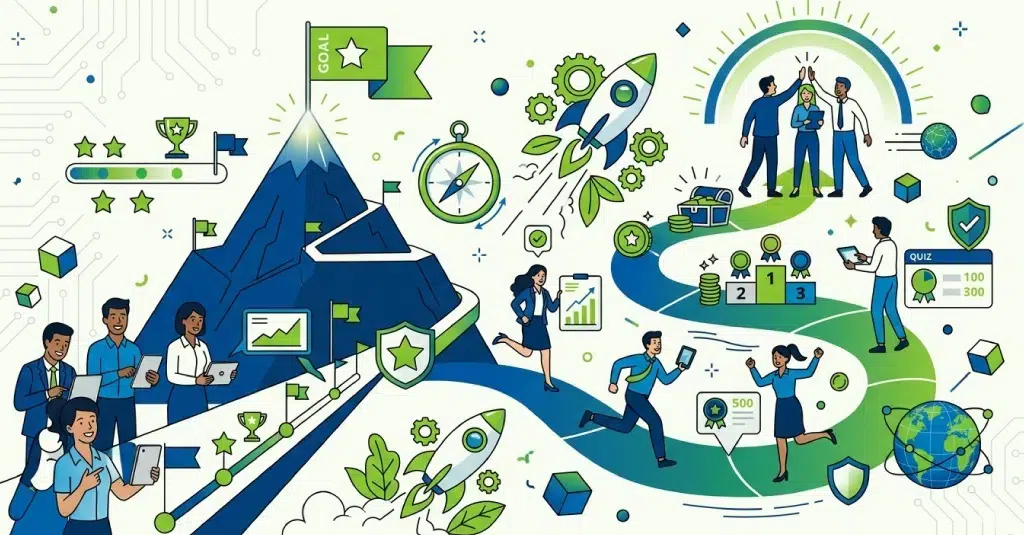
Gamification in corporate training uses game mechanics such as points, badges, leaderboards, and challenges to improve learner engagement and drive behavior change. It is different from game-based learning, which uses actual games as the training method. When designed effectively, gamification improves knowledge retention and measurable skill application.
Gamification in corporate training is one of the most discussed strategies in L&D. It is also one of the most misunderstood strategies. Organizations invest in it, yet results rarely match expectations. The gap between gamification and training outcomes often comes down to how well the strategy is designed.
Leaderboards get added to compliance modules that employees already disengage from. Badges are awarded for completing slides without real learning. Points accumulate, but they are not tied to meaningful outcomes. Engagement spikes briefly, then drops within weeks.
At Upside Learning, we see this gap across enterprise L&D programs. This guide takes a practical look at gamification. It covers what it actually is, where it creates measurable business value, where it falls short, and how to design it for real outcomes.

What Gamification in Corporate Training Actually Means
Gamification applies game mechanics to non-game contexts. In corporate training, this includes elements like points, progress bars, challenges, streaks, and rewards to guide how employees move through learning. The goal is not entertainment. The goal is behavior change.
Gamification is often dismissed as a gimmick, but it works because people respond to visible progress. Completing a challenge or reaching a milestone triggers dopamine, creating a sense of achievement and encouraging continued engagement.
Extrinsic motivators like points and badges drive initial participation. Long-term impact comes from intrinsic drivers such as mastery, autonomy, and purpose. Effective gamification connects both. These mechanics are only tools. The outcome depends on design. When gamification focuses only on rewards, it fails.

Gamification Toolkit: Core Mechanics for Corporate Training
Not every mechanic fits every learning objective. Selecting the right one starts with knowing what you’re trying to change.
Scroll the table to the right to read more.
| Mechanic | Best Used For | Caution |
|---|---|---|
| Points | Tracking effort and activities | Ineffective without meaningful rewards or progression |
| Badges | Recognizing milestone achievements and skill completion | Overuse reduces perceived value |
| Leaderboards | Sales training, competitive skill-building contexts | Can create anxiety in collaborative cultures |
| Progress Bars | Onboarding journeys, multi-module certification paths | Must reflect meaningful progress |
| Challenges | Deepening knowledge application, scenario-based decisions | Must be achievable — impossible challenges demotivate fast |
| Streaks | Building daily learning habits and microlearning consistency | Harsh penalties reduce engagement |
| Levels / Tiers | Leadership development, long-form upskilling programs | Requires depth in learning content |

Where Gamification in Corporate Training Genuinely Delivers Results
Gamification in Onboarding
Gamification helps structure onboarding journeys. Employees can see exactly where they are, what’s next, and what they’ve completed, reducing the cognitive load of starting somewhere new. Organizations that have structured onboarding with milestone-based progression report faster time-to-productivity and stronger 90-day retention.
Sales Enablement
Sales environments naturally align with competition. Leaderboards and performance-based challenges can reinforce product knowledge and selling skills when linked to real outcomes.
Compliance Training: Making Gamification in eLearning Work for Real Judgment
Gamification is often misused in compliance training. When designed well, scenario-based challenges improve decision-making and reduce risk. Adding challenge mechanics and decision branching converts passive compliance into active judgment-building.
Safety Training: Where Gamification in Corporate Training Reduces Real Risk
In safety-critical industries, simulation and decision-based mechanics serve a dual purpose: they replicate real stakes without real risk, and they build procedural memory through repetition in a controlled environment. Gamified safety training in manufacturing, construction, and healthcare has shown measurable reductions in incident rates compared to traditional instruction.
Leadership Development
Challenge-based progression requires leaders to demonstrate capability at one level before moving to the next. This approach is more effective than cohort-based programs that move everyone through the same content at the same pace, regardless of readiness. Gamification supports personalized progression, which is increasingly expected by high-potential employees.

Where Gamification in Corporate Training Fails — and Why It Keeps Happening
The failure modes are consistent enough that they’ve become predictable. Recognizing them before you build saves significant time and budget.
- Mechanics without meaning. Points and badges that have no connection to anything the learner actually cares about generate zero sustained motivation. If the reward doesn't matter to the person earning it, the mechanic is decoration.
- Gamification layered onto bad instructional design. Game mechanics cannot fix content that doesn't teach anything. Putting a leaderboard on a poorly designed course produces a more visible version of the same bad outcome.
- Leaderboards in the wrong culture. In teams where collaboration is the norm or where psychological safety is already fragile, public competitive rankings create anxiety, resentment, and disengagement. Leaderboards are context-dependent, not universally useful.
- Short-term engagement with no behavior change. Most failed gamification efforts produce an engagement spike at launch, followed by a drop to baseline within 30 to 60 days. This happens when the design targets novelty rather than sustained motivation.
- Measuring game activity instead of learning outcomes. Completion rates, points earned, and badges awarded are not learning metrics. If your success criteria stop there, you're measuring the game, not the training.

How to Build a Gamification Strategy for Corporate Training That Actually Works
The organizations that get real results from gamification share one consistent habit: they start with the behavior they want to change, not the mechanic they want to use.
1. Define the behavior change first
What specific action, decision, or habit do you want employees to demonstrate differently after training? That answer determines which mechanics are relevant. If the answer is vague, the design will be vague.
For example, if the goal is to reduce compliance violations, design scenarios that simulate real risks. If the goal is to improve sales performance, align mechanics with conversion behaviors.
2. Map mechanics to the motivation type
Not every learner is driven by competition. Some are motivated by mastery, some by social recognition, some by autonomy. A single-mechanic approach misses most of your audience. Map your learner segments to motivation types before selecting mechanics, and build enough variation to serve each segment.
3. Design for the learning journey, not the module
A single gamified module is not a gamification strategy. The engagement value comes from sustained progression across a learning journey. Such as multiple touchpoints, escalating challenges, and visible advancement over time. To gamify learning effectively, organizations need to think beyond isolated modules.
4. Build meaningful feedback loops
Feedback needs to be specific, timely, and connected to the learning objective. ‘You earned 50 points’ is not meaningful feedback. ‘You identified the compliance risk correctly — here’s why that matters in a real scenario’ is. Frequency matters less than relevance.
5. Define success metrics before launch
Decide in advance how you’ll measure behavior change, not just completion. That might mean post-training performance data, manager observation scores, incident rate reduction, or sales conversion improvement. Define the indicator, build the measurement mechanism, and report against it. Otherwise, you’re running a training program with no outcome accountability.
Key Takeaways
- Gamification is a behavior change tool, not an engagement feature.
- Points and badges drive short-term activity. Lasting impact comes from intrinsic motivation.
- Game mechanics are context dependent. The wrong choice can reduce engagement.
- Gamification cannot fix poor training content. It only amplifies what already exists.
- Completion rates and badges do not measure learning. Performance and behavior change do.
Ready to build a gamification strategy that delivers measurable business outcomes? Talk to the L&D consultants at Upside Learning about designing a program tied to real performance impact, not vanity metrics.

Frequently Asked Questions
Gamification in corporate training is the use of game mechanics such as points, badges, leaderboards, challenges, and progress tracking in workplace learning. It is designed to improve motivation and drive behavior change. The focus is on measurable performance improvement, not entertainment.
Gamification adds game mechanics to existing training content, while game-based learning uses actual games such as simulations or interactive environments as the learning method. Both require different design approaches and serve different learning objectives.
Yes, gamification improves learning outcomes when it is designed around clear behavior change goals. Poorly designed gamification leads to short-term engagement with no retention. Results improve when success is measured through behavior change, not completion rates.
The most effective gamification elements include progress bars, milestone-based journeys, scenario-based learning, and leaderboards. Their impact depends on how well they align with learner motivation and training goals.
Gamification success is measured through behavior change indicators such as performance scores, incident rates, sales conversion data, and observed behavior shifts. Metrics like completion rates and points earned do not reflect learning impact.
Industries such as healthcare, financial services, manufacturing, retail, and technology benefit the most from gamification. These sectors see strong impact due to compliance needs, safety requirements, and performance-driven roles.