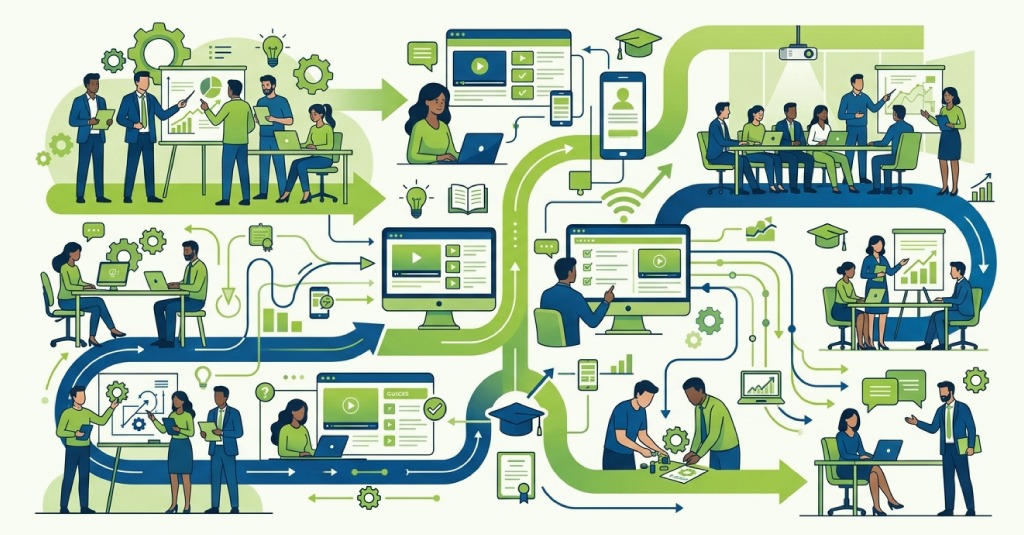




Here is a hard truth most L&D teams quietly know: you can build a beautiful learning journey, deploy it across thousands of employees, hit every completion target, and still see no measurable change in how people actually work.
That is not a content problem. That is a design problem.
The difference between a learning journey that builds skills and one that delivers training is architectural. Especially in the context of workforce upskilling and reskilling workforce capabilities. And most organizations, even sophisticated ones, skip the architecture entirely.

What Is a Skills-Based Learning Journey (And Why It Matters for Enterprise L&D)
A skills learning journey is a structured, multi-stage experience that takes employees from a diagnosed skill gap to measurable, on-the-job proficiency. It sequences learning, deliberate practice, reinforcement, and manager-supported application over time, anchored to a specific business outcome.
Learning Path vs Learning Journey vs Skills-Based Journey
A learning path organizes content for someone to consume. A learning journey engineers the conditions under which a skill is actually formed, transferred, and retained. The distinction is not semantic. It determines whether your investment changes behavior or just fills a training log.
Scroll the table to the right to read more.
| Learning Path | Learning Journey | Skills-Based Journey | |
|---|---|---|---|
| Structure | Sequence of content | Multi-stage experience | Architecture for skill formation |
| Goal | Content completion | Behavior change | Measurable on-the-job performance |
| Duration | Fixed | Time-bound | Milestone-based |
| Measurement | Completions | Behavior indicators | Skill application + business outcome |

The Learning Transfer Problem: Why Only 12% of Skills Are Applied on the Job
Research from training Industry estimates that only 12% of employees apply new skills from training on the job.
Twelve percent. After all, the budget, design effort, and deployment.
The response is to blame learner motivation or manager engagement. Both are real, but they are symptoms.
The root cause is that most learning programs are designed to teach skills, not build them. This is exactly why skills alone fail to deliver business impact in enterprise learning.

The Missing Foundation: Building a Skills Taxonomy for Learning Journey Design
Before you design a module or map a touchpoint, you need a skills taxonomy.
Not a competency framework. Not a list of training topics. A taxonomy that defines, categorizes, and sequences skills at the level required for design.
Without it, content becomes adjacent to skill development rather than targeted at weakening employee upskilling efforts. Journeys cover topics instead of building capabilities.
A minimum viable skills taxonomy includes:
- Skill definitions at behavioral, observable levels
- Skill dependencies (learning sequence)
- Proficiency levels with clear descriptors
- Mapping skills to roles, not just job titles
- A half-life estimate for how quickly each skill becomes outdated
This is not a one-time exercise. In regulated industries such as pharma, banking, and oil and gas, skills taxonomies need governance cycles. Skills change and journeys built on a static taxonomy become obsolete before they are measured.

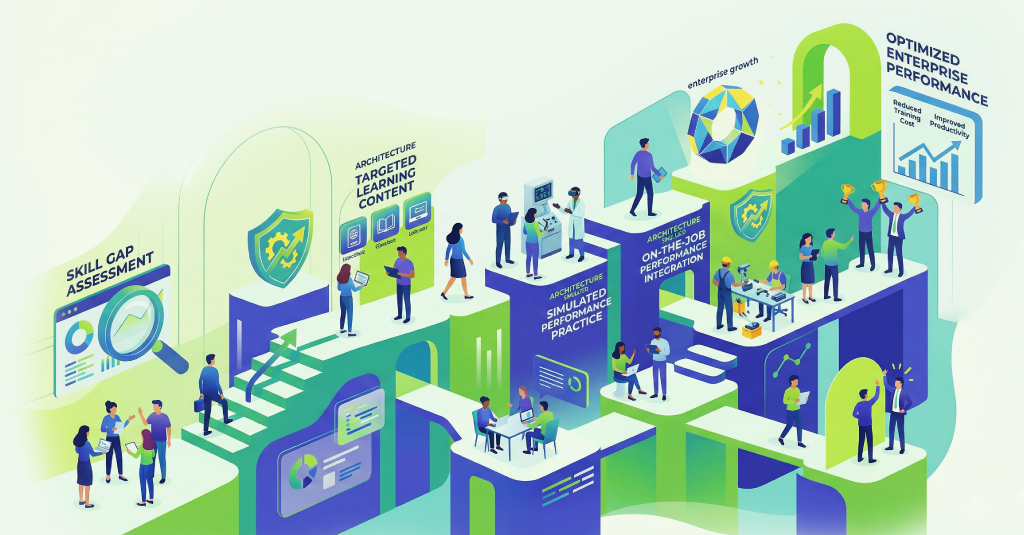
The 6-Layer Architecture for Designing Skills-Based Learning Journeys
Most journey design frameworks cover four or five steps and stop at content selection. The architecture below goes further, because that is where the real design work happens.
Layer 1: Skills Mapping and Gap Analysis
Start by diagnosing the gap precisely. Not “this team needs communication skills” but “this team struggles to give structured feedback in high-stakes conversations, supported by performance data.”
Skill gaps and knowledge gaps need different design responses. A knowledge gap requires information architecture. A skill gap requires practicing architecture. Conflating them is a common and costly mistake in L&D design.
Layer 2: Journey Architecture and Learning Experience Design
This is the structure of the journey, from activation through final verification of skill transfer.
A well-structured journey arc moves through these stages:
- Activation: Prime the learner. Create cognitive readiness before formal enterprise learning begins.
- Foundational input: Deliver conceptual and procedural knowledge. Keep this focused and stripped of content that does not build toward the target skill.
- Deliberate practice: Design structured repetition with feedback. Practice should be scaffolded, increase in difficulty, and connect to real work scenarios.
- Transfer: On-the-job application assignments built into the journey as non-negotiable stages.
- Verification: Observable on-the-job evidence of skill transfer, not test scores.
Layer 3: Right Learning Modalities for Skill Development
Not all modalities build skill types equally. Technical and procedural skills require simulation, practice environments, and coached repetition. Leadership and interpersonal skills require scenario-based learning, peer feedback, and application in live environments.
The choice of modality should follow the skill type, not the content library or LMS platform.
Layer 4: Designing for Learning Transfer and On-the-Job Application
This is the layer that separates effective journeys from those that only look good on paper.
Transfer design means engineering what happens between formal learning: on-the-job assignments, manager check-ins, application prompts, and spaced retrieval within the workflow.
Transfer does not happen automatically. It must be designed. This is what drives the 12% application gap.
The manager’s role is a design element, not an optional support mechanism. Managers who understand the skill, the practice assignment, and the expected behaviors significantly increase transfer rates. Embedding briefing and reinforcement into the journey is not a soft add-on. It is a structural requirement.
Layer 5: Scaling Learning Journeys Across the Enterprise
A journey that works for 40 learners will not scale to 4,000 across six geographies.
Enterprise journey design requires decisions across:
- Ownership: Who maintains the journey, updates it as skills evolve, and retires it when no longer relevant?
- Core vs. adaptive layers: What is fixed and what adapts by role, region, or language? Over-personalization creates content chaos. Under-personalization kills relevance. This boundary must be defined explicitly.
- Localization logic: Cultural and regulatory differences across APAC, the Middle East, and Europe require more than translation. They demand localization of scenarios, examples, and sometimes proficiency descriptors.
Layer 6: Measuring Skill Development and Business Impact
Plan your measurement model at the design stage, not after deployment.
Four levels to track:
- Learner reaction: Did the experience resonate? Useful, but not a success metric.
- Skill acquisition: Can learners demonstrate the skill in an assessed scenario? This is the first signal.
- Transfer: Are learners applying skills on the job at 30, 60, and 90 days post-journey? Manager verification and performance data should feed this.
- Business impact: Is the intended business outcome moving? Error rates, productivity, customer satisfaction, and internal mobility depend on the goal. This is where measuring learning impact beyond completion metrics becomes essential.
xAPI and modern LXP analytics make this tracking achievable. But the data model must be designed into the journey from day one, not retrofitted.

Common Mistakes in Learning Journey Design That Impact Skill Development
These are the most common failure modes in enterprise skills journey design.
- Building content without a skills taxonomy: Journeys cover topics but do not target capabilities. Learners finish modules but cannot demonstrate skills on the job.
- Over-reliance on content instead of practice: Learners consume content but lack structured opportunities to apply, repeat, and refine skills in real-world contexts.
- Treating manager reinforcement as optional: Manager involvement is a high-leverage variable in learning tr1ansfer, yet most journeys provide no structured mechanism for it.
- Measuring completions as outcomes: Completion rates indicate content access, not skill development. If reporting stops at completions, leadership is making decisions on the wrong data.
- Misusing AI in learning personalization without governance: Without a governed framework, AI recommendations drift from skill-building logic toward content consumption. The learner gets a busy path, not a structured journey.

Real-World Example: Transforming Leadership Development Through Skills-Based Design
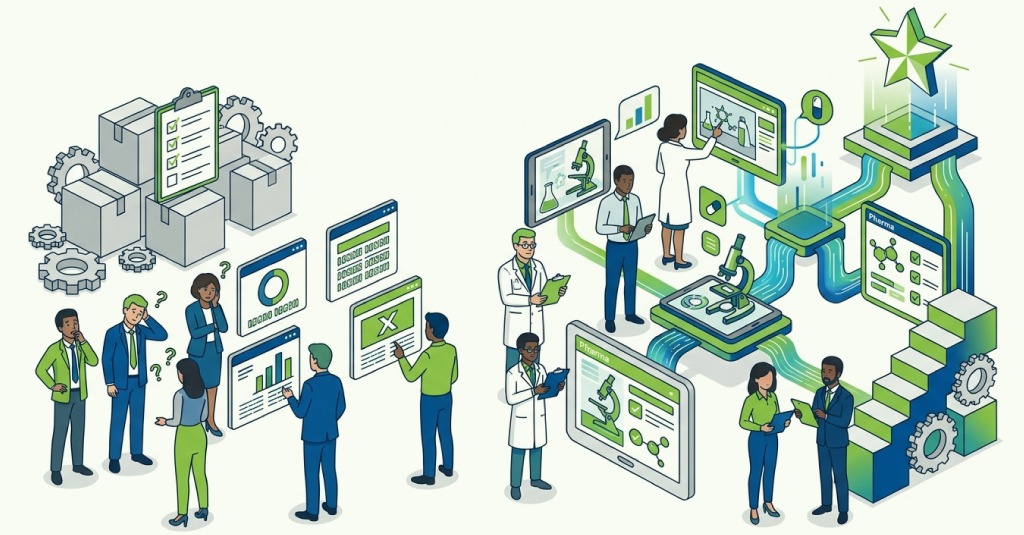
Key Gaps in Traditional Enterprise Learning Journeys
Consider a financial services organization that invested in leadership development for first-time managers. Twelve modules with high production quality. Eighteen months after launch, 360-degree feedback scores had not moved.
The diagnosis: no skills taxonomy, no transfer assignments, no manager briefing structure, and measurement limited to completion and NPS scores.
How a Skills-Based Redesign Improved Performance Metrics
The redesign started upstream. A skills taxonomy defined the four target capabilities. Each was mapped to behavioral indicators.
Restructured around a deliberate practice model, with application assignments verified by a skip-level manager. A measurement model tracked skill application at 60 and 90 days.
Nine months after relaunch, manager effectiveness scores improved by 34% and direct report engagement increased by 21%.
The content changed less than 20%. The architecture changed entirely.

Frequently Asked Questions About Skills-Based Learning Journeys
A skills-based learning journey is a structured, multi-stage experience that builds job-ready capability from a defined skill gap to measurable on-the-job performance. It combines formal learning, practice, reinforcement, and application over time, aligned to business outcomes.
A learning path organizes content for consumption, while a learning journey is designed to build skills. A journey includes activation, practice, application, reinforcement, and measurement, ensuring learning translates into on-the-job performance.
A skills-based learning journey is designed by defining a skills taxonomy, diagnosing specific skill gaps, and structuring the journey into activation, learning, practice, transfer, and verification. Measurement and manager reinforcement are built into the design from the start.
The effectiveness of a learning journey is measured across four levels: learner reaction, skill acquisition, on-the-job transfer, and business impact. Key indicators include skill application rates, time-to-competency, and measurable performance outcomes.
Learning journeys fail when they focus on content delivery instead of skill development. Common causes include lack of a skills taxonomy, absence of practice and transfer design, limited manager involvement, and measurement based only on completion metrics.
Scaling a learning journey requires a standardized skills taxonomy, governance model, and adaptable design. Core elements remain consistent, while role- and region-specific variations are built in without compromising the skill-building structure.
How to Get Started with Skills-Based Learning Journey Design
If you are building or rebuilding a skills capability program and want a design partner who has done this across industries and at scale, speak with the Upside Learning team. The conversation starts with your business problem, not our content library.