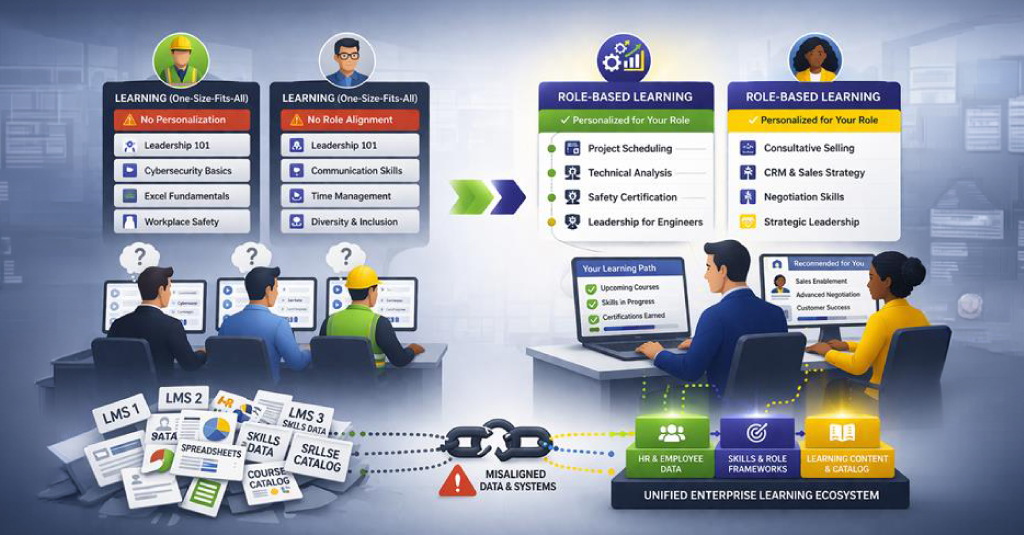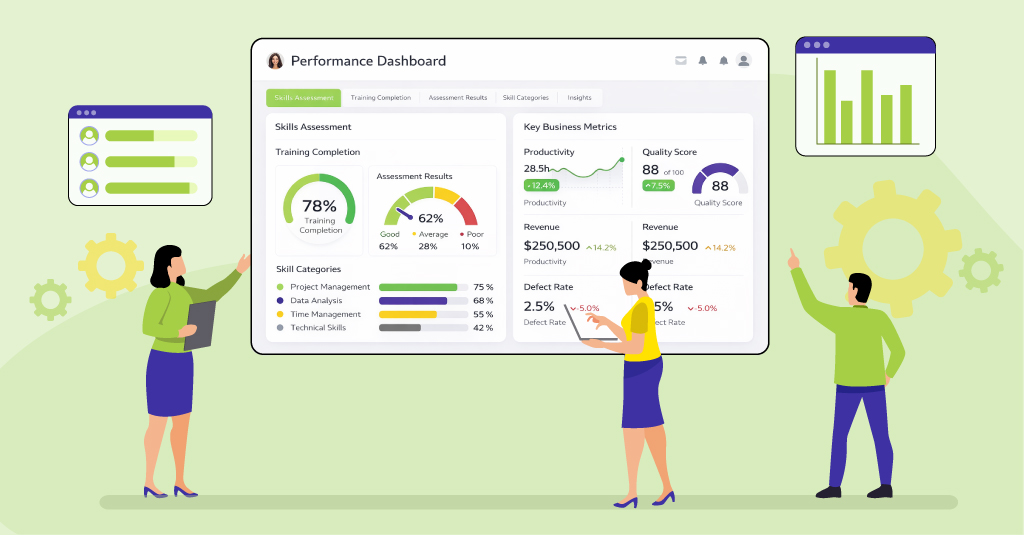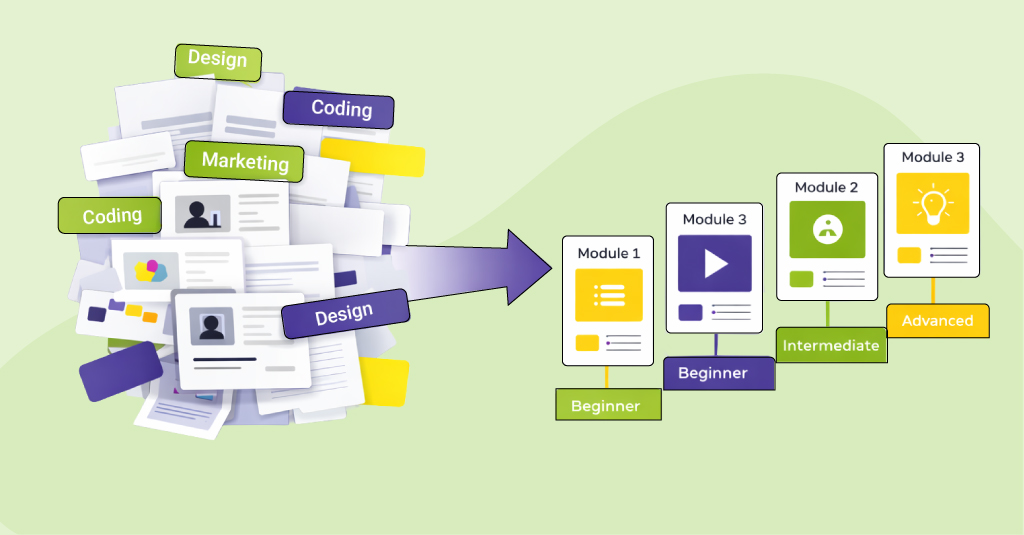




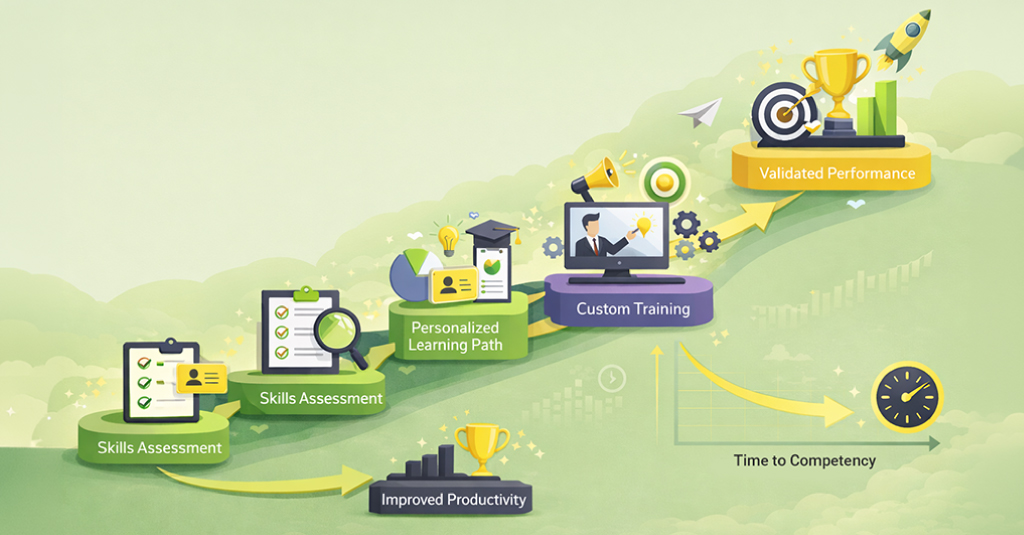
Hyper-personalized skilling starts with a simple question: what does this person already know? It does not assume everyone begins at the same level. Instead of moving everyone through the same training path, it focuses only on the skills that require development. Static learning journeys often add unnecessary seat time. They delay real performance. A targeted approach removes that delay. It shortens ramp time and improves the return on learning investment.
Key Takeaways
- Time to competency represents a business performance variable, not a reporting metric.
- Static learning journeys create hidden productivity drag.
- Competencies-based learning reduces unnecessary seat time.
- Adaptive learning in L&D compresses ramp cycles when linked to performance validation.
- The impact of hyper-personalized skilling becomes most visible in high-risk, complex roles.

The Enterprise Cost of Delayed Time to Competency in Workforce Skilling
Most enterprises measure course completion. Few measure how long employees take to perform independently at required standards. That gap creates financial blind spots and distorts learning ROI discussions.
Time to competency directly affects enterprise productivity, supervisory load, and revenue contribution timelines. When workforce skilling follows static paths, organizations absorb readiness delays without structured visibility.
The Enterprise Readiness Equation
Enterprise Readiness Cost can be modeled as:
Excess Ramp Time × Weekly Productivity Value × Workforce Volume
- Supervisory Drag
- Error Rework Cost
- Opportunity Delay
- Attrition Risk Exposure
This equation reframes learning investment as operational capital efficiency.
Supervisory drag rises when managers compensate for partially prepared employees. Error rework increases when teams execute without validated skills. Opportunity delay slows revenue realization and strategic initiatives.
Worked Enterprise Cost Example
If an enterprise hires 800 employees annually, static learning can extend ramp time by five weeks. Assume each employee generates $2,000 in weekly productivity value. Under those conditions, the excess ramp cost equals:
5 × 2,000 × 800 = $8,000,000
This estimate excludes supervisory time and rework. Once included, readiness drag can reach eight figures depending on role complexity.
Hyper-personalized skilling reduces this drag by targeting actual capability gaps instead of pushing uniform content.

A Competencies-Based Learning Architecture
Hyper-personalized skilling is a competencies-based learning approach. It adapts development pathways based on verified skill baselines, defined role requirements, and real performance signals. It accelerates validated job readiness by aligning learning effort with measurable gaps.
Unlike preference-based personalization, this model depends on skills mapping and structured diagnostics. It treats workforce skilling as capability engineering.
Core components include:
- Skills mapping aligned to role outcomes
- Baseline diagnostics
- Gap prioritization weighted by business impact
- Adaptive intervention logic
- Applied competency validation
- Continuous optimization using performance data
This architecture reduces unnecessary training effort while improving time to competency.

The Role Acceleration Architecture: A Framework for Adaptive Learning in L&D
Adaptive learning in L&D delivers measurable value only when integrated into enterprise design. The Role Acceleration Architecture connects learning interventions directly to readiness variables.
Each stage reduces friction in ramp timelines.
Role Decomposition
Define task-level competencies linked to measurable outcomes.
Skill Baseline Diagnostics
Measure existing proficiency to eliminate assumption-based design.
Gap Prioritization
Rank gaps based on revenue sensitivity and compliance exposure.
Adaptive Learning Assignment
Deploy targeted interventions instead of fixed sequences.
Applied Competency Validation
Confirm skill through scenario-based execution before autonomy.
Performance Stabilization Tracking
Monitor early performance variance.
Continuous Optimization
Refine pathways using performance data.
Skipping diagnostics increases redundancy. Skipping validation transfers risk into live operations.

Enterprise Skilling Maturity Framework for Adaptive Learning in L&D
Organizations operate at different levels of enterprise skilling maturity.
Scroll right to read more.
| Level | Observable Signal | Risk Exposure | ROI Ceiling |
|---|---|---|---|
| L1 Completion | Course dashboards | High | Low |
| L2 Curriculum | Role mapping | Moderate | Moderate |
| L3 Skills-Mapped | Competency models | Reduced | Higher |
| L4 Adaptive | Variable pathways | Controlled | Strong |
| L5 Performance-Validated | KPI-linked readiness | Minimal | Maximum |
If you cannot measure time to competency, your organization likely operates below Level 4.
At higher maturity levels, learning predicts operational outcomes rather than reporting activity.

Industry Impact: Skills Mapping and Workforce Productivity
Skills mapping and adaptive learning improve productivity in every industry. The impact shows up in different ways depending on the industry and role.
In pharmaceutical environments, faster validated readiness reduces compliance deviation rates. In financial services, shorter ramp cycles lower advisory error risk.
In manufacturing, improved technical readiness reduces downtime. In enterprise sales, compressed ramp periods accelerate revenue contribution and quota attainment.
Research across regulated and revenue-generating roles shows that employees often require several months to stabilize performance. Shortening that stabilization period delivers immediate operational value.
Validated readiness reduces operational uncertainty across sectors.

When to Invest in Hyper-Personalized Skilling: Enterprise Decision Criteria
Hyper-personalized skilling does not suit every role. It delivers the strongest impact in roles where performance variability affects revenue. It also creates meaningful value in terms of compliance risk. Operational continuity depends on consistent execution.
Highly standardized, low-risk roles with minimal skill variability often do not justify advanced personalization architecture. In those cases, structured static pathways may remain cost-effective.
Investment discipline requires aligning personalization depth with role impact.

Risks and Governance Considerations in Hyper-Personalized Learning
Hyper-personalization introduces architectural complexity. Enterprises must balance acceleration with control.
Strategic risks include:
- Fragmented capability standards
- AI explainability challenges
- Data privacy exposure
- Compliance traceability dilution
- Scalability constraints
Safeguards should include structured skills taxonomy governance. Organizations should also implement audit-trace validation to maintain transparency. Clear boundaries around personalization parameters help prevent fragmentation. KPI-linked oversight keeps performance and compliance aligned.
Governed enterprise skilling preserves performance gains while protecting compliance integrity.
Common Questions on Enterprise Skilling and Workforce Productivity
Time to competency measures how long an employee takes to independently perform role-critical tasks at defined standards. It links learning investment directly to operational readiness rather than course completion.
It identifies verified skill gaps and assigns targeted interventions instead of full-sequence content. This approach removes redundant seat time and accelerates validated performance.
Multiply excess ramp duration by productivity value and workforce volume. Then add supervisory overhead, rework cost, opportunity delay, and attrition risk exposure.
Yes, when organizations implement structured skills taxonomies, integrate performance data, and govern adaptive learning systems within enterprise architecture.
Track time to productivity, validated competency rates, error frequency, revenue contribution lag, retraining cycles, and cost per role readiness.
Hyper-personalized skilling shifts enterprise learning from activity reporting to capability acceleration. When organizations measure time to competency and align adaptive learning in L&D with enterprise risk variables, workforce development becomes a measurable performance lever rather than a reporting exercise.
At Upside Learning, we focus on building skills-based learning systems that support measurable business results. If your organization is rethinking ramp efficiency, feel free to connect for a practical conversation.