




Your teams completed every mandatory eLearning module last quarter. Yet errors persist, decisions stall, and compliance risks remain. Leadership sees the same problems and starts questioning the learning and development strategy behind them and whether their current eLearning development services are delivering real value.
Course completion does not guarantee behavior change or performance improvement. Many enterprises’ eLearning still prioritizes checklists and assessments over real workplace decisions. Employees finish eLearning courses, but their day-to-day actions stay the same.
In one study, well‑structured virtual training generated a 467% ROI over three years, with payback in less than six months.
In 2026, enterprises cannot afford this disconnect. Teams operate globally. Roles evolve faster than training cycles. Leaders now expect learning to reduce errors, improve decision making, and deliver measurable business outcomes.
This article explains why enterprises are rethinking eLearning development services and what they should demand from enterprise eLearning vendors in 2026.

Why Enterprises Worldwide Are Re-Evaluating eLearning Development Services
Enterprises are revising how they design, build, and measure eLearning. The reasons go beyond technology. Work is changing, roles are evolving, and leaders want learning that actually works.
Why Enterprises Are Moving from Content-First to Skills-First eLearning
Enterprise eLearning used to focus on course completion. It also tracked hours spent learning. That approach doesn’t work anymore. Companies now care about skills-based learning. They link training to job roles, proficiency levels, and real performance gaps. Enterprises want eLearning that builds measurable, job-ready skills.
Agentic AI for Learning Journey Management
AI in corporate training does more than create content now. Modern eLearning development services use Agentic AI to guide learners through their journey. The systems track progress, spot skill gaps, and step in when needed with practice, feedback, and coaching. This approach drives real performance-based training improvement.
Adopting Data-Driven Learning Engineering
The idea of an Instructional Designer has expanded. Many organizations now expect learning engineers who think beyond course design. Enterprises use learner analytics and learning science to drive data-driven eLearning solutions. Teams continue refining content as people learn and perform.
Realistic Training Experiences Using Immersive Simulations
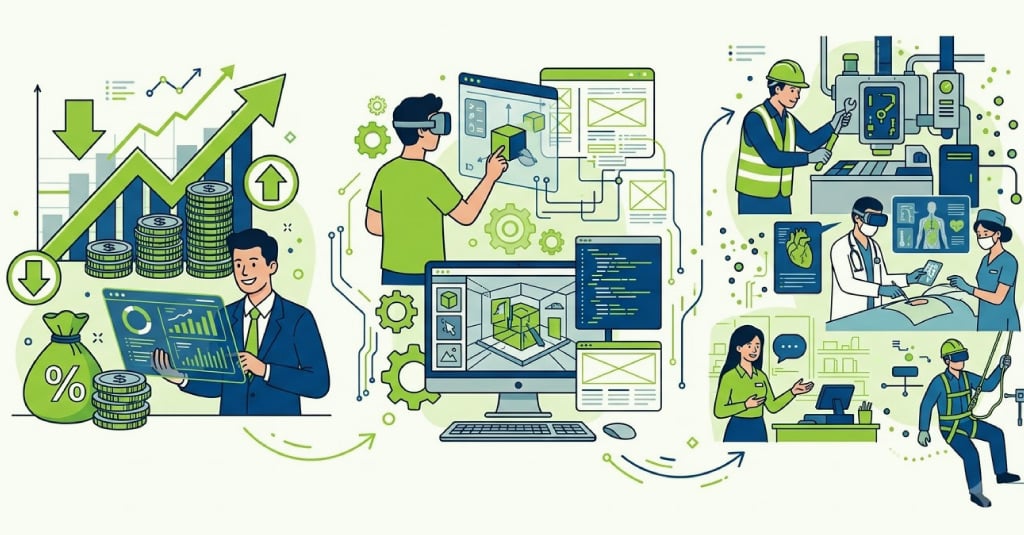
AR, VR, and MR create realistic training experiences. Employees try tasks in simulations and digital twins. They can explore and practice safely. Technicians can explore complex machinery through AR before working with physical equipment. These experiences shorten training time, improve retention, and reduce program duration.
Demanding Global Scalability and Rapid eLearning
Speed matters in a global, always-on business environment. Enterprises cannot afford long development cycles. They increasingly partner with teams that use agile eLearning development frameworks and continuous production models. This approach converts SME knowledge into digital learning assets in weeks, not months.
Mandating Demonstrable ROI and Business Impact
Enterprise learning and development (L&D) teams are now expected to justify training investments with business data. They evaluate training through capability dashboards that track business outcomes. These outcomes include behavioral change, fewer errors, faster onboarding, and higher sales. Course completion alone no longer defines success.
Embracing Content Atomization and Microlearning
Enterprises demand learning that adapts in real time. They use microlearning and content atomization to support this shift. AI-powered journey management tracks progress and identifies gaps early. It then triggers targeted practice or coaching. This approach keeps training continuous and effective.
Focusing on Human-Centric Power Skills
AI handles technical tasks, but people still need skills like understanding others, being curious, and solving problems. Teams practice these skills in real situations. This helps them work better and make smarter decisions every day.

Content Factories vs Learning Design Partners: Key Differences Enterprises Must Understand
Enterprises often ask: What’s the difference between content factories and learning design partners? This distinction matters most for enterprises investing in custom eLearning development rather than off-the-shelf content.
scroll right to read more.
| Aspect | Content Factories | Learning Design Partners |
|---|---|---|
| Primary Focus | Fast production and high course volume | Improving real workplace performance |
| Approach to design | Template-driven and standardized | Custom-designed around roles and workflows |
| Discovery process | Minimal or skipped entirely | Deep understanding of work, decisions, and risks |
| Learning structure | Information-heavy modules | Scenario-based learning tied to real tasks |
| Use of learning science | Limited or implicit | Applied intentionally and explained clearly |
| Applied intentionally and explained clearly | Course delivery and completion rates | Behavior change, decision quality, and error reduction |

How Learning Science, UX, and Analytics Drive Real Performance in Enterprise eLearning
Enterprise eLearning development services miss the mark when they focus only on content rather than skills application. The most effective programs combine learning science, UX design, and analytics to support performance on the job.
Learning Science That Supports Retention and Decision-Making
Employees do not fail because they lack information. They fail because they cannot apply it under pressure.
Effective enterprise eLearning prioritizes practice over information. Learners face realistic scenarios, make decisions, and see consequences. Feedback matters more than heavy testing because it builds judgment, not just recall. Strong learning design focuses on memory retention and skill application so employees can act correctly when it counts.
UX Design That Respects How People Actually Work
Good user interface and learning experience design in enterprise eLearning is not about visual polish. It is about usability in real work conditions. An employee might open a course after a meeting, pause it for a call, and return later. That is how most workplace learning actually happens. That’s why modules need to be simple, quick to access, and easy to follow.
Analytics That Answer Enterprise Questions
Completion data does not prove effectiveness. Enterprises need answers.
Strong eLearning analytics show which errors have decreased, where confidence has improved, and which roles still struggle. This shifts L&D from reporting completion to enhancing performance. Training analytics becomes a tool for action, not just documentation.

Scalable, Governed, and Localized eLearning for Global Enterprises
As organizations grow, custom eLearning development services must scale without losing consistency, governance, or relevance across regions.
Scale Enterprise eLearning Without Losing Consistency
- Build learning that works for employees, not just more modules.
- Use modular design so updates are easy; no need to redo entire courses.
- Role-based paths show employees only what’s relevant to their job.
- Adjust modules for local teams without affecting other content.
- Keep learning consistent while letting it grow with the organization.
- Assign responsible owners for each module's update and maintenance.
Governance Models for Enterprise eLearning Programs
- Use version control so employees are working with the correct content.
- Set up approval workflows to maintain accuracy, especially in regulated areas.
- Define ownership for updates, reviews, and compliance.
- Update learning content regularly to reduce errors.
- Treat eLearning as an active and ongoing part of the process.
Enterprise eLearning Localization Beyond Language Translation
- Go beyond simple translation; adapt content for local roles, culture, and workflows.
- Change scenarios, names, and visuals so they feel familiar to local employees.
- Make sure compliance content reflects regional laws while staying aligned with global standards.
- Treat localization as a core design step to make learning easy to use everywhere.
- Clear, relevant content improves learning engagement, understanding, and consistent compliance across regions.

What Enterprises Should Expect From an eLearning Development Company in 2026
In 2026, enterprises expect eLearning companies to deliver solutions that actually improve performance. These custom eLearning solutions focus on building skills, applying proven learning science, and showing measurable business results. They also include clear governance and localization that works, not just translation.
Structured Discovery Process for Enterprise eLearning
- Start by really understanding the problem, not just jumping into content.
- Look at key decision points and potential risks in everyday workflows.
- Check where different roles struggle the most and focus there.
Clear Link Between Learning and Business Outcomes
- Link training to real business metrics like errors, rework, and productivity.
- See how it actually affects how people do their jobs.
Evidence-Based Learning Design, Not Intuition-Led Content
- Use learning science but explain it in plain language.
- Build the course so every part has a reason, instead of guessing what might work.
- Focus on helping learners remember and make decisions correctly.
UX Design Guided by Learner Behavior
- Test the modules with real employees, not just the design team.
- Make navigation straightforward and fast.
- Allow people to pick up learning where they left off.
Scalable Architecture That Supports Growth
- Build modules that can be reused across teams and regions.
- Design the system so it can grow without breaking existing courses.
- Update parts without having to redo everything.
Governance and Lifecycle Ownership Clarity
- Decide who handles updates and sign-offs.
- Define clear workflows, so nothing gets stuck.
- Make sure everyone works from the same version, everywhere.
Localization as a Core Design Capability
- Adjust examples and scenarios for local roles and culture.
- Go beyond translation, so content actually makes sense in context.
- Follow local regulations and operational rules carefully.

Questions Enterprises Should Ask Before Choosing a Custom eLearning Vendor
These questions help guide eLearning vendor selection for long-term impact.
- How do you diagnose performance problems before creating eLearning content?
- What is your eLearning design and development approach, and how is it evidence-based?
- How do you measure learning outcomes and leverage analytics?
- How scalable and governed is your enterprise eLearning architecture?
- How do you ensure eLearning localization beyond translation?
- What ongoing support do you provide as an enterprise eLearning development partner?
In 2026, enterprises can no longer afford learning that looks complete but changes nothing at work. eLearning development services must support real decisions, real pressure, and real outcomes. Upside Learning works with organizations that want training to improve performance on the job, not just satisfy reporting needs. If your learning strategy needs to deliver measurable impact, this is where the conversation should start. Schedule a consultation with our enterprise learning experts.
Frequently Asked Questions
Employees forget training content quickly because most programs overload working memory. When too much information is delivered at once, the brain discards most of it.
By focusing on one objective at a time and revising it in short sessions. This helps learners understand the content better and use it in their work.
Cognitive Load Theory is a learning science framework that explains how memory limits affect learning. And how training should be designed to improve retention and application.
Yes. When designed correctly, microlearning improves accuracy, recall, and compliance by reducing cognitive overload. For a deeper perspective on how microlearning works in real business environments and compliance contexts, explore our eBook, “Microlearning: It’s Not What You Think It Is.”
Typically, between 3 to 7 minutes, depending on the complexity of the objective being addressed.

Pick Smart, Train Better
Picking off-the-shelf or custom eLearning? Don’t stress. It’s really about your team, your goals, and the impact you want. Quick wins? Off-the-shelf has you covered. Role-specific skills or behavior change? Custom eLearning is your move.