



The $300 Billion Problem with How We Name Skills
The World Economic Forum estimates that 39% of core workforce skills will shift by 2030. That is not a talent acquisition problem. That is a learning design problem, and most L&D teams are not equipped for it.
Here is why. Most enterprise taxonomies contain hundreds of skill labels. But a label is not a definition. But a label is not a definition. “Communication skills” means one thing to a frontline manager writing a job description. It means something entirely different to a learning architect designing development programs. When every stakeholder interprets a skill differently, your training investments are built on sand.
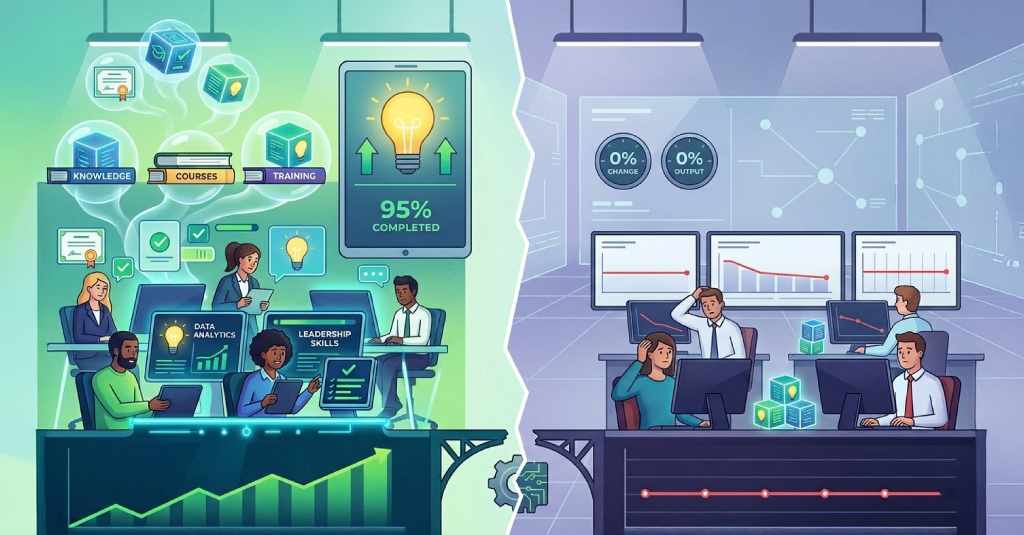
This gap between what a skill is called and what it actually means in practice is what we call the Skill Clarity Gap. Closing it is not just good taxonomy housekeeping. It is the foundational work that determines whether your L&D programs produce measurable behavior change or merely completion certificates.
We will cover what a skills taxonomy is, why skill clarity is the real objective, how to build one that works for learning teams, and how to govern it so it does not collapse within 18 months.

What Is a Skills Taxonomy?
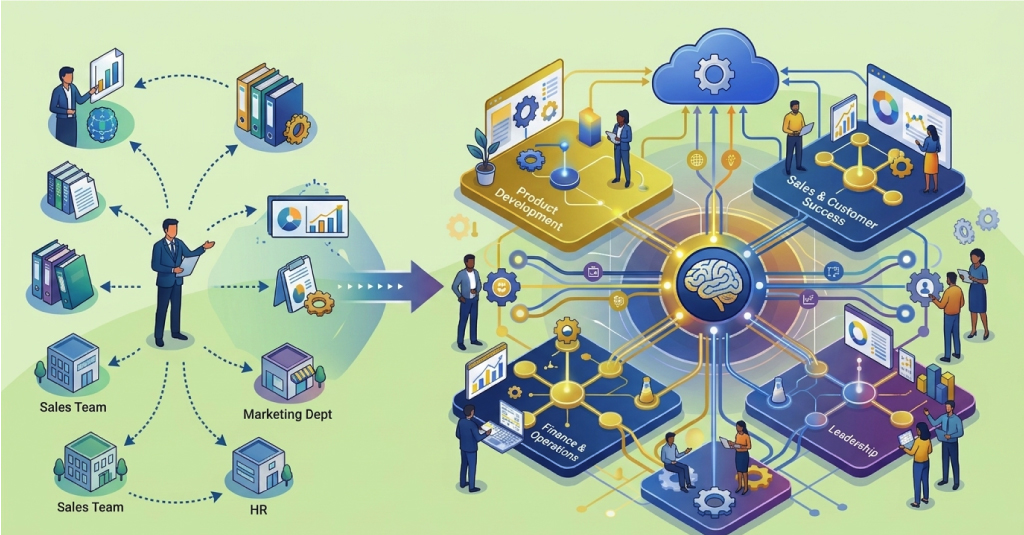
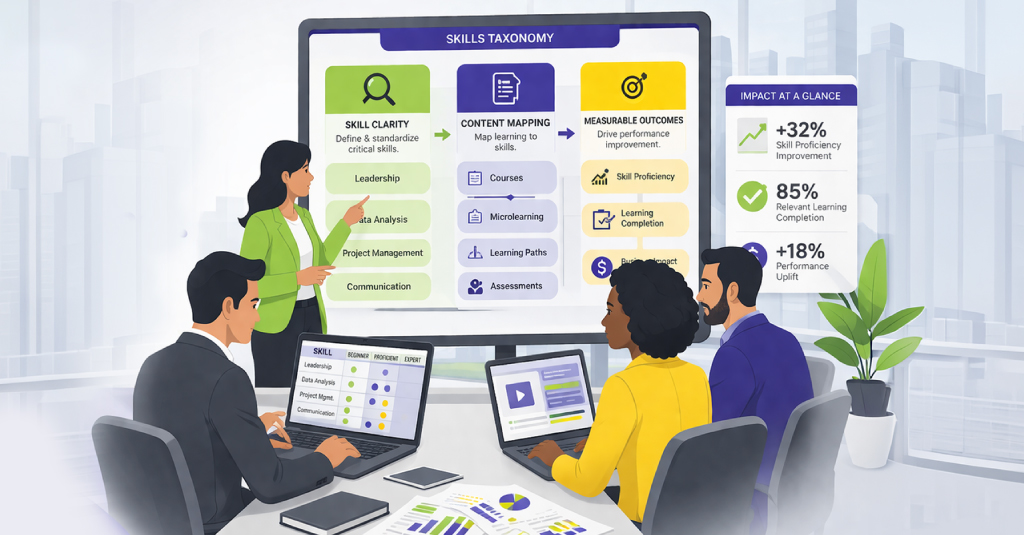
A skills taxonomy is a structured system that organizes skills into categories, sub-categories, and proficiency levels within an organization. It standardizes how skills are named, defined, and measured, helping align learning programs, job roles, and performance outcomes.
The Terminology Triangle: Taxonomy, Ontology, Framework
Scroll the table to the right to read more.
| Term | What It Is | Best Used For |
|---|---|---|
| Skills Taxonomy | Hierarchical tree of skills by domain, cluster, and proficiency | Classification and content mapping |
| Skills Ontology | Relationship web including skill synonyms, adjacencies, and career pathways | Adaptive learning, internal mobility |
| Competency Framework | Bundles of behavior, knowledge, and attitude linked to a role standard | Performance management, recruitment |
The Skill Clarity Gap: Label VS. Definition
This is the distinction most taxonomy guides skip entirely. It is also where learning programs most commonly fail.
A skill label is a noun: Data Storytelling.
A skill definition is a verb plus an observable outcome: Translates complex data insights into narrative-driven presentations for non-technical stakeholders, using visual formatting and business context to drive decisions.
The gap between those two statements is enormous. One tells you what to call something. The other tells you what it looks like when someone actually does it well. That second version is the only one a learning designer can do anything useful with.
When your taxonomy contains only labels, you cannot write meaningful learning objectives. You cannot design valid assessments. You cannot measure whether training worked. The Skill Clarity Gap is not a cosmetic problem. It is a structural one.
Why Skill Clarity Is the Real Objective, Not Just Classification
Most skills taxonomy guides position the taxonomy as an instrument of HR data quality. That is a valid use case. But for L&D teams, the stakes are different and higher.
Research consistently shows that only around 12% of employees successfully apply skills learned in training to their actual jobs. One of the most underappreciated reasons is this: the skill being trained was never clearly defined in the first place. When a learning objective is built on a vague skill label, it tends to produce equally vague instructional design. Content that covers the topic without actually changing the behavior.

Four Downstream Consequences of Poor Skill Clarity
When skills are not clearly defined, learning becomes inefficient, hard to measure, and difficult to apply on the job.
1. Content Redundancy
When skills are vague, different teams create similar learning content for the same skill without realizing it.
Over time, the learning catalogue fills up with duplicate or overlapping content.
Many organizations find that 30 to 40% of their content is redundant once they audit it against clearly defined skills.
2. Unreliable Skills Gap Analysis
You cannot measure a skill gap if the skill itself is not clearly defined.
For example, if “leadership” is just a label with no clear meaning, the data you get from assessments will be inconsistent and hard to trust. As a result, teams stop using it for decision-making.
3. Generic Learning Objectives
Vague skills lead to vague learning outcomes.
For example: “Learners will understand communication” is unclear and not measurable.
But when a skill is clearly defined, the objective becomes specific and actionable. This makes it easier to design effective learning programs.
4. Low Learning Transfer to the Job
When learners do not know what a skill looks like in practice, they struggle to apply what they learned.
Managers also cannot reinforce the skill because expectations are unclear.
As a result, learning does not translate into improved performance.

How to Build a Skills Taxonomy in L&D: Practitioner’s Approach
Most build guides start with job descriptions and work forward. We recommend the opposite. Start with the performance outcomes you need. Then work backwards to the skills that produce them.
Step 1: Anchor to Learning Outcomes, Not Job Descriptions
Job descriptions tell you what organizations think they need people to do. Performance data tells you what actually separates effective from ineffective performance.
Start with Kirkpatrick Level 3, which covers observable on-the-job behaviors. Build your taxonomy around the skills that produce those behaviors. This single shift changes what goes into your taxonomy and dramatically increases its usefulness for L&D purposes.
Step 2: Decide Your Architecture
A three-level hierarchy works best for most enterprise contexts:
Domain → Skill Cluster → Individual Skill
For example: Digital Capability → Data Analysis → Data Storytelling
Avoid going deeper than three levels. Overly detailed taxonomies become difficult to manage and usually break down within a year. Most organizations try to build taxonomies from scratch. Start with existing frameworks and adapt them to your context.
Step 3: Define Skills, Not Just Name Them
A skill name alone is not enough. People need to understand what that skill looks like in real work.
Write Clear Skill Definitions
Use Upside Learning’s skill definition formula:
Verb (What they do) + Object (What they work on) + Context (Where/how they do it) + Standard (Desired outcome)
Example:
“Translates complex data insights into clear presentations for non-technical stakeholders using structured visuals to support business decisions.”
For proficiency levels, three tiers are almost always sufficient for L&D purposes.
- Awareness: can recognize and describe the skill
- Application: can perform the skill with guidance in familiar contexts
- Mastery: can perform independently and coach others
Before moving forward, review your skill definitions with subject matter experts. Sit with them, walk through each definition, and ask a simple question: “Is this what good performance looks like in real work?”
If the answer is unclear or inconsistent, refine the definition before proceeding.
Step 4: Map Skills to Learning Content
Once your skill definitions are clear, the next step is to connect them to your existing learning content. Create a simple table where you list your skills on one side and your learning content on the other. Then map which content supports each skill.
When you do this, you will start to see a pattern. Some skills will already have good content coverage, some will have no content at all, and some will have multiple pieces of content covering the same thing.
Both situations need attention. Missing content means people are not being trained where it matters, while duplicate content leads to wasted time and budget.
This step helps you clearly identify where to build, improve, or reduce content.
Step 5: Integrate with Your Learning Ecosystem
Tag every learning object with skill IDs, not topic keywords which are too loose. Connect your taxonomy to your LMS, your talent platform, and your performance review system.
Where possible, replace generic knowledge checks with scenario-based assessments tied to specific proficiency indicators. This makes your taxonomy usable, not just documented.

The Governance Problem: Why Taxonomy Projects Fail at Scale
Most guides mention that a skills taxonomy needs to be “updated regularly.” Few explain how to do this in practice. This is where most taxonomy projects fail.
Four Common Failure Modes
1. Skill definition drift
Without clear ownership, different teams start interpreting skills in their own way. Over time, the same skill can mean different things across the organization, making the taxonomy unreliable.
2. Lack of ownership
When HR or L&D builds taxonomies without business involvement, they are rarely used. Governance requires clear ownership, both at the overall level and within each skill area.
3. Disconnected systems
If the taxonomy exists only in the LMS and is not connected to performance or talent systems, it cannot support real decision-making. That’s why integration is essential.
4. Outdated taxonomy
If the taxonomy is not reviewed regularly, it quickly becomes inaccurate and loses relevance when skills evolve.

How to Build a Skills Taxonomy Governance Model
Assign clear ownership using a RACI model:
- Responsible: L&D or People Analytics team manages definitions and versioning
- Accountable: CLO or CHRO holds final authority on taxonomy changes
- Consulted: Business unit heads and SMEs validate domain-level definitions
- Informed: Hiring managers and line managers consume the taxonomy in tools
Set a review cycle based on how quickly skills change. Emerging skills may need quarterly updates, while core skills can be reviewed annually.
When removing outdated skills, map them to updated ones first. This ensures learning content stays aligned and usable.
The Skill Clarity Audit
Before building a new taxonomy, assess what you already have.
Ask:
- Is each skill clearly understood without extra explanation?
- Does every skill have a clear, observable definition?
- Are proficiency levels measurable?
- Is each skill linked to learning content?
- Has it been reviewed recently?
If the answer is no or unclear, the problem is not structured. It is skill clarity.
If you’re exploring how to move from skills to capability-building at an enterprise level, this eBook breaks down the full approach in detail.
Frequently Asked Questions
A skills taxonomy defines and organizes individual skills in a structured hierarchy. A competency framework combines skills with behaviors, knowledge, and attitudes into role-based standards. Taxonomies support learning design and content mapping, while competency frameworks are used for performance management and hiring.
A skills taxonomy covering a few domains with clear definitions and SME validation typically takes 8 to 12 weeks. Enterprise-wide taxonomies can take 6 to 12 months, especially when integrating with HR and learning systems.
Maintaining a skills taxonomy requires clear ownership, regular reviews, and version control. Fast-changing skill areas should be reviewed quarterly, while stable skills can be reviewed annually. A governance model ensures definitions stay accurate and consistent.
A skills taxonomy organizes skills into a hierarchical structure, while a skills ontology maps the relationships between skills, such as dependencies and similarities. Taxonomies support L&D structure, while ontologies enable advanced use cases like personalization and career pathing.
To connect a skills taxonomy to L&D programs, map each learning asset to specific skills and proficiency levels. Use the taxonomy to design learning objectives, recommend learning paths, and track skill development through integrated learning systems.

From Taxonomy to Transformation: The L&D Team’s Next Step
A well-defined and governed skills taxonomy is not just an administrative tool. It is a strategic asset that shifts L&D from tracking completions to building real capability.
The Skill Clarity framework focuses on three things: define skills clearly, connect them to learning design, and establish governance early.
If you are starting from scratch, focus on definition and content mapping first.
If you are auditing an existing taxonomy, use the Skill Clarity questions to identify gaps and priorities.
Looking to build or rebuild your enterprise skills taxonomy? Upside Learning’s L&D consultants have worked with enterprise organizations across pharma, financial services, manufacturing, and technology to design capability architectures that drive real performance. Talk to our team to turn your skills taxonomy into a capability-building system.