



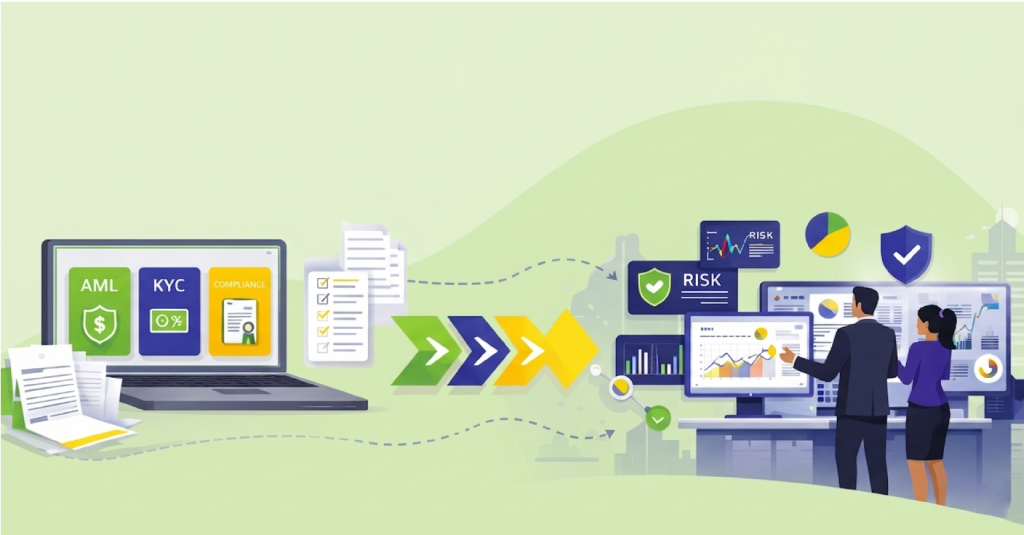
Compliance training in financial services helps organizations meet regulatory obligations such as AML, KYC, and data protection laws. This ensures employees understand internal policies and procedures.
Yet training completion rarely guarantees compliant behavior. Employees may know regulations but struggle to apply them in complex operational situations. Regulators increasingly evaluate how organizations manage conduct risk.
Many institutions still treat financial compliance training as a library of training courses and certifications. This approach focuses primarily on knowledge delivery. It rarely prepares employees to identify risk signals or respond appropriately during operational pressure.
Financial institutions are therefore shifting toward workforce compliance capability, focusing on decision readiness and risk awareness across the organization.
Key Takeaways:
- Compliance training alone does not ensure compliant behavior
- Employees must interpret regulatory requirements during complex operational decisions
- Compliance capability integrates knowledge, risk recognition, and judgment
- Capability-based compliance reduces regulatory exposure and operational risk
- Organizations must embed compliance learning within real work environments

Why Compliance Training in Financial Services Is No Longer Enough
Traditional financial compliance training programs deliver regulatory knowledge through structured courses. These programs often cover AML training, fraud prevention, customer due diligence, and data protection rules.
However, regulatory violations still occur even when employees complete mandatory training. They often understand the rules but misapply them during complex operational decisions.
Regulators increasingly examine employee conduct and escalation behavior. They also evaluate whether organizations maintain an effective compliance culture across business units.
Financial institutions must therefore move beyond knowledge delivery. They need employees who recognize regulatory risks and respond correctly in operational situations.

The Compliance Decision Gap
The compliance decision gap describes the disconnect between policy knowledge and operational behavior.
Several operational conditions contribute to this decision gap:
- Time pressure during operational workflows
- Ambiguous regulatory interpretations
- Conflicting business incentives
These conditions create risk if employees lack decision-making capability.
Traditional financial compliance training builds awareness. However, it rarely prepares employees for these operational dilemmas. Programs focus on explaining policies but they rarely develop behavioral decision capability.
Individual compliance skills act as foundational elements.
Examples of foundational compliance skills include:
- Recognizing suspicious transactions
- Understanding AML obligations
- Identifying potential regulatory violations
These skills resemble atoms in a capability model, where each skill represents a unit of knowledge.
Compliance capability emerges when these skills combine with operational context. Judgment also plays a critical role. Employees must interpret risk signals and apply regulations. They must also make compliant decisions under pressure.
Organizations that strengthen these combined abilities reduce the probability of compliance failures.

What Is Compliance Capability in Financial Services
Compliance capability represents an organization’s ability to ensure employees apply regulatory requirements during operational work.
Employees with strong compliance capability identify risks early. They escalate concerns appropriately. They maintain compliant behavior across daily activities.
Compliance capability combines several elements:
- Regulatory knowledge
- Risk awareness
- Ethical judgment
- Operational context
- Disciplined decision-making
Financial institutions that build these capabilities strengthen regulatory readiness. They also reduce operational risk.
Compliance Training vs Compliance Capability
Scroll the table to the right to read more.
| Dimension | Compliance Training | Compliance Capability |
|---|---|---|
| Objective | Deliver regulatory knowledge | Enable compliant decisions |
| Measurement | Course completion | Behavioral outcomes |
| Learning Model | Periodic training | Continuous reinforcement |
| Application | Policy understanding | Operational decision making |
Understanding this distinction helps organizations rethink how they manage regulatory risk.
Why Compliance Capability Matters for Enterprise Risk
Compliance capability directly influences enterprise risk exposure. Regulatory violations rarely occur because employees lack awareness of policies.
Most failures occur when employees misinterpret rules. Employees may also overlook early warning signals. Complex operational environments often require judgment. Memorizing rules alone is not enough.
Organizations that build compliance capability detect risks earlier. They escalate issues faster. Employees respond appropriately to regulatory requirements.
Strong capability also improves regulatory confidence. Supervisory authorities increasingly evaluate organizational behavior. They also examine decision processes.
Financial institutions that develop compliance capability strengthen governance. They also improve operational resilience.

The Compliance Capability Framework
Organizations need a structured approach to develop compliance capability. A practical framework includes four layers.
1. Regulatory Knowledge
Employees must understand regulatory frameworks relevant to their roles. These include AML requirements and KYC training obligations. They also include market conduct rules and data protection standards.
2. Compliance Risk Recognition
Employees must identify operational situations that create regulatory risk. Examples include suspicious transactions and unusual client activity. Potential conflicts of interest also require attention.
Risk recognition allows early detection of compliance threats.
3. Regulatory Decision Capability
Employees must interpret regulatory requirements during operational decisions. These decisions may involve customer onboarding. They may also involve transaction approvals or escalation of suspicious activity.
Decision capability ensures knowledge translates into appropriate action.
4. Operational Compliance Behavior
Employees demonstrate compliance capability when correct decisions become routine. Behavior aligns with regulatory expectations. It also aligns with organizational policies.
These layers interact continuously to reinforce compliant decision-making.

From Compliance Training Programs to Capability Ecosystems
Traditional financial compliance training relies heavily on learning management systems. These systems store training modules. They also track completion records. However, these systems rarely influence operational behavior once employees return to daily work.
Capability-driven organizations develop compliance learning ecosystems instead. These ecosystems connect learning with operational tools. They also integrate risk monitoring systems.
Examples include regulatory training platforms and transaction monitoring systems. Compliance analytics dashboards also support this ecosystem. Decision support tools guide employees during operational tasks.
This integrated approach strengthens compliance capability. It reinforces correct behavior within real work environments.

Measuring Compliance Capability
Organizations often measure training effectiveness through completion metrics associated with compliance training for employees.
Capability-driven organizations analyze indicators such as:
- Compliance incident trends
- Internal audit findings
- Escalation patterns
Leading institutions connect learning metrics with operational risk indicators to gain deeper visibility into workforce readiness. This approach reveals how workforce capability affects compliance outcomes.
Time to Proficiency as a Capability Metric
Time to proficiency measures how quickly employees demonstrate consistent compliance behavior.
It tracks how long employees require to perform correctly. This measurement focuses on operational situations.
Shorter time to proficiency reduces exposure to regulatory risk. It also improves workforce readiness during onboarding and role transitions.

The Future of Compliance Training in Financial Services
Behavioral compliance monitoring is gaining importance as institutions analyze conduct risk indicators across operational activities. This helps detect potential compliance failures earlier.
Artificial intelligence is increasingly being used to support compliance decisions through automated risk signals and contextual regulatory guidance.
Continuous compliance readiness is another emerging approach. Institutions reinforce capability through simulations and practice scenarios. Workflow guidance also supports learning.
These methods strengthen decision capability across the workforce.
Compliance leaders must rethink how workforce readiness is evaluated beyond training completion metrics. True compliance capability must be measured through decision behavior and risk awareness in operational contexts.
Compliance leaders should evaluate whether employees:
- Recognize regulatory risks early
- Escalate compliance concerns appropriately
- Apply policies during operational decisions
Capability-driven compliance programs strengthen governance, reduce operational exposure, and build confidence among regulators and stakeholders.
Organizations that invest in workforce compliance capability improve resilience. This is critical in complex regulatory environments.
Enabling Compliance Capability in Practice
Many financial institutions struggle to operationalize compliance capability through traditional compliance training courses. The shift requires changes in learning design.
Organizations increasingly seek risk and compliance training solutions that support:
- Scenario-based learning
- Realistic compliance simulations
- Operational decision practice
These approaches allow employees to practice regulatory decisions safely.
Capability measurement tools help leaders understand workforce readiness.
These platforms embed compliance learning within operational workflows. This approach accelerates capability development. It also strengthens regulatory readiness.

FAQs
Compliance training teaches employees regulatory obligations such as AML training, KYC requirements, fraud prevention policies, and data protection standards. These programs help financial institutions ensure employees understand regulatory responsibilities. They also reinforce internal compliance procedures.
Compliance training helps banks reduce regulatory risk and prevent financial crime. Regulators expect employees to understand applicable regulations. Employees must also apply those regulations during operational decisions.
Corporate compliance training typically covers anti-money laundering regulations and customer due diligence requirements. Programs also include fraud prevention policies and insider trading rules. Data protection obligations also form a key part of training.
Compliance capability describes the workforce’s ability to identify regulatory risks. Employees must apply rules during operational decisions. This capability integrates knowledge, risk awareness, and decision judgment. It ensures employees behave in accordance with regulatory requirements.
Conclusion
Financial compliance training remains an important component of regulatory governance.
However, knowledge alone cannot ensure compliant behavior. Employees must recognize risks and apply regulatory requirements during real operational situations.
Financial institutions that develop workforce compliance capability strengthen governance, improve risk detection, and enhance regulatory confidence.
At Upside Learning, we help organizations move beyond traditional compliance training and build workforce compliance capability.
Schedule a strategy call with our experts to explore how your organization can move beyond compliance training and build true compliance capability.