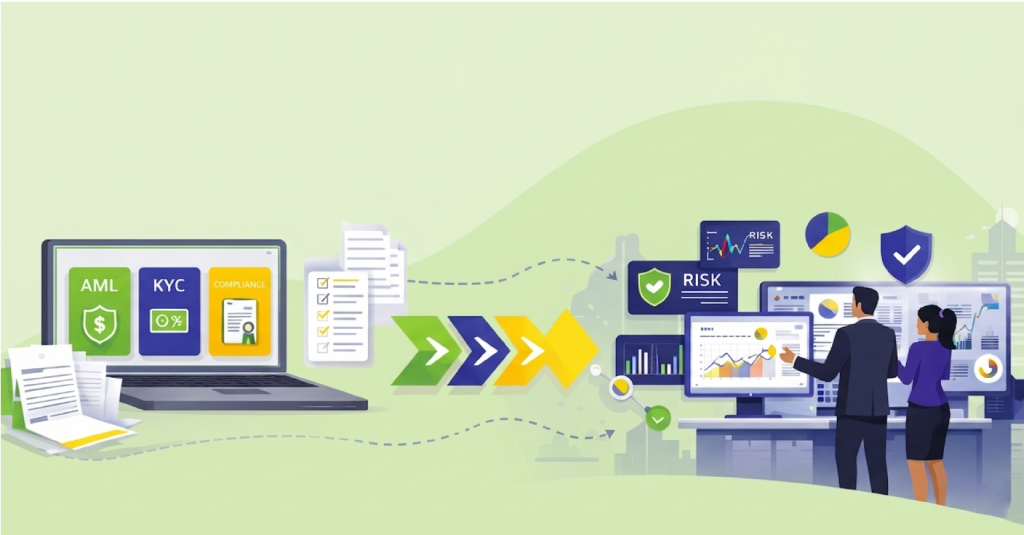





Content production timelines have been compressed. Review timelines have not.
In several enterprise learning environments, AI-assisted authoring has reduced draft creation time by 40 to 60 percent. Yet release cycles, measured from initial concept to LMS deployment, remain largely unchanged. The bottleneck has moved. It has not disappeared.
Generative AI in L&D is changing how quickly material can be produced. It is not automatically changing how enterprises validate, approve, version, and deploy that material. In complex organizations, those steps carry institutional weight. They are rarely optional.
This is where custom eLearning development begins to function less as content creation and more as governance infrastructure.

AI Course Creation Is Outpacing Enterprise Deployment Controls
AI course creation tools can generate scripts, assessments, and branching scenarios within minutes. Enterprise training automation platforms can convert policy documents into structured learning modules with minimal human drafting.
On the surface, this appears to solve long-standing capacity constraints inside L&D.
In practice, enterprise systems impose layers between draft and deployment. A typical workflow inside a multi-region organization includes:
- Instructional design refinement
- SME validation for technical and operational accuracy
- Legal or compliance review
- Localization and regional contextualization
- LMS configuration and metadata tagging
Each layer exists for traceability. Removing them would introduce operational risk.
What changes with generative AI is the volume entering this pipeline. When content generation becomes easier, draft frequency increases. Review capacity does not scale at the same rate.
Enterprise-wide research on AI adoption, including McKinsey’s State of AI report, indicates that governance, risk management, and deployment controls often lag behind experimentation and rapid deployment cycles.
In one manufacturing enterprise, AI-assisted drafting doubled the number of modules entering review within a single quarter. The compliance team’s approval queue extended by three weeks. Deployment timelines reverted to previous averages.
The constraint is not the generation of content. It is the orchestration of structured validation.
This creates pressure upstream. When validation becomes congested, version control begins to fragment.

SME Validation and Review Cycles Remain Fixed Resources
Subject to matter of experts operating within business functions, not learning functions. Their availability is shaped by operational priorities and performance targets.
When generative AI in L&D accelerates first drafts, SMEs receive review requests more frequently. Without a defined validation pipeline, review cycles extend in informal and inconsistent ways.
Common patterns appear:
- Drafts circulate through email rather than centralized workflow systems
- SMEs comment on static documents without visibility into revision history
- Multiple stakeholders provide feedback in parallel, without coordination
The result is layered editing rather than structured validation.
A healthcare enterprise recently audited its internal training development cycle. Average SME review time exceeded 18 business days, not because the content was technically complex, but because version clarity was inconsistent. SMEs occasionally validate outdated drafts.
Enterprise custom eLearning in this context requires a defined review of architecture. That architecture typically includes:
- A controlled draft baseline before SME engagement
- A single validation checkpoint with documented sign-off
- Locked revision logs before compliance routing
Without these guardrails, AI-generated drafts multiply touchpoints without improving decisional throughput.
And when reviewing documentation is incomplete, compliance with exposure increases.

Compliance and Audit Requirements Do Not Adjust to AI Velocity
Regulated enterprises operate within defined documentation standards. Training materials must demonstrate alignment with policy language, regulatory updates, and timestamped validation.
Generative AI introduces an additional complexity: content origin traceability.
Audit teams increasingly examine:
- The source documents used to generate learning material
- The identity of the validating SME
- The date of compliance approval
- The deployment record within the LMS
If scalable content pipelines do not embed these checkpoints, the organization cannot demonstrate defensibility during audits.
In financial services, minor discrepancies between policy revisions and training deployment dates can trigger remediation cycles. In pharmaceuticals, inaccurate procedural phrasing may require formal retraining documentation.
AI does not reduce these obligations.
Instead, it increases the need for structured content transformation workflows that convert generated material into validated enterprise assets.
That transformation stage is often underestimated.

As AI accelerates course creation, the number of draft iterations expands. Regional teams may request contextual adjustments. Functional leaders may propose additional scenarios. Compliance teams may revise terminology.
Without a centralized versioning structure, fragmentation occurs.
Typical risks include:
- Parallel drafts edited by different regional stakeholders
- Regenerated AI content that overrides previously validated sections
- LMS uploads based on incomplete approval cycles
- Localized modules that diverge from global standards
In one global retail enterprise, three active versions of a leadership compliance module were discovered during an internal review. Each had minor variations in policy interpretation. The discrepancy stemmed from decentralized edits layered onto AI-generated drafts.
Enterprise learning architecture must therefore establish clear baselines:
- A defined source-of-truth document
- Structured version numbering prior to localization
- Controlled regeneration policies when AI updates are applied
- This is less about software capability and more about governance discipline.
Once version control is stabilized, integration becomes the next structural concern.

Enterprise Learning Architecture Must Support Structured Deployment
AI-generated content does not exist in isolation. It enters a broader enterprise ecosystem that typically includes:
- A learning management system or learning experience platform
- HRIS for employee and role data
- Performance management systems
- Compliance tracking databases
If AI-generated modules are not mapped to role in hierarchies, competency frameworks, and reporting structures before deployment, downstream assignment errors occur.
Role-based learning design reduces this ambiguity. Rather than organizing content purely by topic, role-based architecture aligns modules to job families and operational responsibilities.
In one enterprise implementation, re-architecting learning assignments around role taxonomies reduced manual reassignment corrections by nearly 25 percent over six months.
Enterprise training automation is most effective when content structure mirrors workforce structure.
Without that alignment, scalable content pipelines introduce operational drift.
And over time, drifts become systemic.

Structured Content Transformation Workflows as Governance Mechanisms
AI accelerates drafting. Enterprises still require structured transformation before release.
A functional content pipeline typically includes staged checkpoints:
- Draft generation and instructional alignment
- SME validation with documented approval
- Compliance confirmation
- Localization with controlled adaptation
- Technical packaging and LMS configuration
- Post-deployment verification
When these stages are informal, bottlenecks emerge unpredictably. When formalized within enterprise custom eLearning frameworks, variability decreases.
Custom eLearning development at the enterprise level now involves designing these workflows alongside instructional assets. The objective is not to speed alone. It is controlled by scalability.
Generative AI in L&D will continue to compress production timelines. That trajectory appears to be stable.
What remains unchanged is enterprise accountability. Validation must be traceable. Versions must be controlled. Deployment must be audited.
Organizations that treat AI as a drafting tool without restructuring their governance architecture experience recurring friction. Those that integrate structured content pipelines within their enterprise learning architecture maintain deployment stability even as content volume increases.
The distinction is procedural rather than technological.
Speed is visible. Governance is structural.

How Upside Learning Structures AI-Enabled Content Pipelines for Enterprises
In complex enterprises, governance does not emerge organically. It is designed.
Upside Learning approaches AI course creation within a broader enterprise learning architecture framework. The starting point is rarely the tool. It is the workflow.
Engagements typically focus on four structural layers.
Workflow Definition Before Automation
Before introducing enterprise training automation, validation checkpoints are mapped explicitly. Draft ownership, SME routing, compliance sign-off, and localization gates are defined in sequence. This reduces ambiguity when AI-generated drafts enter the system.
Role-Based Learning Design Alignment
- Custom eLearning development is aligned to enterprise role taxonomies rather than content categories. Learning pathways are structured around job families and operational responsibilities. This minimizes reassignment errors once modules are deployed across regions.
Version Governance Embedded in Design
- Version baselines are established at defined milestones. Regeneration rules are documented before AI tools are introduced into the workflow. Each approved iteration is archived with traceable metadata, enabling audit defensibility.
- Deployment is structured in coordination with LMS, HRIS, and compliance reporting systems. Metadata standards are defined early, not retrofitted post-production. This supports consistent reporting across business units and regions.
The emphasis remains procedural. AI accelerates drafting. Governance sustains enterprise integrity.
In large organizations, the effectiveness of generative AI in L&D is not determined by how quickly a module can be written. It is determined by how predictably it can be validated, versioned, deployed, and defended.
Custom eLearning, when designed as governance infrastructure, provides predictability. In large organizations, the effectiveness of generative AI in L&D is not determined by how quickly a module can be written. It is determined by how predictably it can be validated, versioned, deployed, and defended.
To discuss how a structured custom eLearning strategy can support your enterprise governance model, connect with the Upside Learning team.

Frequently Asked Questions
A readiness gate is a formal validation checkpoint that requires employees to demonstrate applied capability before performing independently in high-risk roles or tasks.
Measure skill readiness using operational indicators such as repeat error rates, decision latency, escalation frequency, supervisor intervention levels, and validated performance under real conditions.
Completion certificates lack performance evidence. Audit teams require defensible proof that employees can execute responsibilities within defined operational and regulatory thresholds.
Measure skill readiness through operational signals. Focus on repeat error rates, decision latency, escalation frequency, and supervisory intervention levels. Validate performance under real work conditions.
Technology can support validation at scale. However, governance design and assessor calibration define the standard. Leadership accountability ensures workforce readiness and long-term workplace readiness becomes measurable and defensible.
Many enterprises remain at completion-led or assessment-based stages. Few integrate readiness gates into risk management frameworks. Honest evaluation determines where transformation must begin.
Enterprises that equate training completion with skill readiness create governance exposure. Leaders who embed validation into operational systems convert training effectiveness metrics into measurable workforce readiness. The difference lies not in content delivery, but in accountability architecture.
At Upside Learning, we help enterprises move beyond completion dashboards. We focus on whether people can perform independently in real work conditions. Our approach centers on validated capability, not course completion.
If you are rethinking how you measure training effectiveness and workforce readiness, speak with our team. We will review your current model and outline practical next steps to strengthen capability governance.