



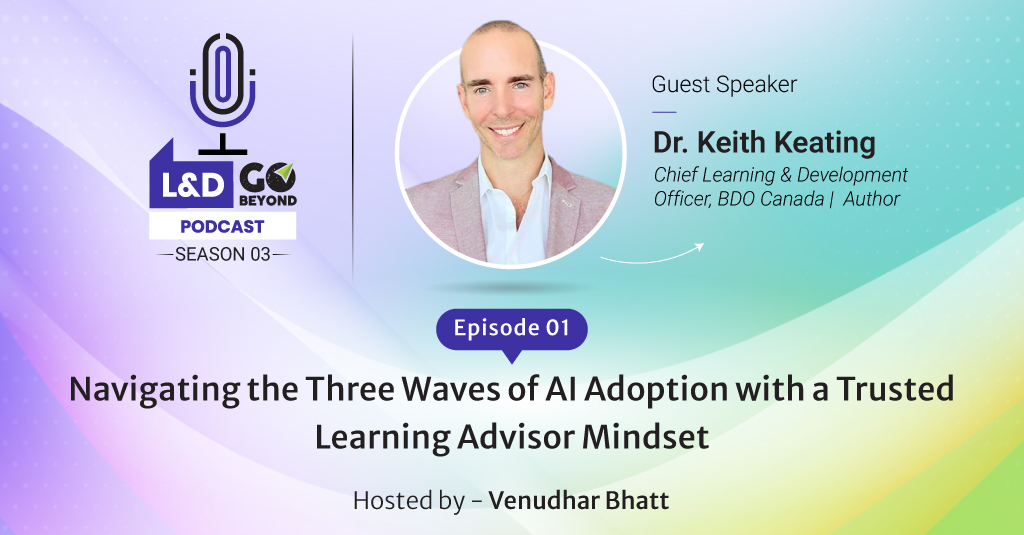
Season 3 of the L&D Go Beyond podcast opens with a powerful conversation between host Venudhar Bhatt and Dr. Keith Keating, Chief Learning Officer at BDO Canada and author of The Trusted Learning Advisor. Together, they explore how L&D leaders can navigate the fast-moving world of AI while staying anchored in business impact.
The conversation sets the tone for Season 3: thoughtful, grounded, and focused on what genuinely moves organizations forward in the age of AI.
Keith traces the shift happening across organizations as AI reshapes how people work, learn, and operate. He highlights the three waves of AI adoption:
- Wave 1: Efficiency – improving speed and reducing cost
- Wave 2: Quality – increasing relevance, personalization, and usefulness
- Wave 3: Transformation – unlocking entirely new ways of learning and performing
Most organizations are stuck in Wave 1. The opportunity lies in Wave 2 and Wave 3, but getting there requires L&D to step into a different role.
The discussion also touches on why many AI pilots fail. According to Keith, the issue isn’t technology. It’s unclear intent, weak alignment, and missing context. By starting small, using MVPs, and grounding experiments in outcomes instead of tools, L&D teams can rebuild trust and demonstrate impact faster.
L&D’s job is no longer to keep up with change – it’s to make sense of it. Organizations need clarity, not more content, and it’s the advisor mindset that will carry L&D through the AI-driven future.
- Understand the three waves of AI adoption and what they mean for L&D.
- Shift from speed to judgment, focusing on decisions that matter.
- Use the Trusted Learning Advisor mindset to influence meaningful change.
- Start small with MVPs to build trust and reduce risk in AI projects.
- Apply the IDAD framework to choose the right problems before choosing tools.
- Focus on building capabilities, not just delivering training.
- Become the sense-maker for your organization in a time of rapid change.
FAQs About Embedding Skills Assessment into Performance Workflows
Workflow-embedded skills assessment measures how employees apply skills during real work tasks instead of only testing knowledge at the end of a course. Traditional LMS-based assessment validates recall or simulated responses. Embedded performance-based assessment captures live signals such as CRM entries, quality metrics, safety adherence, or manager-validated observations. This approach allows enterprise learning teams to measure actual capability rather than course completion.
Traditional skills assessment measures knowledge at a single point in time inside the LMS. It does not track whether skills are consistently applied in real workflows. When learning data is disconnected from operational metrics, organizations measure participation instead of capability.
Performance-based assessment improves ROI training analysis by linking skill application to measurable business outcomes. Instead of reporting course completions, organizations track changes in metrics such as defect rates, deal conversion, resolution time, or safety incidents. When applied skill signals align with operational improvements, ROI training conversations shift from assumptions to evidence. This strengthens executive confidence in enterprise learning investments.
Start with one high-impact role. Define three to five observable behaviors aligned with skills mapping. Use existing CRM, ERP, or operational data to capture performance signals. Combine system data with manager validation and compare baseline and post-training results over 60 to 90 days.
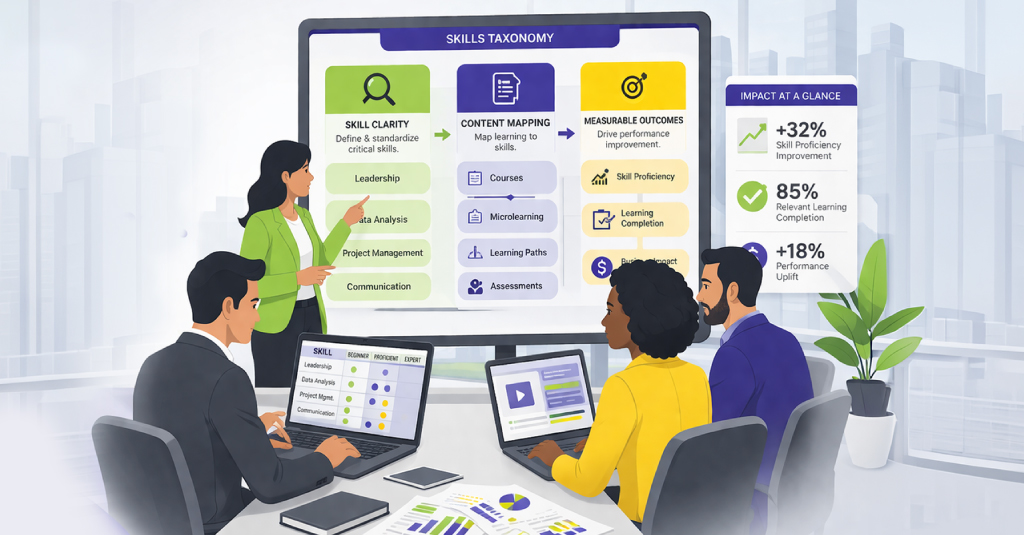
Skills mapping defines the required capabilities for each role. Embedded skills assessment validates whether those capabilities appear in real work. When operational evidence aligns with mapped skills, organizations gain accurate visibility into workforce capability.
Embedded assessment shows which skills improve productivity, quality, and revenue. It helps learning and development focus investment on measurable outcomes and strengthens executive confidence in employee training and development.
Ready to Move from Assessment to Measurable Capability?
Understanding the gap is one thing. Redesigning how capability is measured across systems is another.
If you are evaluating how to evolve your skills assessment approach, start with a structured diagnostic conversation. Identify where assessment currently sits, how performance-based assessment signals are defined, and what data already exists inside your operational platforms.
At Upside Learning, we work with enterprise teams to translate strategic intent into practical implementation plans. That includes pilot scoping, stakeholder alignment, skills mapping refinement, governance structuring, and ROI training measurement design.
If you want a practical roadmap tailored to your skills-based learning environment, let’s begin with a focused discussion around your current architecture and business priorities