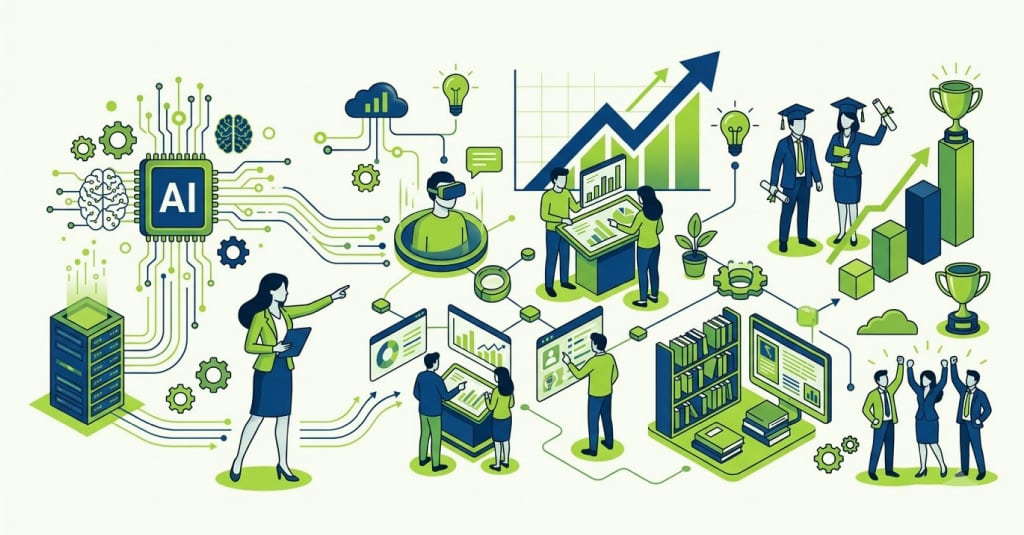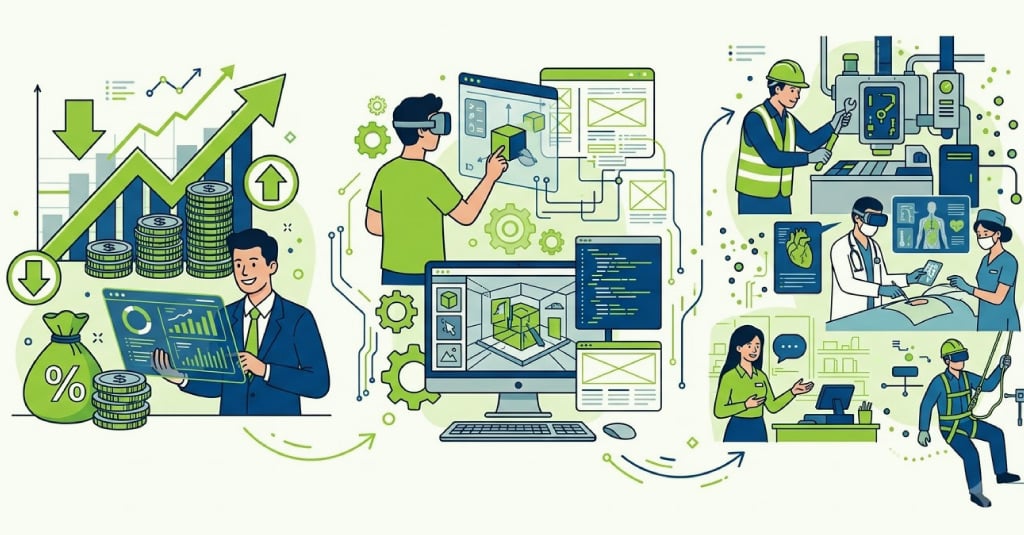





Automated reporting tools have shortened close cycles and reduced visible errors across many finance functions. Exception alerts surface quickly; reconciliations run with minimal manual input, and dashboards present a steady picture of compliance. From an operational standpoint, the environment appears to be controlled.
What has shifted more quietly is accountability. Fewer people process transactions; more people interpret system outputs and regulatory changes. The work has moved upstream, toward judgment and oversight, even if the systems appear stable.
Capability models, however, often remain anchored in older role definitions. As automation reshapes work, enterprise custom eLearning frameworks have to account for how compliance responsibilities now sit with fewer individuals who carry broader oversight expectations.
The system may be stable. That does not automatically mean the capability behind it is.
How AI and RPA Are Changing Compliance Workflows Inside Finance
AI and RPA are now embedded in core finance operations, particularly in auditing and reporting environments. Transactions are screened continuously; reconciliations run in the background, and irregular entries are flagged before formal review cycles begin. What once required layered manual checks is now compressed into system-driven monitoring.
In practical terms, this has altered daily expectations:
- Automated anomaly alerts are replacing extended manual review cycles.
- Reporting systems update faster than internal review habits have adapted.
- Transaction processing has reduced, while interpretation and sign-off responsibility have increased.
The visible outcome is speed and consistency. Quarterly reporting stabilizes. Error rates decline. Yet the compression of execution time leaves less space for reflection, discussion, and informal knowledge transfer.
When the work changes in this way, the definition of being “skilled” in compliance with work changes as well. If enterprise custom eLearning programs continue to mirror older task structures, they risk reinforcing competencies that automation has already displaced.

Why Finance Roles Now Require Different Skills Than Before
As automated systems absorb routine processing, finance roles are becoming less transactional and more interpretive. The daily workload no longer centers on compiling reports from multiple data sources. It increasingly revolves around assessing whether automated outputs are aligned with policy, regulation, and internal control standards. That shift changes the skill profile of the team in practical ways.
The work now includes responsibilities such as:
- Evaluating system outputs rather than generating reports manually
- Interpreting regulatory updates that may apply differently across regions
- Questioning whether automated classifications still reflect current guidance
- Sitting in cross-functional review calls where interpretations are discussed in real time
- Preparing responses when auditors question how automated decisions were applied
- Clarifying assumptions behind numbers that leadership now sees almost instantly
In one multi-entity structure, reporting cycles became faster after automation was implemented, yet audit discussions grew longer. The issue was not data completeness. It was interpretation. Teams had to justify why certain entries were treated consistently across markets despite local regulatory nuances.
As organizations operate across more jurisdictions, these interpretive demands multiply. What appears in uniform at the system level often varies at the regulatory level. That growing divergence is where complexity begins to accumulate.

Managing Multi-Region Regulatory Complexity in Automated Environments
Multi-region finance structures rarely operate under a single regulatory lens. US GAAP and IFRS may overlap in principle, yet interpretation and timing of updates do not always move in sync. In shared service models, reporting activities are often centralized while regulatory accountability remains local. Automation brings efficiency to consolidation, but it also assumes a level of uniformity that does not fully exist.
Policy updates in one jurisdiction may be implemented within weeks, while another market reviews implications over a longer cycle. Systems, however, tend to apply standardized rules unless configuration changes are made deliberately. In one regional setup, updated revenue recognition guidance was incorporated into internal documentation quickly, yet automated classifications reflected the prior interpretation until the next reporting configuration cycle. Reports looked stable. The underlying assumption had shifted.
These timing gaps are not dramatic failures. They accumulate quietly. Over time, the distance between evolving regulation and embedded system logic widens. That distance is where knowledge begins to age, and where exposure often sits unnoticed.
The Hidden Risk: Knowledge Ages Faster Than Systems Update
Automation creates an impression of stability. Reports are consistent. Controls appear embedded. Yet regulatory interpretation continues to evolve, sometimes incrementally, sometimes in response to external guidance. Systems do not reinterpret policy on their own. People do. When the learning layer does not move at the same pace, knowledge begins to lag behind operational execution.
This misalignment often appears in small ways:
- Internal policy is updated, but supporting learning materials remain unchanged
- New hires are trained using older examples that no longer reflect current interpretation
- Quarterly refresh cycles overlook regulatory adjustments issued mid-year
- Teams rely on prior case discussions that assumed different reporting treatments
The gap is rarely visible in dashboards. It shows up in review conversations and audit clarifications. Compliance automation therefore becomes a learning issue as much as a system one. Enterprise eLearning structures that operate on annual updates struggle to keep pace.
A more continuous compliance learning model starts to look less optional and more structural, which leads naturally to reconsidering how learning architecture is designed in the first place.

Designing Continuous Compliance Learning as Part of Enterprise Digital Learning
If compliance expectations evolve continuously, the learning model cannot remain annual. In many organizations, training still follows a calendar rhythm rather than a regulatory one. That structure may have worked when reporting cycles were slower, and roles were stable. In automated environments, it leaves gaps.
A more resilient approach treats compliance capability as part of enterprise digital learning rather than a standalone course series. Within a broader digital learning transformation, the focus shifts toward alignment with real work. That often includes:
- Role-mapped learning pathways that reflect current decision responsibilities
- Short refresh modules triggered by policy updates or audit feedback
- Scenario-based practice built around recent regulatory interpretations
- Teams rely on prior case discussions that assumed different reporting treatments
This is not an expansion of content volume. It is a shift in learning transformation strategy, where compliance becomes an operating discipline supported by structured eLearning architecture. Learning content evolves alongside policy changes and workflow adjustments instead of waiting for annual review cycles.
Once compliance learning is positioned this way, the question becomes less about delivering courses and more about selecting the right custom eLearning provider to design capability systems that remain current.
How Upside Learning Supports Organizational Learning Transformation in Finance
Upside Learning works with finance teams in regulated industries. It builds custom eLearning based on how compliance work is actually carried out inside the organization. That includes how reports are reviewed, how interpretations are discussed, and how decisions are recorded during audit cycles. The learning is structured around existing workflows instead of generic course templates.
In finance environments, this often means connecting learning design directly to reporting cycles and review practices instead of separating training from operational reality.
The approach generally includes elements such as:
- Capability maps tied to specific compliance responsibilities
- Learning modules that can be revised when policies change
- Scenario exercises built around recent audit observations
- Review structures that link policy updates with learning updates
Programs are structured around real workflow pressures and regional variation, so learning remains connected to the work being performed. Within broader digital learning transformation efforts, this supports organizational learning transformation by keeping capability aligned with evolving expectations rather than static course calendars.

Compliance Capability Must Evolve with Automation
Automation can stabilize reporting cycles, but stable systems do not guarantee capable teams. When compliance is treated mainly as a technology initiative, attention often centers on controls and configuration while learning evolves more slowly. In regulated environments, that gap creates risk. Regulations shift, roles expand toward interpretation, and accountability becomes more distributed. Governance therefore has to include how knowledge is refreshed and how teams are prepared for decisions; automated tools cannot be resolved.
Upside Learning supports organizations aligning compliance capability with enterprise digital learning priorities. Through custom eLearning grounded in real workflows, finance teams can strengthen consistency as regulations and responsibilities change.
Organizations reassessing their compliance learning architecture, reach out to Upside Learning to build a more durable capability foundation.
FAQs About Embedding Skills Assessment into Performance Workflows
Workflow-embedded skills assessment measures how employees apply skills during real work tasks instead of only testing knowledge at the end of a course. Traditional LMS-based assessment validates recall or simulated responses. Embedded performance-based assessment captures live signals such as CRM entries, quality metrics, safety adherence, or manager-validated observations. This approach allows enterprise learning teams to measure actual capability rather than course completion.
Traditional skills assessment measures knowledge at a single point in time inside the LMS. It does not track whether skills are consistently applied in real workflows. When learning data is disconnected from operational metrics, organizations measure participation instead of capability.
Performance-based assessment improves ROI training analysis by linking skill application to measurable business outcomes. Instead of reporting course completions, organizations track changes in metrics such as defect rates, deal conversion, resolution time, or safety incidents. When applied skill signals align with operational improvements, ROI training conversations shift from assumptions to evidence. This strengthens executive confidence in enterprise learning investments.
Start with one high-impact role. Define three to five observable behaviors aligned with skills mapping. Use existing CRM, ERP, or operational data to capture performance signals. Combine system data with manager validation and compare baseline and post-training results over 60 to 90 days.
Skills mapping defines the required capabilities for each role. Embedded skills assessment validates whether those capabilities appear in real work. When operational evidence aligns with mapped skills, organizations gain accurate visibility into workforce capability.
Embedded assessment shows which skills improve productivity, quality, and revenue. It helps learning and development focus investment on measurable outcomes and strengthens executive confidence in employee training and development.
Ready to Move from Assessment to Measurable Capability?
Understanding the gap is one thing. Redesigning how capability is measured across systems is another.
If you are evaluating how to evolve your skills assessment approach, start with a structured diagnostic conversation. Identify where assessment currently sits, how performance-based assessment signals are defined, and what data already exists inside your operational platforms.
At Upside Learning, we work with enterprise teams to translate strategic intent into practical implementation plans. That includes pilot scoping, stakeholder alignment, skills mapping refinement, governance structuring, and ROI training measurement design.
If you want a practical roadmap tailored to your skills-based learning environment, let’s begin with a focused discussion around your current architecture and business priorities