



By 2025, digital learning platforms were effectively standard across large enterprises. One industry projection put adoption at roughly 93% for corporate training systems, a number that now shows up routinely in 2026 planning assumptions. Learning technology is no longer treated as an optional infrastructure. That shift is visible in both budget cycles and audit expectations.
Compliance learning, in particular, has expanded quickly. Estimates placed the compliance-focused eLearning market above USD 9 billion in 2025, with continued growth tied to regulatory spread across industries that operate very differently. That growth has not simplified enterprise learning environments. Instead, it has added layers of complexity that surface unevenly across business units.
Investment has increased, but many systems still struggle once regulatory requirements, skill definitions, and reporting rules stop aligning across business units. Central dashboards often remain clean. Local gaps are harder to see.
This blog focuses on how enterprise learning systems need to adjust to that reality. The emphasis stays on learning as infrastructure, looking at architecture, experience design, governance, and system integration in organizations operating across multiple industries.

How Enterprise Learning Systems Operate in Multi-Industry Organizations
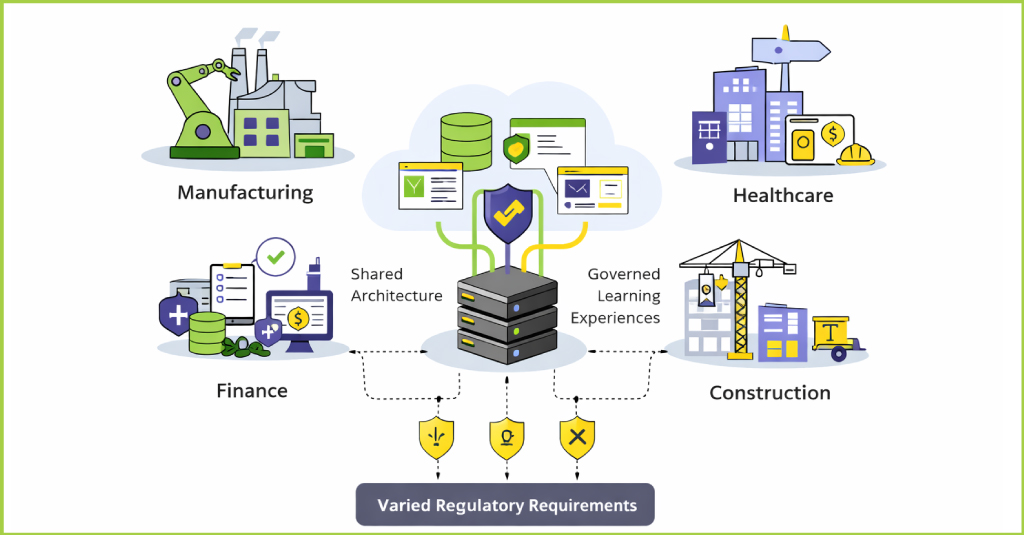
Enterprise learning systems tend to be designed around a dominant operating model, even when the organization itself is no longer organized in that way. This shows up early in diversified enterprises, especially those that have grown through acquisition or expanded into adjacent industries. A single learning platform is expected to serve manufacturing, financial services, healthcare, or technology units with minimal structural adjustment. On paper, the system appears flexible enough. In practice, its assumptions remain narrow.
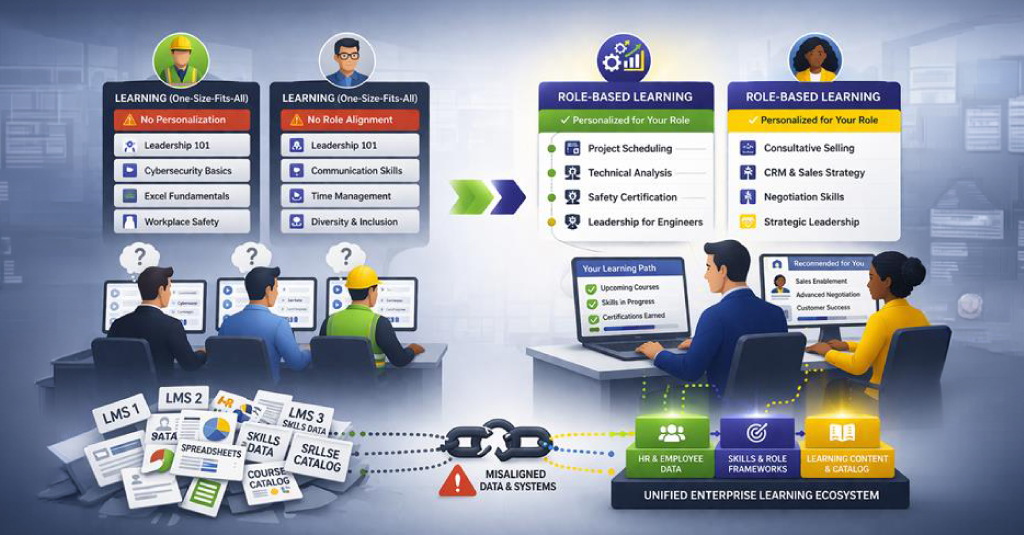
Friction usually does not appear at the content level, even in environments where custom eLearning is already in place. It surfaces when skills are defined differently across industries but reported as if they were equivalent. A role labeled “operations manager” may require task-level certification in one business and policy acknowledgment in another. The learning system records both as completion. Reporting treats them as comparable. Over time, this creates a quiet distortion in workforce visibility, where leaders believe capability is standardized because the data says it is.
This matters because multi-industry organizations rarely operate with synchronized risk profiles. When learning systems compress those differences into a single logic, they stop reflecting how the enterprise actually functions. The gap is not always visible immediately. It becomes clearer when regulatory scrutiny increases or when talent is moved across business lines without the expected readiness.
At that point, learning stops behaving like a shared service and starts behaving like infrastructure under strain, which raises a different set of questions about structure, ownership, and control.

Managing Regulatory and Skill Variation Across Business Units
Regulatory variation is where most enterprise learning systems stop behaving predictably.
The problem usually shows up as mismatch rather than confusion. Business units operate under different regulators and risk thresholds, and the way readiness is defined and evidenced varies accordingly. Learning systems, including custom eLearning environments, are expected to reconcile those differences quietly.
They usually do not.
Where regulation reshapes learning behavior
In regulated environments, learning is tied to proof. Evidence matters more than completion. Timing matters. So does traceability. A healthcare unit may need role qualification recorded down to task and observer, while a commercial services arm is allowed to treat the same role as trained once a policy module is acknowledged.
The system captures both without resistance, because it is designed to treat completion as equivalent even when the underlying requirements are not.
Skill definitions drift faster than systems adjust
Skill frameworks tend to evolve locally. Business units respond to regulation, market pressure, or operational change by refining what a role actually requires. These refinements are rarely synchronized across the enterprise, even when custom eLearning is used to address role-specific needs.
What emerges over time looks consistent at the surface and fragmented underneath.
- Skills are grouped for reporting convenience rather than regulatory accuracy.
- Recertification cycles differ but are normalized in dashboards.
- Evidence of quality varies, though records appear complete.
- The system reports stability. The organization absorbs risk.
Why this becomes a structural issue
Once regulatory and skill variation accumulate, learning stops being a content coordination problem. It has become an architectural one. Systems designed to standardize learning struggle when standardization itself is the wrong objective. Most organizations respond by managing variation case by case, usually through exceptions rather than design. As those exceptions accumulate, questions about governance surface faster than questions about delivery.

Centralized and Localized Learning Models in Enterprise Environments
Most enterprises end up with centralized and localized learning behaviors long before they formally name them. The distinction becomes visible only when something breaks. A certification fails audit review. A role transfer exposes gaps. Reporting looks stable, but confidence in it starts to thin.
At that stage, conversations tend to shift. What looked like a single learning model starts to behave like a set of overlapping practices that evolved under different constraints. The table below is not a comparison of choices. It reflects how learning models tend to behave once those pressures are in play.
scroll right to read more.
| Dimension | Centralized Learning Model | Localized Learning Model |
|---|---|---|
| Primary intent | Consistency, audit visibility, enterprise reporting | Operational fit, regulatory responsiveness, speed |
| Decision ownership | Central L&D or corporate HR | Business unit, regional, or functional leadership |
| Role definition | Standardized role frameworks applied broadly | Role expectations shaped by industry or regulator |
| Compliance handling | Uniform completion rules and evidence standards | Evidence depth varies based on regulatory exposure |
| System behavior | Optimized for aggregation and comparability | Optimized for accuracy within context |
| Change response | Slower, requires cross-enterprise alignment | Faster, often handled through exceptions |
| Risk profile | Risk of false confidence from normalized data | Risk of fragmentation and reporting inconsistency |
| Visibility to leadership | High-level clarity, limited nuance | High nuance, limited enterprise visibility |
In practice, centralized and localized approaches end up addressing different pressures at the same time. That coexistence usually works early on, when exceptions are limited, and context still travels informally across teams.
As organizations grow, those informal understandings stop scaling. The same learning decision starts to mean different things in different parts of the enterprise. At that point, the issue is no longer whether learning should be centralized or localized. The issue becomes how experienced, data, and accountability are designed to hold together when both are present.
This is where learning experience design starts to move beyond usability or engagement and into structural territory.

Learning Experience Design as a Structural Capability in Enterprise Digital Learning
- Learning experience design starts to matter differently once centralized and localized learning behaviors coexist. At that point, experience is less about engagement and more about holding together a system that is already accommodating variation.
- In multi-industry enterprises, experience often acts as a translation layer. Employees move through shared platforms even when regulatory regimes and skill expectations differ. What the experience emphasizes signals what matters operationally.
- Many enterprise digital learning environments drift at this level. Content may be aligned and systems integrated, while learning remains disconnected from workflows, evidence capture, and real role expectations.
- When experience design is treated structurally, custom eLearning becomes a mechanism for supporting variation without fragmenting the system. Roles are examined before content, workflows before catalogs, and decision points before completion of rules. The objective is coherence, not uniformity.
- This often results in experiences that branch while the underlying architecture stays stable. The same system supports different paths and evidence of expectations without fragmenting the platform.
- Once experience begins to absorb variation intentionally, questions about ownership and enforcement surface more clearly, pushing attention toward how learning ecosystems are governed rather than how learning is delivered.

Governance Frameworks for Enterprise Learning Ecosystems
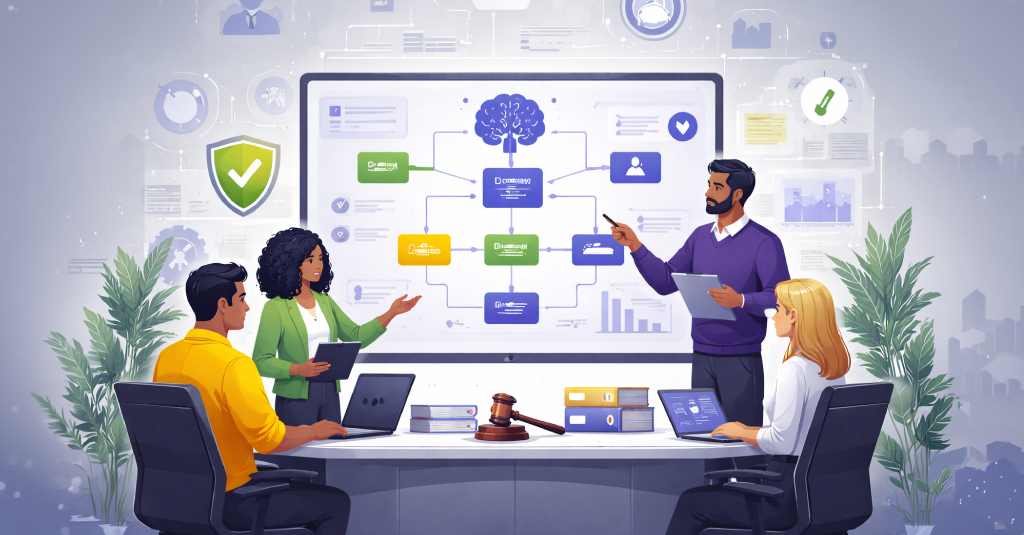
Governance usually enters the conversation after variation is already present. By that point, learning decisions are being made in multiple places, often under real operational pressure. The gap is rarely intent. It is structural.
Rules exist, but they do not always extend far enough to reconcile how learning behaves across different industries.
In multi-industry environments, governance pressure tends to surface through specific moments rather than policy discussions. Audit reviews expose differences in evidence standards. Role transitions reveal misalignment in readiness expectations. Central reports raise questions that local teams cannot always answer confidently.
Most organizations respond incrementally. Ownership is clarified for individual programs. Exceptions are documented to stabilize reporting. Temporary rules are introduced to manage immediate risk. These steps help in isolation, but they do not scale well.
Over time, layers of process accumulate without resolving how learning decisions should operate across industries with different regulatory and skill requirements.
Governance starts to work only when variation is no longer handled informally. Decisions about differences begin to get surfaced, questioned, and tracked, instead of being absorbed quietly by local teams. The objective is not to remove differences, but to prevent them from becoming hidden.
As learning ecosystems expand across platforms, regions, and business lines, governance also extends beyond L&D. IT, compliance, risk, and business leadership begin to share responsibility for how learning systems behave.
When governance is treated this way, scale becomes more manageable. Variation is expected rather than corrected. Integration decisions become intentional. Learning systems reflect complexity instead of smoothing it out.

How Upside Learning Works in Multi-Industry Enterprise Learning Environments
Upside Learning enters organizations after learning systems have already accumulated complexity. These are enterprises operating across multiple industries, often with a mix of legacy platforms, newer digital learning solutions, and regulatory requirements that do not align cleanly. In such settings, learning is no longer treated as a discrete initiative. It is part of the enterprise digital learning infrastructure, shaped by architectural decisions, governance gaps, and experience inconsistencies that have built up over time.
Rather than imposing a single learning transformation strategy, Upside Learning works within existing constraints. Work usually begins by looking at how learning is actually handled across business units, especially where local teams have adjusted processes to manage risk on their own. Those adjustments are surfaced and examined, rather than corrected immediately.
In practice, Upside Learning’s work in multi-industry environments often centers on a few recurring areas:
- Learning experience design is reshaped to reflect how roles actually operate in different industries, allowing pathways to vary without fragmenting the underlying enterprise learning architecture.
- Multi-system integration is approached as a long-term condition rather than a temporary phase, with learning data structured to remain usable even as platforms evolve.
- Governance and scale management are addressed by clarifying decision rights around variation, evidence standards, and skill definitions, instead of relying on exceptions handled quietly by local teams.
This experience has led to learning ecosystems that are easier to govern and more reliable as indicators of readiness. Differences in regulation, skill validation, and reporting do not disappear, but they stop distorting enterprise visibility. Over time, organizations gain learning environments that can support organizational learning transformation across industries, without forcing uniformity where it creates more risk than value.

Enterprise Learning as Infrastructure in Multi-Industry Organizations
In multi-industry enterprises, learning systems tend to mirror how the organization actually operates. Differences in regulation, skill validation, and risk tolerance do not disappear through standardization. They resurface through workarounds and exceptions that build over time.
Treating learning as infrastructure changes how those differences are handled. Architecture has to tolerate change. Experience has to guide behavior without enforcing uniformity. Governance has to surface variation early enough for decisions to be made deliberately.
There is no fixed end state. Business models shift, regulations change, and organizations evolve. Learning systems that hold up are those designed to absorb that movement without losing visibility or control.
For organizations navigating this reality and looking to review how their learning systems are structured today, contact Upside Learning.
Frequently asked questions on hyper-personalized skilling
Hyper-personalized skilling is an enterprise learning approach focused on skills, not job titles or course completion. Learning pathways adapt based on what people can actually demonstrate on the job.
Learning personalization organizes content, while hyper-personalized skilling adapts learning based on validated capability and changing role requirements.
Learning personalization fails at scale because static role models, activity-based metrics, and weak governance cannot keep pace with changing work and risk.
Skills mapping defines observable capabilities and enables consistent assessment, governance, and personalization decisions across enterprise roles.
Governance and human validation ensure that skill assessments are trusted, learning decisions are defensible, and personalization scales without fragmentation.
Yes. Hyper-personalized skilling cuts down unnecessary training by recognizing what people already know and focusing only on the gaps that truly matter.
Enterprise buyers should look at how skills are defined and assessed, how decisions are governed, and whether the approach stays consistent across roles, regions, and risk contexts.

Pick Smart, Train Better
Closing Perspective
Hyper-personalized skilling is not about better recommendations. It is about defensible readiness.
Completion can give a false sense of progress. Over time, gaps show up through audits, slower productivity, and repeated escalations to leadership.
Organizations that invest in disciplined skilling design build systems that adapt as the business changes, without losing governance, trust, or control.
At Upside Learning, we specialize in designing enterprise learning systems where hyper-personalized skilling, governance, and measurable readiness work together in regulated, high-complexity environments.
The question is no longer whether learning should be personalized. It is whether personalization is preparing the workforce or simply organizing content more efficiently.
If your organization is reassessing how learning translates into real capability and risk reduction, start a conversation with our learning specialists.