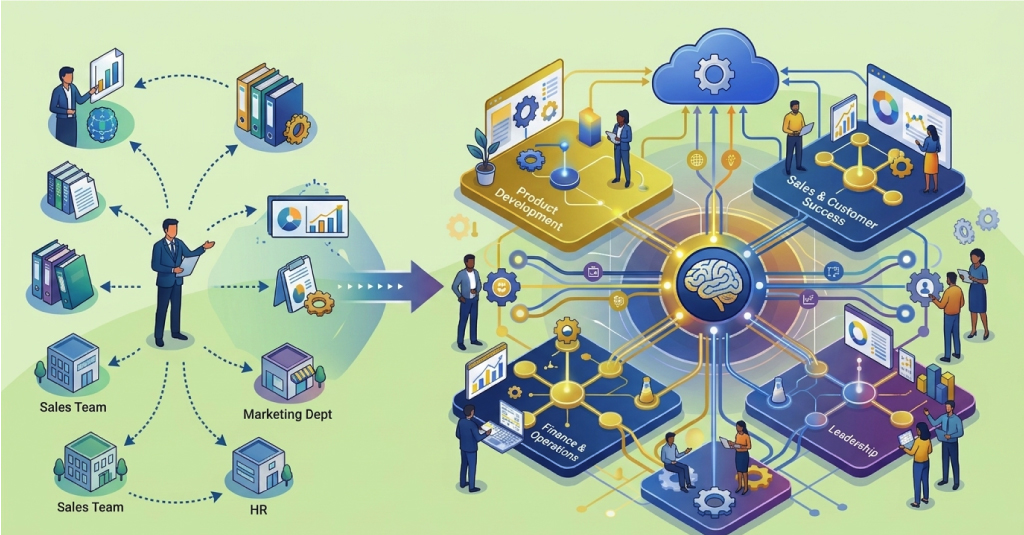





In many organizations, leadership actions are showing up in roles that were never designed to carry them.
A project coordinator steps into a decision because the manager is in another review. A specialist guides a discussion simply because the information sits with them.
These are routine moments but taken together; they show how leadership responsibilities now move according to workflow pressure rather than hierarchy.
Leadership development still tends to follow formal structure, even when the work itself does not. People without authority begin making judgment calls because the task cannot wait, and the capability gap becomes visible only after patterns repeat.
This is where the shift becomes clearer, and it leads to a closer look at why leadership expectations surface much earlier in a career than most frameworks account for.

Why Leadership Expectations Are Showing Up Earlier in Careers
The shift becomes clearer when workflows begin to demand decisions from people who were not hired to make them. Roles designed around execution now sit closer to information flow, and that proximity introduces leadership moments earlier than most frameworks anticipate.
These expectations surface quietly, often in the spaces between tasks where decisions need to be made before formal guidance is available. The person closest to the information, the timing, or the dependency chain becomes the one who directs the next step.
Over time, these small moments create a pattern in which leadership behavior appears earlier than the organizational structure anticipates. Additional signals tend to cluster around operational pressure points.
- People step into issue resolution before escalation becomes necessary.
- They shape communication between teams by interpreting information rather than passing it along.
- They stabilize tasks during resource gaps, especially when timelines are tight.
- They provide informal guidance to peers who rely on their contextual understanding.
- They redraw short-term priorities, so the work remains aligned with immediate needs.
These signals reflect how often organizations depend on instinctive leadership from employees without preparing them for it. When this pattern repeats across teams, uneven capability becomes noticeable, especially in moments that require judgment rather than technical skill.

How Top-Heavy Leadership Development Creates Capability Gaps
When instinctive leadership starts filling gaps in everyday work, it happens quietly, and the organization begins leaning on it without really noticing. After a while, the lack of any structured preparation shows up in small ways, in how people read a situation or decide what to do next, or try to coordinate with whoever is involved. It does not happen at all times, but it sits there in the way the work moves.
These gaps do not appear because individuals avoid responsibility; they appear because leadership development centers the senior tier while daily work requires capability across many roles.
A clearer view emerges when the gaps are traced through actual workflows, especially in situations where judgment matters more than technical experience.
-
Decision Pathways Shift Without Shared Foundations: Many decisions fall to the person closest to the task, yet their reasoning is shaped by personal habits rather than a common framework. Two people in similar roles may approach the same situation in completely different ways. The organization eels this in subtle inconsistencies, especially when multiple teams interact with shared work.
-
Communication Flow Becomes Uneven: Information moves quickly, but interpretation does not always follow the same pattern. Teams communicate based on how they understand the task, not on a unified approach learned through leadership development. This affects clarity, timing, and how confidently teams act on updates that influence other parts of the workflow.
-
Escalation Patterns Become Unpredictable: Thresholds for escalation vary widely when only a small group has been trained to assess risk or urgency. Some issues move upward too quickly, while others linger longer than they should. Both behaviors slow progress, and both point to the same underlying gap in leadership training at all levels.
-
Task Continuity Depends on Formal Authority: Work often pauses until someone with a leadership title approves the next step, even if the person with the clearest understanding of the task sits outside that structure. The delay is not caused by lack of initiative but by uncertainty about responsibility. Task continuity becomes inconsistent when capability and authority are out of alignment.
The gaps may appear minor in isolation, but together they show how often organizations rely on instinctive leadership from individuals who were never prepared for it. As this becomes routine, differences in judgment and consistency become more visible, particularly in situations that sit beyond technical skill.
As these patterns surface, attention shifts to the people who step into these moments repeatedly. Their influence on workflow, coordination, and team behavior becomes noticeable even without a formal title.
Once these individuals are visible, the focus turns to how their early leadership signals develop and what those signals suggest about wider developmental needs. This leads us to understanding the characteristics of emerging leaders and why these patterns appear well before formal promotion.

What Early Leadership Signals Reveal About Emerging Leaders
Once certain individuals begin taking informal leadership actions repeatedly, the patterns become easier to observe. These signals appear long before title changes or formal recognition, developing gradually as work passes through people who sit close to the context and timing.
They emerge because the workflow requires someone to interpret, guide, or stabilize a situation, not because the individual is consciously positioning themselves as a leader.
A useful observation is that these signals tend to reflect structural conditions rather than personal ambition. Someone becomes central to a process because information reaches them first or because their role exposes them to ambiguity that others do not see. The signals grow stronger each time the person responds in ways that help the work continue.
How These Signals Form in Real Work
Early leadership signals take shape through repeated interactions with tasks that demand judgment. When a workflow encounters uncertainty, the person closest to the details often steps in, and this repeated exposure creates recognizable patterns. These signals develop slowly, shaped by how individuals interpret information, organize steps, or navigate competing needs.
Several categories of signals tend to appear across different environments:
- Involvement in ambiguous tasks that require interpretation rather than completion.
- Informal coordination when timelines shift and teams need clarity.
- Steadying discussions when different groups move in conflicting directions.
- Interpreting context for peers when information spreads unevenly.
- Guiding short-term prioritization when workflows stall, and immediate direction is needed.
These signals matter because they show how capability begins forming ahead of formal development. They also point to the limits of unstructured growth, especially when multiple teams depend on consistent judgment.

Why Early Leadership Signals Matter in Leadership Development
Once certain individuals take informal leadership actions repeatedly, the patterns become easier to recognize. These signals often appear long before any change in title, shaped by proximity to information, timing, and the flow of work. They emerge because tasks require interpretation or coordination, not because someone is actively trying to lead. The signals grow as individuals respond to gaps that need attention, and the repetition makes their influence more visible.
A key point is that these signals form because the work moves toward whoever can stabilize it. Someone becomes central to progress simply because they see the problem earlier or understand its context better than others. Over time, their decisions shape how tasks align, how teams interact, and how ambiguity is managed.
How These Signals Form in Real Work
These signals develop through repeated exposure to judgment-heavy situations. Individuals interpret ambiguous tasks, coordinate when timelines shift, steady conversations when teams diverge– and help clarify priorities when workflows stall. The behaviors show capability forming ahead of formal development– but also reveal where instinct alone becomes insufficient. In environments without structured leadership development, these patterns remain uneven and depend heavily on personal interpretation.
As these signals become clearer, organizations begin considering how broader leadership development strengthens them and supports wider resilience across teams.

Why Leadership Development Across Levels Supports Organizational Resilience
As early leadership signals become clearer, the question shifts to how organizations maintain stability when work moves quickly or priorities change without much notice. Resilience depends on more than a single leader or process. It reflects how well people across the organization can respond to uncertainty without waiting for senior intervention.
When leadership development sits only at the top, responsibility concentrates in a narrow group. This holds until demand exceeds their bandwidth. Wider development distributes judgment, allowing more people to interpret situations rather than escalating them. The change is gradual, but workflows remain steadier when individuals share a common approach to ambiguity instead of relying on instinct.
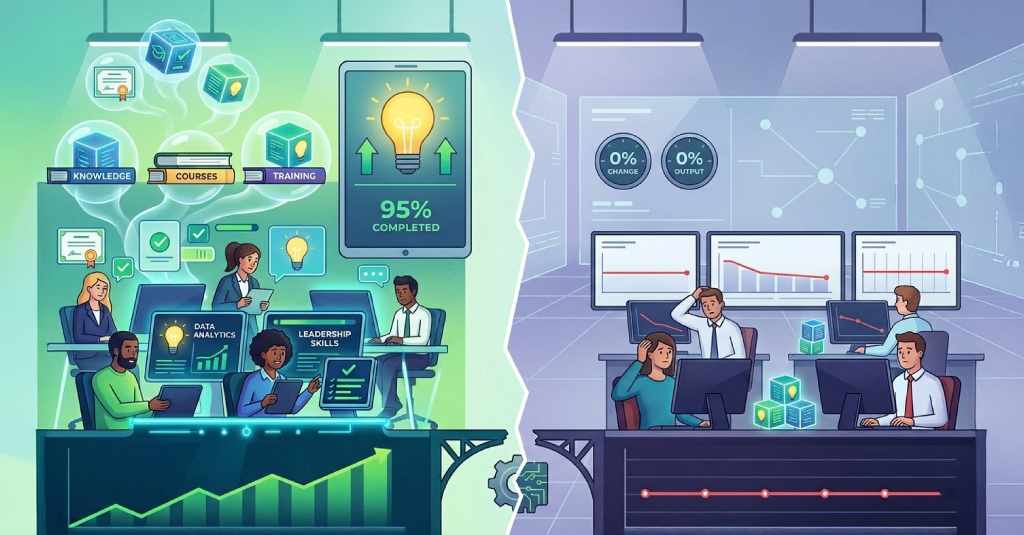
A simple contrast shows this. In teams with broader development, decisions align because people use similar cues to assess risk and priority. In teams without it, issues circulate longer and coordination improves only when a senior leader steps in. The difference lies in preparation, and that preparation influences how quickly teams regain momentum during disruption.
As organizations seek ways to reduce reliance on a small group of decision makers, leadership development at all levels becomes an operational support rather than a developmental add-on. It provides a baseline that keeps work moving when hierarchy cannot respond at the required pace.
This leads to how learning is designed and where a custom partner can align development with real organizational conditions rather than generic models.

How Upside Learning Supports Leadership Development Across Levels
Upside Learning is a custom eLearning provider that focuses on designing eLearning solutions shaped by the realities of organizational work. The intention is not to introduce abstract leadership ideas but to align development with how decisions, communication patterns, and responsibilities appear across levels. This becomes especially relevant when leadership behavior shows up early in careers, and teams need a consistent foundation for judgment.
To support this, Upside Learning uses design elements that connect directly to operational needs and much more
- Scenarios are based on real judgment calls rather than generic leadership templates.
- Practice sequences that reinforce consistent decision habits across teams.
- Role-specific pathways that acknowledge how leadership signals evolve over time.
- Context-driven learning moments reflect how information, ambiguity, and timing influence decisions.
- Measurement approaches that track how capability develops within actual workflows.
This approach gives organizations a structure that supports emerging leaders while also strengthening the capability of those in formal roles. It ensures that leadership development is not limited to the senior tier but is distributed across the places where work demands it.
Once development aligns with real conditions, the final consideration becomes how organizations sustain this approach without turning it into a rigid, one-size-fits-all model.

A Consideration on How Leadership Capability Expands Across Levels
Leadership development becomes more effective when organizations recognize how often capability forms outside formal roles. The signals appear early, shaped by routine interactions with ambiguity, timing, and shared work. When development reaches those levels, the organization gains steadier judgment and more reliable coordination, especially when priorities shift. It is a gradual adjustment, but one that supports long-term stability without relying solely on senior intervention.
To understand how tailored learning can support your organization’s leadership needs, contact Upside Learning today.
FAQs: Custom vs. Off-the-Shelf eLearning
If your workflows, tools, or brand vibe are one-of-a-kind- or if behavior change matters- custom’s your cheat code.
Yep, upfront it’s lighter on the wallet. But for long-term wins and role-specific skills? Custom flexes harder ROI.
For sure. Start with off-the-shelf for the basics, then sprinkle in custom modules where it really counts.
Depends on how ambitious you get- usually weeks to months. Planning ahead keeps you from sweating deadlines.
For general topics, yeah. For real-life scenarios or changing habits? Engagement can ghost you.
Totally. You own the content, so edits, tweaks, or upgrades? All yours.
Custom can adapt paths, toss in interactive exercises, and mix multimedia to match every brain type.
Mostly basic stuff- completion rates, quiz scores. Custom digs deeper: behavior, skill gaps, all the good analytics.
Quick wins? Off-the-shelf. Lasting change? Custom. Pick your lane- or flex both.
Yep. They make it seamless- fast deployment, tailored experiences, or a mashup.

Pick Smart, Train Better
Picking off-the-shelf or custom eLearning? Don’t stress. It’s really about your team, your goals, and the impact you want. Quick wins? Off-the-shelf has you covered. Role-specific skills or behavior change? Custom eLearning is your move.
Upside Learning makes both options effortless. Whether it’s ready-to-roll courses or fully tailored experiences, we handle the heavy lifting- interactive modules, adaptive paths, branded visuals, and analytics that tell you something. No wasted time, no generic content- just learning that sticks.
Ready to level up your team’s learning game? Connect with Upside Learning today and see how we make training fast, engaging, and results-driven. Your team deserves training that works- and we deliver.